
Airbnb Startup Guide: How to Start an Airbnb That Runs Profitably
Contents
Table of Contents
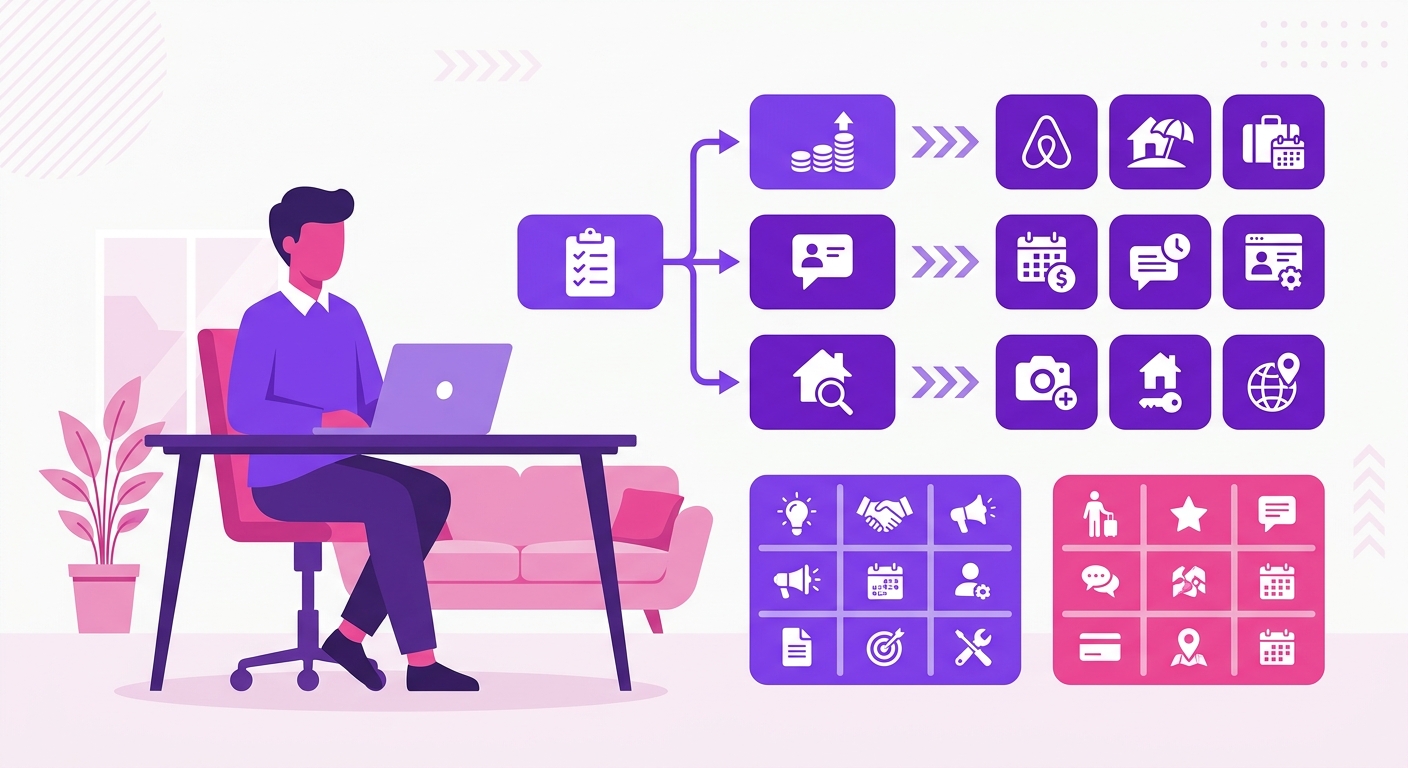
Starting an Airbnb listing takes 30 minutes. Running a business profitably takes a system.
This Airbnb startup guide covers the operational decisions, pricing structure, compliance, turnover logistics, and channel setup across Airbnb, Vrbo, and Booking.com, which determine whether your first 90 days build momentum or burn you out.
Starting an Airbnb Startup: Step-by-step
Opening an Airbnb is an operations decision, one that affects your cash flow, your compliance exposure, and your guest reviews from the first booking.
What to Validate Before You Open the Calendar
Most hosts who struggle in their first year skipped the same two steps: they never confirmed legal permission to operate, and they never stress-tested their revenue math against real occupancy data.
Pull a comp set of 10 to 20 listings matching your property type, bedroom count, and neighborhood, and look at actual occupancy bands across a full calendar year, not just peak weeks.
Check booking windows; a 3-day average window signals last-minute demand, which affects the minimum-stay strategy
Identify shoulder-season occupancy drops, since a market falling below 40% for four months changes the annual math significantly
Count same-type listings within a 1-mile radius, as saturation above 50 comparable units compresses ADR by 15–20%
Before anything else, confirm these four things in writing:
Zoning and permits: most municipalities require a short-term rental license, a fire inspection, or both before your first booking
Lease or HOA restrictions: subletting clauses and HOA bylaws void your right to operate, regardless of what the city allows
Insurance: standard homeowners policies exclude STR activity; you need a policy explicitly covering short-term guests
Safety minimums: smoke detectors, CO detectors, and a posted emergency exit plan are non-negotiable in most jurisdictions
Startup Model and Property Setup
Three distinct paths exist for getting an Airbnb running, and each one carries a different operational load from day one. Picking the wrong model doesn't just affect revenue; it affects how many hours per week you're physically tied to the property.
Choosing Between Owner-hosted, Whole-home, and Co-hosted Setups
Most hosts start with one of two models. With owner-occupied hosting, you're renting a spare room while living on-site, which keeps costs low but trades your privacy for income. This model is great for getting early reviews, but it doesn't scale.
The far more common path for operators with 1-to-3 properties is whole-home self-managed: you control every decision, you keep 100% of the net revenue, and you personally absorb every 2 AM phone call about a clogged toilet. It's all on you.
Co-hosted or managed units make sense when you hit 4+ properties, travel frequently, or simply can't handle turnovers reliably. Co-host fees typically run 10-25% of gross revenue, depending on scope.
For a deeper breakdown of co-host structures, the Mr. Props co-host guide covers contract terms and fee negotiation specifically.
What You Need to Start an Airbnb Without Overspending
The essentials list is shorter than most hosts expect. Every bedroom needs two complete sheet sets, so turnovers don't stall waiting on laundry. A keypad lock eliminates key handoffs and cuts lockout calls to near zero.
Beyond that: reliable Wi-Fi (budget $60-80/month for a dedicated router), a locked owner's closet for personal items and backup supplies, and a cleaning kit stocked with 2-week consumable reserves.
Listing Build and Channel Strategy
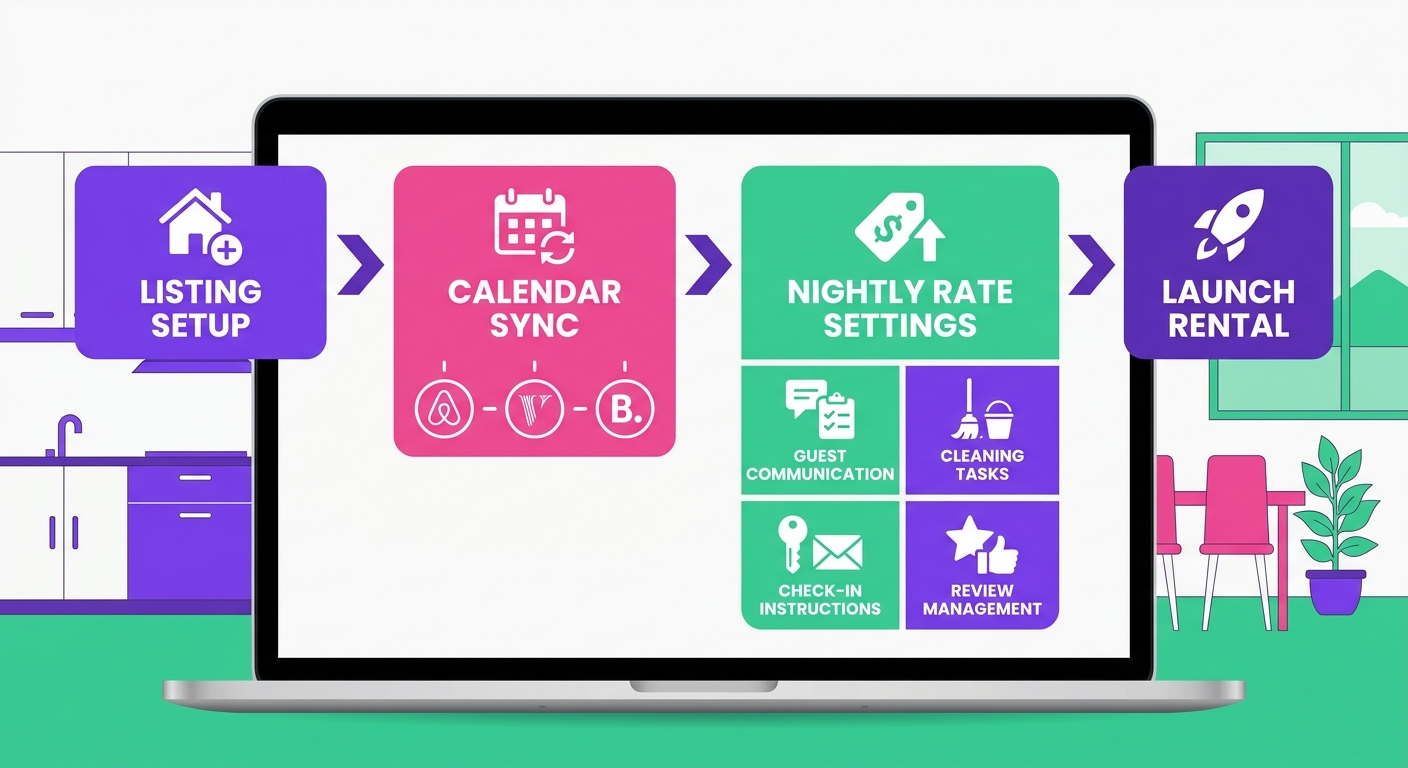
Build your first listing structured for all three platforms from the start: Airbnb, Vrbo, and Booking.
Lead your title with property type and location in the first 32 characters: "3BR Bungalow · Walk to French Quarter" outperforms vague descriptions. Keep house rules and cancellation policy consistent across platforms to avoid chargeback disputes.
A 2-night minimum lifts ADR by 12–18% in mid-density markets; treat minimum-night settings as a revenue lever, not a default.
The Minimum Viable Listing That Still Converts
Don't go live without these completed:
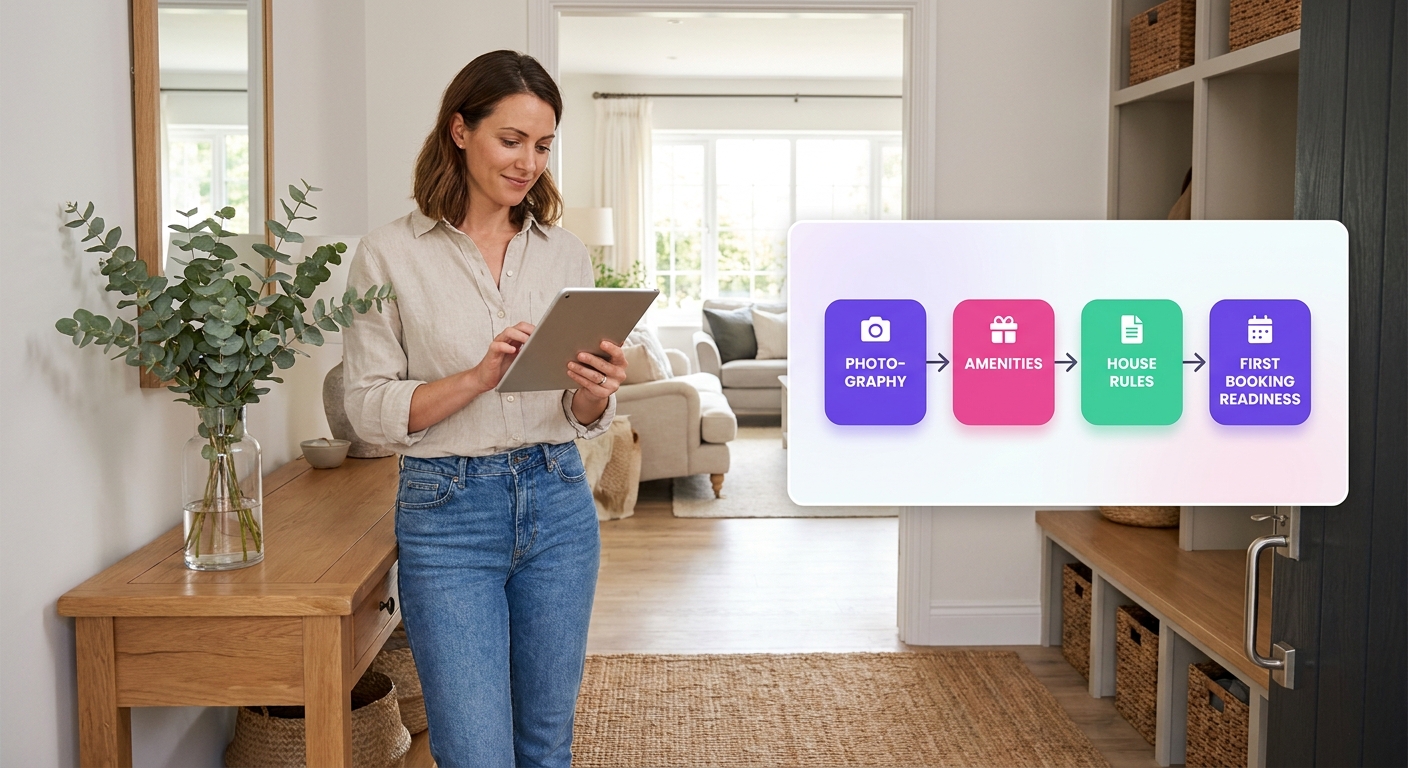
20 to 30 photos ordered: hero exterior, main living area, every bedroom, bathrooms, kitchen, parking, and any outdoor space
Accurate bed type per room, a "king" listed as "double" generates 1-star reviews
Check-in method, Wi-Fi speed in actual Mbps, and parking instructions
All fees disclosed, including the cleaning fee, pet fee, and extra guest charges
Incomplete amenity fields hurt search ranking and generate negative reviews when reality doesn't match expectations.
Multi-Channel Setup Without Double-booking Risk
iCal sync is free but runs on a 15-to-30-minute delay, enough to accept two bookings for the same night during high-demand periods. A channel manager with real-time API sync eliminates that risk.
Set this up from your first property, not your third.
Pricing, Fees, and First 90 Days
Your first 90 days on Airbnb set your review baseline, your search ranking, and your long-term ADR ceiling. Get the pricing wrong early, and you're correcting for months.
Launch Pricing for a New Airbnb Listing
Your first few bookings aren't about profit. They're about getting reviews. You should plan to start 10–15% below your stabilized comp ADR for the first 3 to 5 guests who book with you.
If comparable 2-bedroom cabins in your market run $150/night, you open your calendar at a tempting $128–$135. Don't get greedy yet. Once you've got five or more solid reviews, you can start raising rates incrementally, maybe $5–$10 per week, until you see resistance in your booking pace.
Cleaning fee logic matters just as much as the nightly rate. A $45 cleaning fee on a 2-night booking adds $22.50 to the effective nightly cost; guests see that at checkout, and it kills conversions on short stays.
Either price the fee into your nightly rate for stays under 3 nights, or set a 2-night minimum during launch to avoid sticker shock entirely.
Two tactics that recover revenue on thin calendars:
Length-of-stay discounts: 10% off for 7+ nights, 20% off for 28+ nights. These reduce turnover costs and fill gaps without dropping base rate.
Gap night pricing: Orphaned 1–2 night gaps between bookings should be priced 20–30% lower automatically. Most channel managers handle this natively.
The First 90 Days Benchmark Table
Track these six metrics weekly. They tell you whether your pricing, operations, and guest experience are on track before a slow month compounds the damage.
Guest Screening, Protection, and Risk Controls
Platform defaults leave you exposed. Airbnb's standard settings allow Instant Book with minimal friction, which helps occupancy but shifts risk entirely onto you.
Tightening those settings takes under 10 minutes and changes the risk profile of every booking you accept.
Guest Identity Verification and Booking Rules
Require government ID verification through Airbnb's settings before any reservation is confirmed. This doesn't guarantee good behavior, but it creates a paper trail and deters the guests most likely to cause problems.
Pair it with a minimum of one prior review and a 24-hour lead time, same-day bookings from unreviewed guests account for a disproportionate share of incident reports.
Set Instant Book to "guests with verified ID and positive reviews" rather than all guests
Enable a lead time of at least 1 day to prevent last-minute party bookings
Check local laws before restricting bookings by guest location; some jurisdictions prohibit it
Platform Protection Versus Real Insurance
AirCover is not insurance. It's a damage reimbursement program with Airbnb as the decision-maker on every claim. It excludes cash, jewelry, shared spaces, and loss of income during repairs.
A dedicated STR policy covers liability (typically $1M+), contents replacement, and lost revenue while the unit is uninhabitable.
Before filing any claim, document everything: timestamped photos within two hours of checkout, a written incident summary, and itemized repair quotes. Insurers and Airbnb both require this evidence chain. Without it, claims get denied regardless of who's at fault.
Cleaning, Turnovers, and Owner Operations
This is where most first-time hosts get blindsided. A two-bedroom at $150/night with 75% occupancy runs roughly 22-23 turnovers per month.
Each one requires cleaning, inspection, restocking, and a linen reset. That's not a Saturday task, it's a part-time job, and underestimating it is the single fastest way to tank your early reviews.
Your check-in instructions should be locked down before your first booking, not drafted the night before. Digital codes, parking specifics, and WiFi credentials need to live in one place that your cleaner and your guest can both access without calling you.
Turnover Standards That Protect Reviews
Every turnover needs three things beyond basic cleaning: an inspection photo set, a linen par count, and a consumables check. Run two full linen sets per bed as your minimum par, one in use, one in the wash.
Drop that, and a same-day double-booking becomes a crisis.
Consumables (toilet paper, dish soap, coffee pods) should have a restock threshold, not a "check when you remember" policy.
Response-Time and Maintenance Rules for Small Portfolios
Set these targets and hold them:
Under 15 minutes for any active-stay issue (lockout, no hot water, broken AC)
Same day for non-urgent fixes reported between stays
A named backup vendor for lockouts, plumbing, and HVAC, not a Google search at 11 pm
One-property hosts can manage this personally. At three or more properties, you need a vendor list built before you need it. A missed lockout at midnight costs you a five-star review, not just an hour of sleep.
The Go-live Checklist
Don't publish until every gate below is closed. One open item, an unconfirmed cleaner, and an untested lock will cost you your first review.
Permit confirmed: Your short-term rental permit number is in hand and posted where local law requires.
Insurance bound: Your STR-specific policy is active, not pending. Standard homeowner's coverage won't pay a claim on a paying guest.
Lock tested: Complete a full guest-entry cycle, code issued, door opened, code expired, from a phone that isn't yours.
Cleaner assigned: Your cleaner has access to the turnover checklist and your first booking date on their calendar.
Pricing loaded: Base rate, weekend adjustment, and minimum-stay rules are set in your channel or active pricing tool before you go live.
House rules published: Check-in time, quiet hours, pet policy, and parking instructions are visible on the listing, not buried in the welcome letter.
First-message templates ready: Booking confirmation, check-in instructions, and checkout reminder are drafted and queued in your messaging tool.
When every item above is checked, publish.
FAQs
Can You Rent on Airbnb If You Don't Own the Property?
Yes, but you need explicit written permission from your landlord, and your lease must not prohibit subletting. Some cities also require the primary tenant to be present during guest stays, so check your local short-term rental ordinance before listing.
Is It Worth Listing Just One Room in Your Home?
A private room listing typically earns 40–60% of what a full-unit listing commands in the same market, but your startup costs are near zero, and occupancy tends to run higher because the nightly rate is lower. If your market's median private-room ADR is above $65, a single room can clear $800–$1,200/month at 75% occupancy without a separate cleaning crew.
Should You Turn on Instant Book From Day One?
Turn it on. New listings with Instant Book enabled receive roughly 20% more booking requests in their first 30 days, according to Airbnb's own host data, and the algorithm favors them in search ranking. You can still set guest screening requirements, verified ID, and positive review history, so it doesn't mean accepting anyone blindly.
How Many Reviews Do You Need Before Raising Your Rates?
Ten reviews with a 4.8-star average is the practical floor. Below that, a rate increase typically drops conversion enough to hurt monthly revenue net. After 25 reviews at 4.8+, you have enough social proof to test a 10–15% rate increase without a meaningful occupancy penalty.
Should You List on Vrbo and Booking.com Immediately, or Focus on Airbnb First?
Airbnb first, for 60–90 days. You need a review basis before multi-channel listing makes sense. Vrbo and Booking.com both surface listings partly by review count, and a zero-review property on those platforms converts poorly. Once you have 10+ Airbnb reviews, add Vrbo next (higher ADR, lower volume) and Booking.com last (highest volume, lowest average guest quality in most leisure markets).