
How to Handle Negative Airbnb Reviews Without Hurting Future Bookings
Contents
Table of Contents
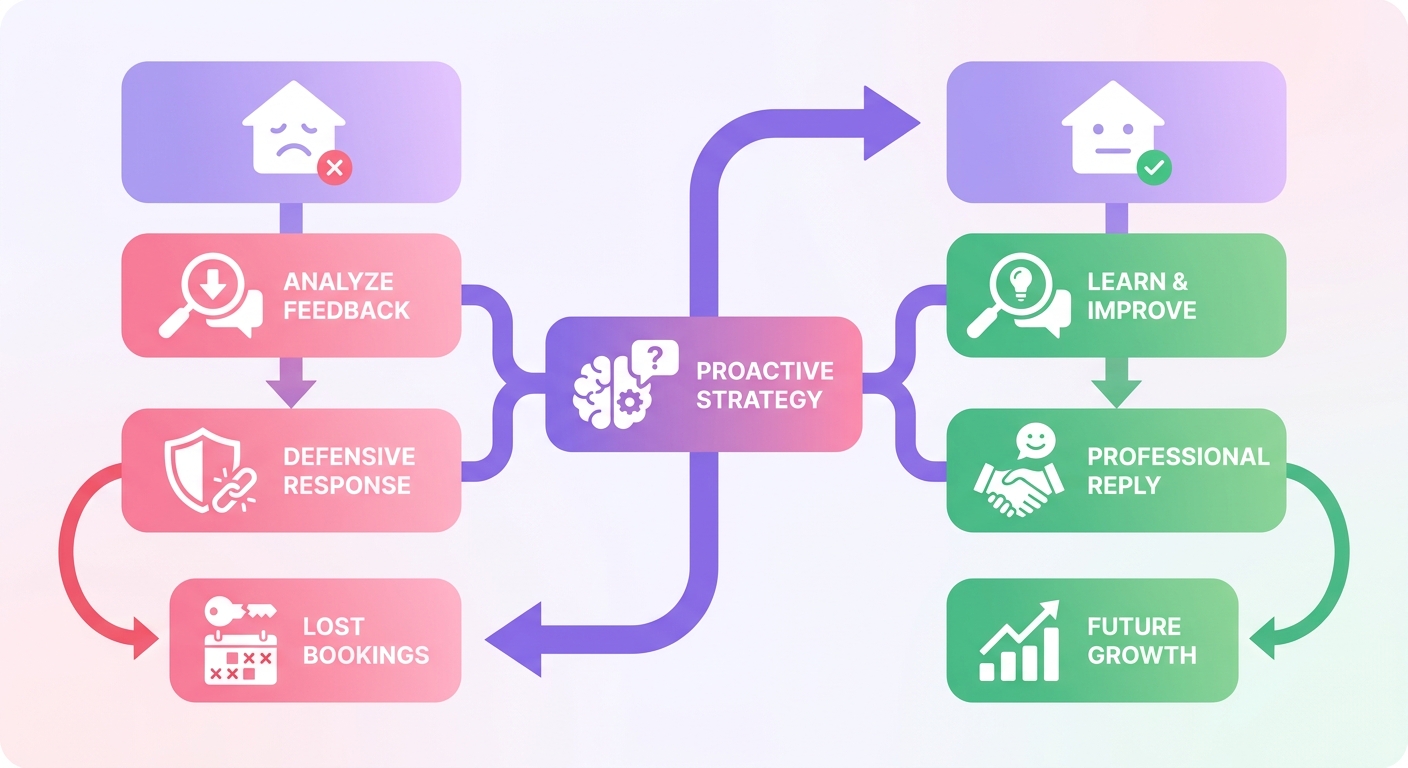
Most hosts treat a bad review as a verdict. How you respond to a negative review is visible to every future guest who reads your listing and a well-written reply does more for your booking rate than the review itself ever could.
No credit card required · Join 3,200+ Hosts
How to Handle Negative Airbnb Reviews Without Making Things Worse
Most hosts read a critical review and immediately want to defend themselves. That instinct is understandable, and it's almost always the wrong move. The response you write in the first 10 minutes after seeing a bad review is rarely the one you should publish. Negative feedback stings, and responses written from that place tend to read as defensive, dismissive, or petty to anyone who wasn't there.
The actual goal when you handle negative airbnb reviews isn't to win an argument with one guest. It's to signal to every future guest reading that page that you run a professional operation and take feedback seriously.
Read the Review Twice Before Responding
First pass: read it for what the guest actually experienced. Second pass: read it for what a prospective guest will take away. Those two readings often produce very different priorities. A guest who complains that "the WiFi was slow" is expressing frustration. A prospective guest reading that review is asking whether the WiFi is still slow, and your response either answers that question or it doesn't.
Separate the emotional content from the operational content. Phrases like "we felt unwelcome" or "the host was difficult to reach" flag a specific operational gap, communication speed, check-in warmth, or response time. Address the operational gap directly. The sentiment resolves itself when you do.
What a Strong Response Actually Contains
A response that works has three components, in this order:
- Acknowledgment: Name the specific issue the guest raised, not a generic "we're sorry you had a bad experience" that reads as dismissal.
- Context or correction: If something was genuinely wrong, say what changed. If the review misrepresents facts, clarify once, briefly, without lecturing.
- Forward signal: One sentence that tells future guests this situation is resolved or that feedback has been acted on.
That structure keeps responses under 100 words, which is the right length. Anything longer shifts the focus from resolution to grievance.
Tone is the First Thing Readers Judge
Defensive responses lose bookings. Not because the guest is always right, but because a future guest reading "this guest was impossible to please" immediately imagines being on the receiving end of that attitude. The goal is to sound like a property manager who takes operations seriously, not a homeowner who takes criticism personally.
- Avoid exclamation points, they read as defensive or performative depending on context
- Skip phrases like "we pride ourselves on", they're filler that signals nothing to a skeptical reader
- Never open with "unfortunately", it front-loads blame-shifting before you've said anything substantive
When the Review Contains Factual Errors
A one-sentence clarification is appropriate. "Our maintenance records show the hot tub was serviced on April 14th, we're sorry the experience didn't reflect that." Anything beyond one sentence reads as combative, even when the facts are on your side.
If the error is severe enough to warrant a formal dispute, Airbnb's review removal process is the right channel, not your public reply. Public responses cannot remove reviews; they can only frame them. Using your reply to argue a factual case at length signals to future guests that disputes get messy at this property.
Turning Critical Feedback Into Listing Improvements
Responding well is only half the work. The other half is using negative reviews as diagnostic data before the next guest checks in. A single complaint about WiFi speed is an outlier. Two complaints in three months is a pattern. Three is a listing problem actively suppressing your rating. Hosts who maintain 4.8+ ratings aren't the ones who get fewer complaints, they're the ones who act on patterns before they compound.
Reading Review Patterns Across Channels
A guest complains about slow Wi-Fi on Vrbo in February; another dings you for it on Airbnb in March. It's the same problem. When you're siloing your review monitoring by platform, that single, fixable issue, like a router that needs replacing, can go unaddressed for months. You're just letting the damage pile up. Centralized review tracking across all channels is the only way you'll spot these cross-platform patterns quickly.
Fixing the Root Cause, Not the Symptom
When the same issue triggers two or more reviews within 60 days, treat it as a listing defect requiring a documented fix, not a guest preference worth noting. A defect gets a solution with a deadline. A preference gets logged and reviewed quarterly.
Common patterns hosts routinely underestimate:
- Checkout instructions guests describe as confusing, even when the host considers them straightforward
- Noise from HVAC units, neighboring properties, or street traffic mentioned repeatedly in otherwise positive reviews
- Amenity descriptions that don't match what guests find on arrival
When a complaint exposes a gap between guest expectation and reality, the listing description is usually where that gap was created. Adjusting the listing copy fixes the expectation, and prevents the complaint from recurring even if the physical issue takes time to resolve.
When to Escalate, Dispute, or Ignore a Review
Not every negative review deserves the same response, and some don't deserve a response at all. Most hosts get this wrong in both directions, some escalate everything, burning time on unwinnable cases, and some never escalate anything, leaving genuinely removable reviews on the record.
Reviews That Qualify for Removal
Airbnb will remove a review only if it violates their content policy, not because it's unfair or exaggerated. The qualifying categories are narrow:
- Extortion: a guest threatened a negative review unless you refunded them
- Irrelevant content: the review describes a property or stay that isn't yours
- Discriminatory or hateful language: content that violates Airbnb's anti-discrimination policy
- Verified fake reviews: the booking was fraudulent or the reviewer never stayed
Screaming "this review is unfair" won't get you anywhere. Airbnb isn't a courtroom, and it doesn't arbitrate he-said-she-said disputes between hosts and guests over things like whether the hot tub was really at 102 degrees. In that scenario, your public response is the only tool you've got.
How to File a Dispute That Actually Gets Reviewed
Documentation wins cases. Screenshot the message where the guest threatened a bad review. Save the timestamp. Pull the booking record. File through the Resolution Center and lead with the policy violation rather than your feelings about the review.
Vague submissions get dismissed quickly. Specific submissions that cite the exact policy, attach evidence, and reference the booking ID get escalated to a human reviewer. That's the difference between a low and a meaningful success rate on disputes.
Reviews You Should Leave Alone
Don't dispute that 3-star review. Even if you think the guest's complaint that "the driveway was a little steep" is a wild exaggeration, it's almost never worth fighting. Suck it up. A well-written public response actually converts more skeptical future guests than a perfect 5.0 record does, because it proves you're a real human who takes criticism seriously. The only exception is a pattern: if you get three reviews in a row complaining about that steep driveway, that's an operations problem you need to fix, not a review you need to dispute.
How Ratings Recover: a Realistic Timeline
Airbnb's rating algorithm weights recent reviews more heavily than older ones. A reasonable working model: at 10 reviews per month, one 2-star review takes roughly six to eight weeks of strong performance to meaningfully dilute. At two reviews per month, that same review can affect your visible rating for six months or more. Volume of new positive reviews is the only reliable recovery mechanism, which is why operational fixes matter more than any individual response.