
How Does Vrbo Work for Owners? Setup, Fees, and Booking Basics

Contents
Table of Contents
Vrbo is an OTA marketplace. You create a listing, set rates, sync your calendar, accept bookings under Vrbo's platform rules, and pay either a 5% per-booking fee or an annual subscription (around $499/year).
That's the full mechanical picture of how Vrbo works for owners. The platform doesn't manage your operations, it generates demand for them.
That distinction matters more than most guides admit.
What You Need to Know First
Vrbo is a demand channel, not your operating system. It won't track your cleaning schedules, automate guest messaging, or tell you when to drop your rate by $12 on a slow Tuesday.
Understanding how to use Vrbo as an owner means recognizing that you still need a PMS and a active pricing tool sitting behind Vrbo, not instead of it, especially if you're running more than two or three properties.
Vrbo's Role in a Multi-channel Stack
Hosts get tripped up when they use Vrbo's calendar as their master calendar, or rely on its messaging inbox as their primary guest comms tool. That works at one property. At five, it breaks.
Part of learning how to use Vrbo as an owner is understanding that Airbnb and Booking.com have the same limitation, they're booking channels, not property management platforms. Your PMS holds the source of truth; Vrbo pushes and pulls from it via iCal or API.
Who Vrbo Fits Best
Vrbo skews toward entire-home rentals in leisure markets. Family groups booking beach houses, lake cabins, and mountain retreats are its core guest profile, and average stays on Vrbo tend to run longer than Airbnb in many of those markets, which reduces turnover costs per dollar earned.
This is a key part of how Vrbo works for owners with larger leisure properties; longer bookings mean fewer turnovers and stronger per-stay margins. Private-room listings and urban studio apartments generally see weaker demand here. If your property sleeps six or more and sits near a vacation destination, Vrbo belongs in your channel mix.
If it's a one-bedroom city apartment, the platform will likely underperform relative to the effort of maintaining a separate listing.
How to Set up a Vrbo Listing the Right Way
If your assets are already in order, professional photos, an accurate floor plan, a confirmed payout account, and a clean Vrbo listing take 45 to 90 minutes to complete. The bottleneck is almost never the platform. Its owners are arriving at the setup without those assets ready.
Account creation requires email, phone, identity verification, and property address. Vrbo runs an ID check before your listing goes live, so have a government-issued ID and business registration documents ready if you're listing under an LLC. Delays push your go-live date back 24 to 72 hours.
The property details section is where most owners underinvest. Fill out every field: bedroom count, bed configuration, max occupancy, bathrooms, and square footage. Vrbo's search filters are guest-facing, and an incomplete amenity list means your listing won't surface in filtered results even when your property qualifies.
Listing Inputs That Actually Affect Conversion
Your lead photo determines whether a guest clicks. Put your best exterior or great room shot first, then sequence photos by guest decision logic: sleeping areas, outdoor space, then supporting amenities.
Bedroom count must match your sleeping configuration exactly, mismatches generate pre-booking questions that kill conversion
Cancellation policy affects search ranking; Vrbo surfaces more flexible policies in competitive markets
House rules that say "be respectful" instead of specifying no-pet policy, quiet hours, and parking limits create disputes. Write rules like a lease addendum, not a welcome card.
Payouts, Taxes, and Verification
Payout setup requires a bank account linked via direct deposit, Vrbo pays out roughly 24 hours after guest check-in.
Vrbo collects and remits lodging taxes automatically in jurisdictions where it has tax collection agreements covering most U.S. states and several international markets. Where it doesn't collect, the obligation falls on you.
Vrbo Fees and What Owners Actually Pay

Vrbo charges owners through two models: a pay-per-booking fee of 8% on the total amount collected (rent plus cleaning fee plus any extras), or an annual subscription at roughly $499/year that drops the per-booking rate to around 3% for payment processing only.
Traveler service fees, typically 6–12% added on top of your listed rate, are paid by guests, not you. They don't reduce your payout, but they do affect your price competitiveness against Airbnb listings.
Damage deposits work differently than most hosts expect. Vrbo can hold a refundable deposit from the guest, but it passes through the platform, not directly to you. If a guest disputes a damage claim, you're working through Vrbo's resolution process, not a direct charge.
Here's a worked example using illustrative figures. A $250 ADR booking for 4 nights plus a $125 cleaning fee produces a gross booking value of $1,125. Under pay-per-booking, the 8% owner fee runs $90, leaving a net payout of roughly $1,035 before your own operating costs.
Subscription vs Pay-per-booking Math
Let's crunch the numbers. Vrbo's $499 annual subscription only makes sense once you hit about $16,600 in gross bookings. If you're pulling in $40,000, for example, the 8% pay-per-booking fee costs you a whopping $3,200, which means the subscription saves you over $2,700 that year.
If you're consistently clearing $20,000+ on Vrbo alone, the subscription pays for itself. If not, stick with pay-per-booking to keep your fixed costs from eating you alive during the off-season.
One exception: hosts running multiple properties under a single Vrbo account may find the subscription economics shift depending on how Vrbo structures multi-property access in their market.
The Fees Hosts Forget to Model
Platform fees are only part of the picture. The costs that quietly erode margins include:
Cleaning labor and linen turns (often $60–$120 per turnover at market rates)
Supply restocks, toiletries, paper goods, coffee, typically $8–$15 per stay
A damage reserve, ideally 1–2% of annual revenue, set aside before you need it
Calendar, Rates, and Availability Control
Vrbo's native calendar works for a single listing on one channel. Add a second property or list the same unit on Airbnb, and manual updates become a liability fast.
A booking confirmed on Vrbo at 9 a.m. stays blocked only if you close those dates on every other platform before another guest inquires.
Manual Calendar Management vs Channel Manager
Here's the double-booking scenario that catches operators off guard. A guest books Friday through Sunday on Vrbo at 11:04 a.m. At 11:07 a.m. Without a channel manager running two-way iCal sync or an API connection, that three-minute window creates a confirmed overlap.
iCal sync, Vrbo's free built-in option, refreshes on a 15-to-60-minute delay depending on the platform pulling the feed. An API-connected channel manager updates in under 60 seconds. For a single listing, iCal is acceptable. For two or more listings across two or more OTAs, it's not.
Rate Settings That Prevent Bad Bookings
The rates you set filter out bookings that cost more than they earn. Five settings matter most:
Minimum night rules: A 2-night minimum on weekends protects against single-night turnovers that eat $45 in cleaning fees against a $120 nightly rate.
Gap-night protection: Vrbo lets you set a minimum stay that blocks orphan nights, single days stranded between bookings that rarely fill at standard rates.
Last-minute discounts: A 10–15% reduction on nights within 7 days recovers revenue that would otherwise go unbooked.
Far-out premiums: Bookings 90+ days out carry lower cancellation risk; a 5–8% premium is defensible on high-demand dates.
Holiday overrides: Set these manually, Thanksgiving, July 4th, local events, because base-rate logic won't price them correctly without intervention.
Booking Flow, Guest Communication, and Screening
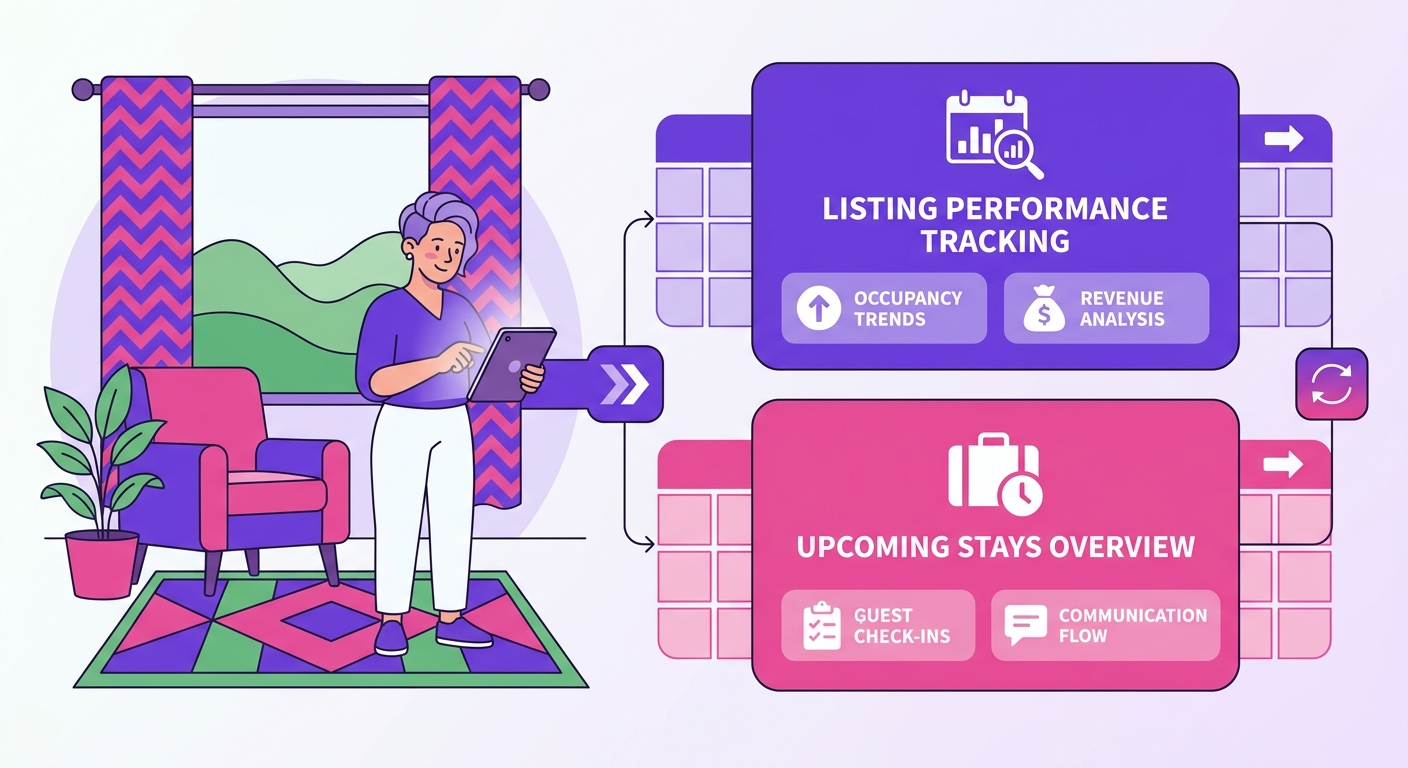
Every booking on Vrbo triggers the same operational sequence, and how you handle each step determines whether you field five support messages per stay or zero. The platform's messaging system is functional, but it doesn't automate timing for you. That's your job.
For a deeper look at flagging risky guests before they arrive, see Mr. Props' guide to vacation rental guest screening.
Request to Book Vs. Instant Booking
Instant booking converts at a meaningfully higher rate. Vrbo's own data suggests listings with instant booking enabled see roughly 20-25% more bookings than comparable request-to-book listings, because leisure travelers book impulsively and won't wait 24 hours for approval.
Request to book gives you a screening window. For properties with strict house rules, a no-party policy you actually enforce, or a location that attracts bachelor groups, that window matters. You can review the guest's profile, message history, and stated trip purpose before committing.
The honest tradeoff: high-volume beach or mountain cabins with flexible rules convert better on instant booking. Urban condos near event venues, or properties where a single bad stay costs $3,000 in damages, are better served by the friction of a request flow.
Message Timing That Cuts Support Load
Five message triggers cover 90% of the questions guests ask repeatedly:
Booking confirmation: rental agreement link (if you use one), house rules acknowledgment, and a note on what they'll receive next
7 days out: check-in time, parking, and any local logistics that aren't obvious from the listing
24 hours out: access code or lockbox instructions, Wi-Fi credentials, and your emergency contact number
First morning: a short check-in note, confirms arrival, surfaces issues before they compound
Checkout eve: checkout time, bin locations, and what to do with keys or codes
Turnovers, Reviews, and Owner Standards
Stop tweaking your listing title. The variables that actually move your Vrbo ranking aren't in the listing editor at all. Think about how fast you resolve a broken AC unit in July or whether the kitchen actually has the Nespresso machine you promised. It's the small stuff.
Guests who find a missing coffee maker or a rushed clean don't just leave bad reviews; they contact Vrbo support, which immediately flags your account.
The Handoff Metrics That Matter
Four numbers define your operational floor:
Ready-by-check-in rate: target 98% or above. A single late-ready incident in a 30-day window drops your Vrbo host rating faster than three mediocre reviews.
Same-day turnover buffer: build a minimum 2-hour gap between checkout and check-in if your cleaner can't guarantee a 90-minute turn on a 3-bedroom property.
Issue resolution SLA: Vrbo's guest satisfaction data shows hosts who acknowledge maintenance issues within 1 hour receive 23% fewer escalations than those who respond within 4 hours.
Review response cadence: reply to every review within 72 hours. Public responses to negative reviews are visible to future guests and signal active management.
Common Vrbo Mistakes Owners Make
Most online guides obsess over getting your listing live and then they just stop. They don't tell you that your revenue is quietly leaking out through a dozen tiny, avoidable operational errors, like a single unresolved maintenance ticket about a leaky faucet that costs you a 5-star review. It’s death by a thousand cuts. Here are the ones that consistently cost hosts real money.
Underpricing weekends: Vrbo's family-trip demand spikes Friday-Sunday. Hosts who set a flat weekly rate leave 15-25% ADR on the table compared to those running day-of-week multipliers.
Copying Airbnb copy verbatim: Vrbo guests skew older, travel in larger groups, and book further out. A listing description that sells "perfect for couples" ignores the platform's core demographic.
Hiding fees until checkout: Vrbo surfaces the total price early in search results. If your cleaning fee or taxes create a shock at checkout, your conversion rate drops, and Vrbo's algorithm notices abandonment signals.
Stale calendars: An unblocked calendar with no recent bookings reads as an inactive listing. Update availability or adjust pricing at least every 14 days to stay visible in search.
Weak cancellation settings: "No Refund" policies on Vrbo reduce booking volume significantly. A Moderate or Firm policy converts better for most property types without exposing you to last-minute cancellation risk.
Where Hosts Get Tripped Up After Launch
The first 90 days on Vrbo set your baseline ranking. Incomplete listing data, missing amenity tags, no house rules, and fewer than 20 photos suppress your placement before you've earned a single review. Vrbo's algorithm weights listing completeness as a proxy for host reliability.
Response lag kills early momentum fast. Vrbo tracks response rate and response time separately. A 24-hour reply window drops your response score below the threshold Vrbo uses to award Premier Host status, which requires a sub-1-hour median response time.
Photo sequencing is underrated. Your first image determines the click-through rate from search. Hosts who lead with an exterior shot convert at roughly half the rate of those who open with a bright, wide-angle living room or kitchen, the spaces Vrbo's family audience actually evaluates first.
When Vrbo Works Best in Your Channel Mix
Vrbo earns its place as a primary channel under specific conditions. Larger homes with 3+ bedrooms, drive-to leisure markets, and family-group bookings consistently outperform on Vrbo relative to other platforms, partly because Vrbo's search filters attract guests planning longer, higher-spend trips rather than quick urban stays.
Vrbo becomes a secondary channel when your unit is a studio or one-bedroom in an urban core, or when your market skews toward business travelers and last-minute bookers. Those guests default to Airbnb. Running Vrbo there isn't wrong, it just won't move the needle much without the right property type behind it.
The channel decision also intersects with your overall acquisition strategy; the investment fundamentals behind property selection are covered separately in the guide to buying rental property.