
How to Become an Airbnb Co-Host: Duties, Fees, and How to Get Clients

Contents
Table of Contents
A co-host manages someone else's Airbnb listing in exchange for a percentage of revenue, typically between 10% and 30% depending on the scope of work. That's the short version.
The longer version is that co-hosting is a formal arrangement where you take on operational responsibility for a property you don't own handling guest communication, coordinating cleaners, managing pricing calendars, and protecting the host's Superhost status.
Don't mistake a co-host for a simple virtual assistant, it's a role that lands squarely between that and a full-on property manager.
You aren't just answering messages; you're responsible for the listing's revenue performance, which can mean anything from coordinating with a plumber at 2 AM to adjusting dynamic pricing. If reviews drop, guess what? That’s on you.
Why Becoming an Airbnb Co-host Matters Right Now
Airbnb's active listing count crossed 8 million in 2024, yet host burnout is the platform's quietest churn driver.
Superhosts who manage 5+ properties report spending an average of 20 hours per week on guest communication alone, before accounting for turnovers or pricing updates.
That gap is exactly where co-hosts earn their cut. Property owners want occupancy without the operational load. Co-hosts supply the labor and get a recurring percentage, typically 10–30% of gross revenue, without owning a single square foot of real estate.
Key Factors That Drive Success as an Airbnb Co-host

Co-hosts who earn consistently above 4.8 stars share three operational traits: they respond to guest messages within 60 minutes, they catch pricing gaps before check-in week, and they document every property issue with photos. Those aren't personality traits, they're systems.
What Actually Separates Effective Co-hosts
Response time is the single biggest lever. Airbnb's algorithm weights response rate heavily in search ranking, and a co-host who lets messages sit for four hours will drag a listing's visibility down within weeks. Automate the first reply; personalize the follow-up.
Pricing oversight matters just as much. A co-host who monitors rates weekly, not monthly, catches demand spikes that a set-and-forget tool misses. Even a $15 rate adjustment on a high-demand weekend across five listings adds up to real revenue.
Set a 90-minute response window as your operational floor, not your target
Review calendar pricing every Tuesday for the next 30 days
Log every maintenance issue with a timestamped photo before reporting to the owner
How to Become an Airbnb Co-host Actually Works in Practice
The mechanical steps for how to become an Airbnb co-host are covered in detail in the guide on how to add a co-host on Airbnb without giving away too much control so this section focuses on what the role looks like once you're operating inside a listing.
Most co-hosts start by taking on one or two properties for owners they already know. The average co-host fee runs 10–20% of gross revenue with the higher end applying when the co-host handles turnovers and guest communication, not just calendar management.
Day-to-day, the role splits roughly into three areas:
Guest communication: responding to inquiries, check-in instructions, and issue resolution
Operations: coordinating cleaners, handling maintenance requests, restocking supplies
Performance: monitoring pricing, occupancy gaps, and review scores
Real-World Examples and Numbers
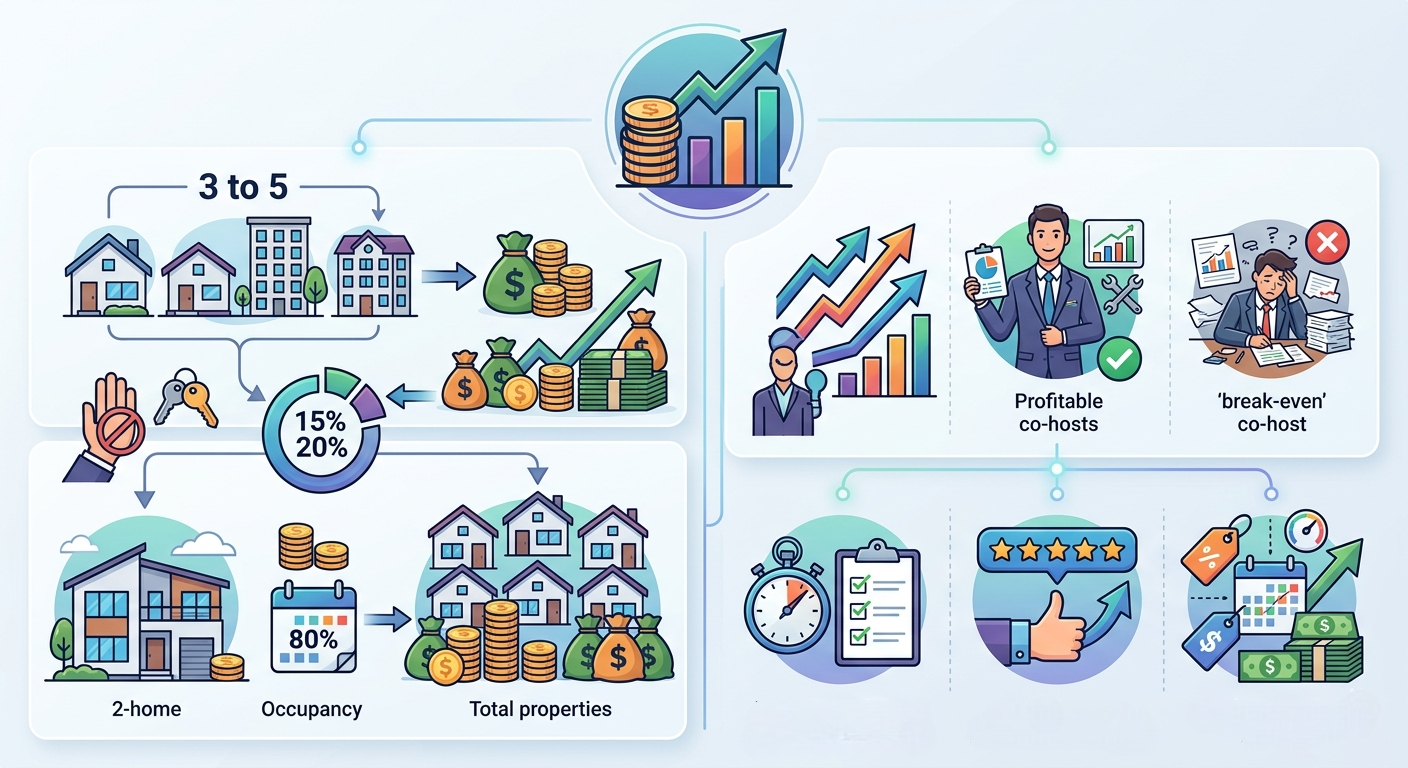
So, what's the actual earning potential? A co-host managing just 3 to 5 properties can typically earn between $2,000 and $4,500 per month, based on a standard 15% to 20% commission on gross rental revenue. Let's do the math.
A single solid 2-bedroom in a market like Asheville or Scottsdale, generating $3,800/month in bookings with an 80% occupancy rate, pays its co-host between $570 and $760.
Scale that to five properties and you're looking at $2,850 to $3,800 every month, and you don't even have to own the place.
What Separates Profitable Co-hosts From Break-even Ones
The co-hosts who clear $5,000/month consistently aren't taking on more properties, they're charging correctly and cutting unpaid labor. Flat-fee arrangements almost always undervalue the co-host's time once occupancy climbs above 70%.
Hosts who learn the steps to becoming an Airbnb property co-manager by starting with one owner's portfolio report faster growth than those who cold-pitch strangers.
One referral from a satisfied owner is worth 6 months of outreach. Start close, perform well, and the pipeline builds on its own.
Co-hosts with documented SOPs onboard new properties 40% faster than those operating ad hoc
Properties managed by active co-hosts average 12% higher review scores than self-managed listings in the same market
Co-hosts who handle pricing adjustments weekly outperform those on static rates by 18 to 22% in annual revenue
Common Pitfalls and How to Avoid Them
Most co-hosts lose their first client within 90 days, not because of bad cleaning or slow response times, but because the business arrangement was never clearly defined upfront. Vague agreements about who handles what create friction fast.
The most damaging mistakes fall into a predictable pattern:
No written co-host agreement: Verbal splits on revenue get disputed the moment a damage claim or refund request hits. Put percentages, scope, and payout timing in writing before you touch the listing.
Underpricing your services: Co-hosts charging 10% flat for full-service management are typically losing money once you factor in guest messaging time. Full-service rates on active markets run 20–30%.
Skipping a property walkthrough: Taking over a listing without documenting its current condition means you inherit every existing guest complaint as your own reputation problem.
Ignoring local STR regulations: Some municipalities cap the number of co-hosted properties one individual can manage. Check permit requirements before signing a second or third property.
Best Practices and Expert Tips
Co-hosts who reach Superhost status within their first year share one common trait: they treat the role like a business from day one, not a side arrangement. That means documented systems, not verbal agreements.
Before taking on a second property, get your first one to a 4.8-star average across at least 15 reviews. That baseline proves your systems work under real conditions.
Operational Habits That Separate Good Co-hosts
Lock in your fee structure in writing before managing a single booking, verbal agreements break down when a $400 damage claim arrives.
Audit the listing's calendar sync every 30 days; double-bookings cost co-hosts an average of $280 in rebooking penalties on Airbnb.
Keep a dedicated phone number or inbox for each property owner you represent, mixed threads cause missed escalations.
Side-by-Side Comparison
The mechanics of becoming an Airbnb co-host differ significantly depending on whether you're starting from scratch or stepping into an established portfolio. The table below breaks down the two most common entry paths.
Factor | Self-Sourced Client (Cold Outreach) | Invited by Existing Host |
|---|---|---|
Time to first booking managed | 4–12 weeks (prospecting + negotiation) | 3–7 days (invitation + permissions setup) |
Typical commission rate | 15–25% of gross revenue | 10–20% (host sets the terms) |
Access level | Negotiated upfront, often limited | Host-controlled; calendar and messaging standard |
Airbnb profile requirement | Your own account, verified ID | Your own account, verified ID |
Revenue risk | Higher (you bear acquisition cost) | Lower (existing bookings in place) |
For the technical side of permissions and access tiers, the full breakdown lives in the guide on adding a co-host on Airbnb.
Cold outreach produces higher long-term margins but demands a real sales process. Getting invited by an existing host is faster and lower-risk, but you're operating on someone else's terms from day one.
Cost and ROI Considerations
Co-hosting typically costs a host between 10% and 25% of gross rental revenue per month, depending on the scope of services.
A property generating $4,000/month means the co-host earns $400–$1,000 before any expenses. That spread matters when you're deciding what services to include in your agreement.
Where the Numbers Actually Land
A full-service co-host managing guest communication, turnover coordination, and pricing oversight on a $5,000/month listing earns roughly $1,000–$1,250.
After platform fees and cleaning costs, the host nets around $2,800–$3,200. That's still a better outcome than a poorly managed self-run listing sitting at 55% occupancy.
The ROI calculation flips when co-hosts take on properties with thin margins. A $1,800/month cabin in a low-demand market can't support a 20% fee without the host going negative. Always model netrevenue before agreeing to a rate.
Startup costs are real too. Expect to spend $200–$500 on software, $50–$150 on business registration, and unpaid hours building your first client relationship. Most co-hosts don't break even until month two or three on their first property.
Tools, Resources, and Service Providers
The right tools cut your admin time by 40-60% once you're managing more than two listings. Co-hosts who rely on Airbnb's native inbox alone spend roughly 3x longer on guest communication than those running a dedicated property management system.
Essential Software Categories
Channel management: Guesty, Hostaway, and Lodgify sync calendars across Airbnb, Vrbo, and Booking.com, eliminating double-bookings without manual updates.
active pricing: PriceLabs and Wheelhouse pull real-time demand data; most users report a 15-25% revenue lift in the first 90 days.
Automated messaging: Hospitable (formerly Smartbnb) sends templated check-in instructions, mid-stay check-ins, and review requests on a trigger-based schedule.
Cleaning coordination: TurnoverBnB matches turnovers to vetted cleaners and auto-triggers jobs when a booking closes.
Free Resources Worth Bookmarking
Airbnb's co-host resource center covers payout structures and permission levels directly from the platform. For regulatory compliance by market, STR operators also reference local short-term rental ordinances published on city and county government sites.
Anyone figuring out how to become an Airbnb co-host should build their tool stack before taking on a second property, not after. Retrofitting systems onto a growing portfolio is slower and messier than starting structured.
Step-by-Step: Getting Started as an Airbnb Co-host
Most guides bury the actual sequence. Here it is, in order:
Build a service menu with fixed rates. Decide which tasks you'll handle (guest comms, pricing, turnovers) and what each costs. Co-hosts who charge a flat 15–20% of revenue close deals faster than those who negotiate case by case.
Get added to the listing. The primary host invites you through Airbnb's co-host settings. You'll receive an email confirmation and can set your access level from there.
Sign a co-host agreement before touching anything. Cover commission, termination notice (30 days minimum), liability for guest damage disputes, and who controls the pricing tool.
Set up your management stack. At minimum: a channel manager, a active pricing tool, and a shared inbox. Properties managed with dedicated software average 18% higher occupancy than those run through the native Airbnb app alone.
Run your first turnover inspection personally. Don't delegate this until you know exactly what the property needs. One missed issue in week one costs more in bad reviews than a month of management fees.