
How Much Do Airbnb Cleaners Charge in 2026? Rates by Turnover, Hour, and Property Size
Contents
Table of Contents
If you're trying to figure out how much do Airbnb cleaners charge in 2026, start with these benchmarks: solo cleaners typically run $25–$50 per hour but hourly rate is the wrong unit for STR operators.
What matters is per-turnover cost.
Per-turnover pricing for short-term rentals commonly lands around $80–$120 for a studio or one-bedroom $130–$200 for a two- or three-bedroom, and $250–$350+ for larger homes. A cleaner quoting $35/hour sounds cheap until a three-bedroom turnover takes five hours.
These figures apply whether your listing runs on Airbnb, Vrbo, or Booking.com. The platform doesn't change what a cleaner charges, property size, turnover frequency, and your market do.
Airbnb Cleaning Rates Per Hour
Understanding how Airbnb cleaning rates per hour break down by cleaner type prevents costly surprises when turnovers run long.
Here's what the three main cleaner types charge in 2026:
Independent cleaners: $25–$40/hour in lower-cost markets, $35–$60/hour in mid-size metros
Small cleaning teams (2–3 people): $40–$65/hour combined, with faster turnovers
STR-specialized vendors: $55–$80+/hour, pricing in reliability and same-day availability
Hourly billing creates cost drift when cleaners aren't experienced with short turnaround windows.
Regional Variation in Hourly Rates
Geography moves rates more than property size does.
Honolulu and San Francisco STR cleaners charge $75–$90/hour
Phoenix and Nashville sit closer to $45–$65/hour
Rural Smoky Mountains or Ozarks markets reach $28–$38/hour
Minimum Visit Charges
Most cleaners set a minimum of 1.5–2 hours regardless of actual time spent, so factor this into your fee structure before assuming hourly means cheaper.
Per-Turnover Pricing by Property Size
Cleaners don't quote by the hour when they know your property, they quote by the turn. Here's what those numbers look like in 2026.
Studio and 1-bedroom Turnovers
Expect to pay $80–$140 per turn for a studio or one-bedroom unit. At a $150 ADR with 75% occupancy, you're running 12–16 turns per month, so cleaning alone costs $960–$2,240 monthly before any add-ons. That's 6–9% of gross revenue at the low end.
Off-site laundry pickup adds $20–$40 per turn on top of the base rate.
2- to 3-bedroom Turnovers
Two-bedroom units run $120–$190. Three-bedrooms push to $150–$240 especially if the property has multiple bathrooms or a fully stocked kitchen guests actually use. Outdoor resets, patio furniture, grill cleaning, trash bins, typically add $25–$50 per visit.
4-Bedroom and Large-group Homes
Once you get to four-bedroom properties, cleaning fees skyrocket, starting around $220 and easily climbing past $400 for luxury homes with mountain views. It's a huge bill.
Hot tub checks and chemical balancing alone can add another $50–$75, and a professional linen service for six beds might tack on an extra $90 per turnover. At this scale, it's often your single biggest expense for any given booking.
What Changes the Price Fast
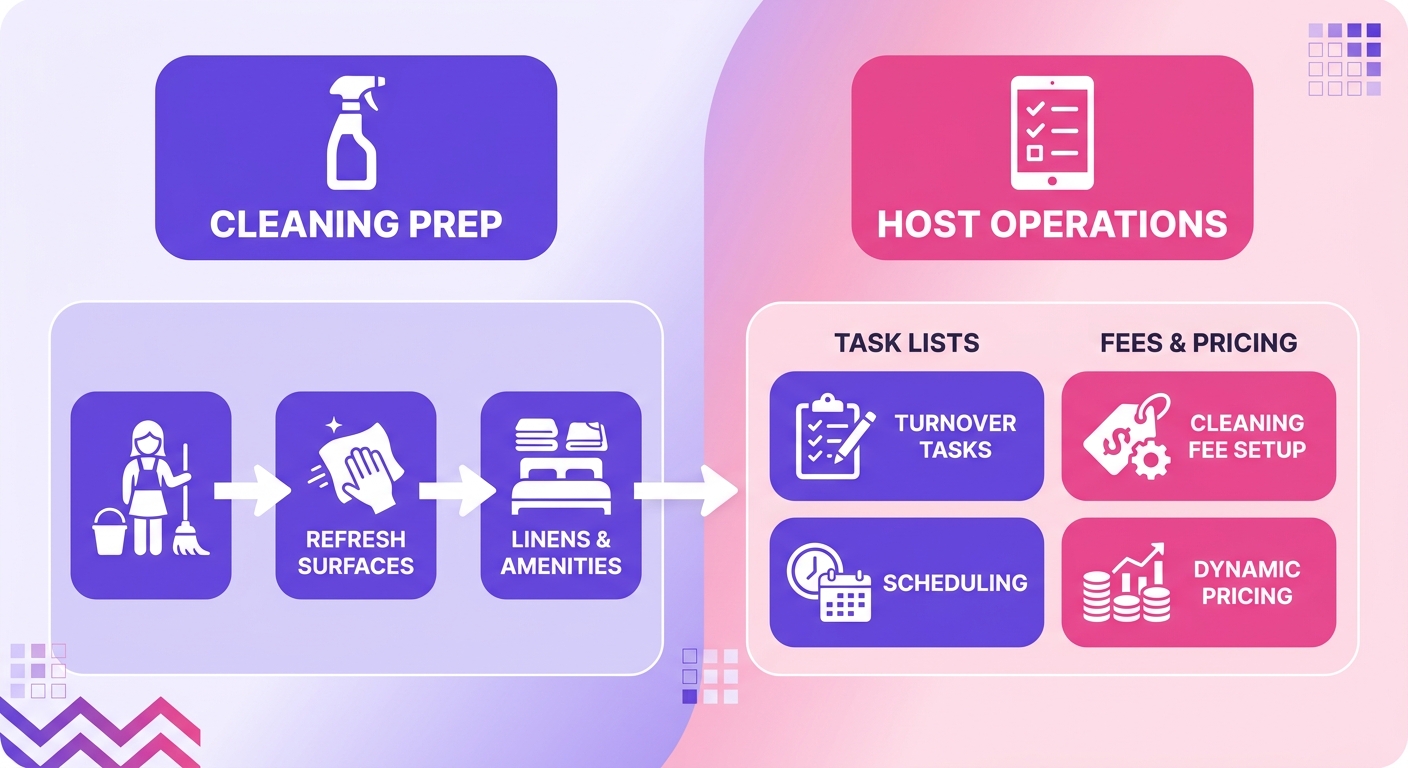
Checkout-to-checkin timing is a bigger pricing driver than square footage. A cleaner working a standard 11am–3pm window charges differently than one who gets a 10am checkout with a 1pm checkin.
Same-day rush fees typically run $20–$75 per turnover depending on market and how compressed the window is. Two hours isn't enough time for a thorough clean on anything larger than a studio, that's the exception where you'll eat either quality or cost.
Laundry and Linen Handling
On-site laundry adds 20–40 minutes per turnover. Off-site wash-and-fold runs $15–$50 per turnover for a standard two-bedroom, and higher if you're using a commercial linen service with pickup.
Hosts who supply multiple linen sets and rotate them cut turnover time, but pay more upfront in inventory.
Supplies and Restocking
Most cleaners apply a 10%–25% markup on consumables they restock (toiletries, paper goods, coffee pods). Some charge per-item at retail. Either way, you're paying above your actual supply cost once handling is factored in.
Damage and Deep-clean Resets
Excessive mess fees vary case by case, expect $50–$200 added to a standard invoice after a rough checkout. A full deep-clean reset after a long stay or party can run 2–3x your normal turnover rate.
How the Airbnb Cleaning Fee Works
The cleaning fee is a one-time charge added to the guest's booking total it's not a nightly rate, and it doesn't go to your cleaner automatically.
You set the amount in your listing settings, the guest pays it at checkout, and you pay your cleaner separately under whatever agreement you've negotiated.
So why don't hosts just charge the exact cleaning cost? Because it's a strategic choice.
Some hosts will eat part of the turnover cost, setting their fee below the real price to appear more attractive in price-sensitive searches where every dollar counts. Others go the opposite direction, charging well above their actual cost to pad their revenue, especially on short two-night weekend stays.
Neither approach is wrong; it all depends on your average booking length and where your listing lands in the search rankings once all those fees are finally factored in.
Setting the Right Cleaning Fee
Your true turnover cost and your guest-facing fee are two different numbers, and confusing them costs you money on short stays or kills conversion on long ones.
Start with the actual cost formula:
Average cleaner charge (e.g.
Laundry and supplies: $18
Inspection buffer: $12
True cost: $165
From there, you have three ways to price the guest-facing fee.
Pass-Through, Absorption, or Length-of-stay Balancing
Pass-through pricing means charging guests the full $165. Transparent, but it hurts conversion on 1-2 night bookings where the fee is 30-40% of the total stay cost.
Partial absorption means charging $149 and folding the $16 gap into your average daily rate. You recover it on stays of three nights or more, you don't on one-nighters.
Length-of-stay balancing is the most precise approach: set a $149 visible fee and apply a minimum-stay rule of two nights for peak periods. Shorter stays are far more sensitive to visible fees than longer ones, so this protects both your margin and your search ranking.
Hiring Models and Margin Trade-offs
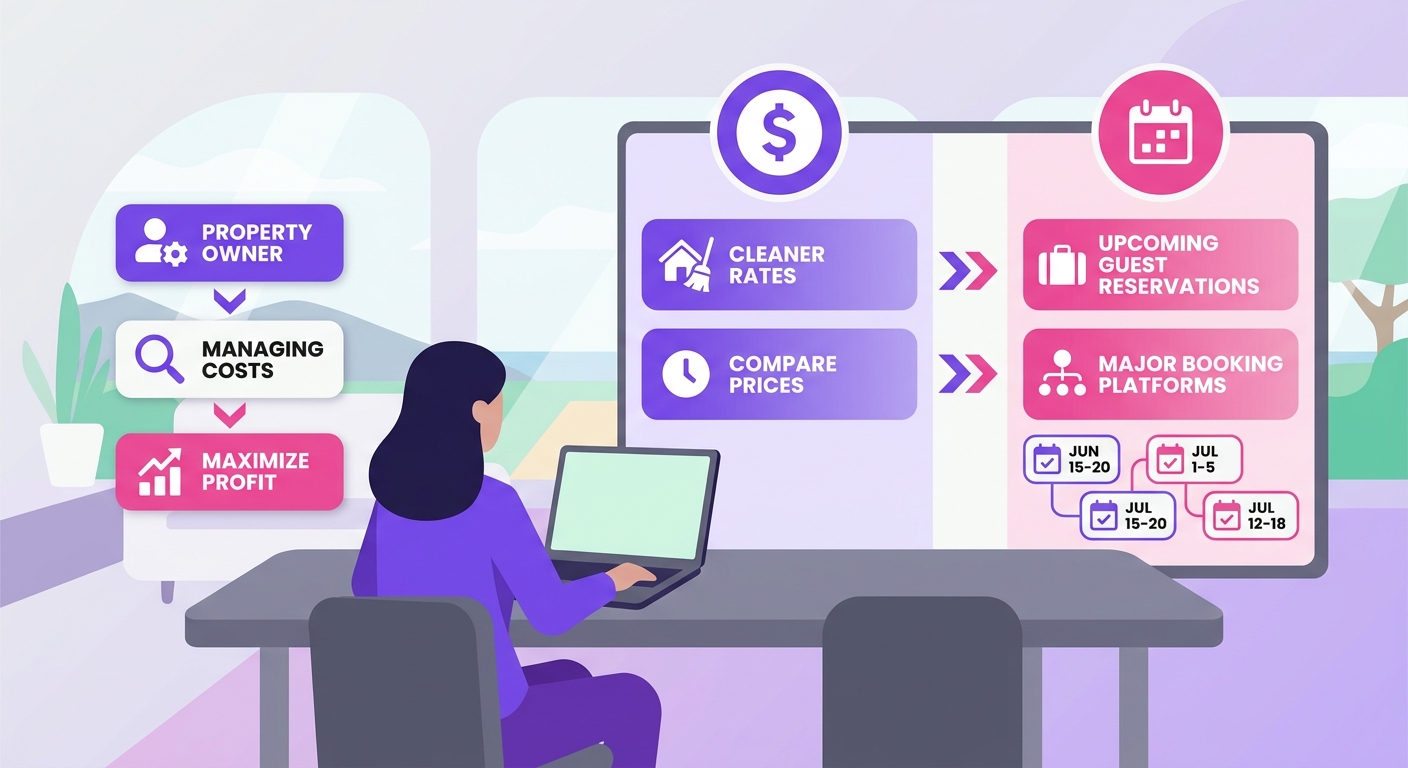
Your cleaning model is a cost structure decision, not just a staffing preference. Get it wrong and you're either overpaying for flexibility you don't need or under-resourced during peak turnover windows.
Solo Cleaner Vs. Company Pricing
Independent cleaners typically charge $20–$35/hour and often set their own per-turnover flat rates. Cleaning companies run $35–$55/hour but include backup coverage when your regular cleaner cancels, which happens more than hosts expect.
Solo cleaner: lower per-clean cost, higher no-show risk, zero quality escalation path
Cleaning company: 15–25% cost premium, but built-in redundancy and standardized checklists
When In-house Starts to Pencil Out
At 2 units, external cleaners almost always win on margin. Payroll taxes, benefits, and guaranteed hours make a salaried cleaner expensive when turnover volume is thin.
At 15+ units in a dense market with 65%+ occupancy, a dedicated in-house cleaner earning $18–$22/hour can cost less per turnover than a company charging $120–$180 per clean. The math shifts fast when you're running 40+ turnovers a month.
Rate Benchmarks by Market Type
Hourly Airbnb cleaning fees vary more by market than by property type. A 2-bedroom unit in rural Tennessee costs far less to turn over than the same floor plan in coastal California.
Low-Cost Suburban Markets
In smaller metros and suburban areas, you'll find the most affordable cleaners. Expect to pay $18–$28 per hour.
The strong labor supply in a place like a suburb of Cleveland, for example, keeps rates competitive and predictable. It’s why you can often get a flat-rate turnover for a standard 2-bedroom for just $65–$110. No big surprises here.
Mid-Cost Urban Markets
You'll see a big price jump in mid-tier cities like Denver, Austin, or Nashville, where hourly rates hit $28–$42 and a flat-rate clean for the same 2-bedroom unit now costs you between $120–$180. It adds up fast.
Don't forget that same-day turnovers, like when you need a 10 AM checkout cleaned for a 4 PM check-in, will carry a hefty $15–$30 premium in most of these markets.
Resort and High-labor Markets
Beach destinations, ski towns, and high-density metros push effective rates to $40–$65 per hour. Weekend-heavy booking patterns mean cleaners handle back-to-back same-day turnovers, so they price that demand into their base rate.
Supply is tight; reliable cleaners often book out weeks ahead.
Local STR regulations can also affect cleaner availability, markets with strict occupancy licensing or mandatory inspection windows shrink the pool of available turnovers, which puts upward pressure on scheduling and rates.
Cost Control Without Quality Slippage
The cheapest cleaner on your roster is often your highest refund risk. A $15/hour rate means nothing if a missed bathroom triggers a 1-star review and a $200 partial refund.
Operational Controls That Hold Quality
Standardized reset checklist: room-by-room, printed and laminated at the property
Photo verification: cleaners submit timestamped photos of key areas before checkout
Linen par levels: minimum three sets per bed so same-day turnovers never stall on laundry
Owner closet and supply bins: pre-stocked on-site, audited every 30 days
Five Kpis to Track Every Turnover
Cost per turnover (total cleaner pay + supplies)
Minutes per turnover vs.
Re-clean rate (target: under 3%)
Guest cleanliness mentions in reviews (track monthly)
Same-day turnover success rate (target: 95%+)
Run these monthly. A rising re-clean rate almost always signals a cleaner accountability gap, not a pricing problem.