
How Much Does Vrbo Charge Hosts? Fees, Listing Costs & Pricing Models

Contents
Table of Contents
Vrbo charges hosts under a pay-per-booking commission or a flat annual subscription.
On the pay-per-booking side, the total fee typically lands around 8% of the rental amount, a 5% Vrbo service commission, plus roughly 3% for payment processing.
That's the number most hosts mean when they ask about Vrbo's fee structure for property owners, and it's different from asking how much Vrbo takes from hosts in a direct-deposit context.
Vrbo Host Fees at a Glance
There are two ways Vrbo charges hosts. Here is how they differ.
Pay-per-Booking Model
The 5% commission applies to the rental amount, not the full guest-facing total. Cleaning fees and taxes are typically excluded from the commission base, though payment processing (the ~3%) can apply to the full amount collected, depending on how your payout is structured.
On a $150/night booking for three nights, that's $22.50 in commission plus roughly $13.50 in processing fees, so $36 out of a $450 rental charge. Add-ons like pet fees may or may not enter the commission calculation depending on how they're listed.
One real exception: if Vrbo remits taxes on your behalf in certain jurisdictions, the processing fee math shifts slightly because the taxable base changes.
Annual Subscription Model
A handful of old-school hosts are still grandfathered into Vrbo's flat annual listing fee. It's a relic. While Vrbo has moved most new listings to pay-per-booking, some existing subscribers can keep their plan.
The subscription only beats pay-per-booking if your annual rental revenue clears roughly $6,200, which is the breakeven point for the platform's combined 5% booking commission and 3% payment processing fee. Below that, you're just paying more than you have to.
At $150/night ADR and 75% occupancy on a single property, annual rental revenue runs about $41,000, well above the break-even point.
For a property with fewer than 15-20 bookings per year, pay-per-booking is almost always cheaper.
How Much Does It Cost to List on Vrbo
Creating a Vrbo listing costs nothing. That's the answer to how much it costs to list on Vrbo: zero upfront. But "free to list" and "free to operate" are not the same thing, and that gap is where hosts get surprised.
Free to Create Versus Paid to Transact
You pay nothing to publish your listing. The fees start the moment a booking is processed.
Under the commission model, Vrbo takes roughly 5% of the booking subtotal from the host side. Under the subscription model, you pay a flat annual fee, historically around $499/year, and no per-booking percentage comes out of your payouts.
Commission model: no upfront cost, but every booking carries a percentage deduction
Subscription model: fixed annual cost, no per-booking host fee on top
Setup cost: $0 on either plan
The distinction matters operationally. A host pricing at $150/night who assumes "listing is free" and never checks their payout structure may be absorbing a 5% cut without realizing it.
When the Annual Fee Beats Commission
Is the $499/year subscription actually worth it? It pays for itself once your annual Vrbo booking revenue hits about $9,980, which is the point where a 5% commission would have cost you the same amount.
For a typical listing, that's roughly 67 nights booked at a $150 ADR.
If you're running a high-end cabin at a $400 ADR, you'll cross that threshold in just 25 nights. The next section breaks this down by occupancy rate so you can run your own numbers.
What Vrbo Takes From Each Booking in Real Numbers
The 8% host service fee is the starting point, but the actual dollar impact depends on your ADR and what Vrbo includes in the fee base.
Cleaning fees and pet fees may be included in the amount Vrbo charges against, depending on how your listing is configured, so pull a real payout statement before assuming the math is clean.
Taxes are calculated and remitted separately in most markets. That's a different conversation entirely, and the tax treatment of rental income deserves its own breakdown rather than a footnote here.
Example: 1-bedroom at $150 ADR
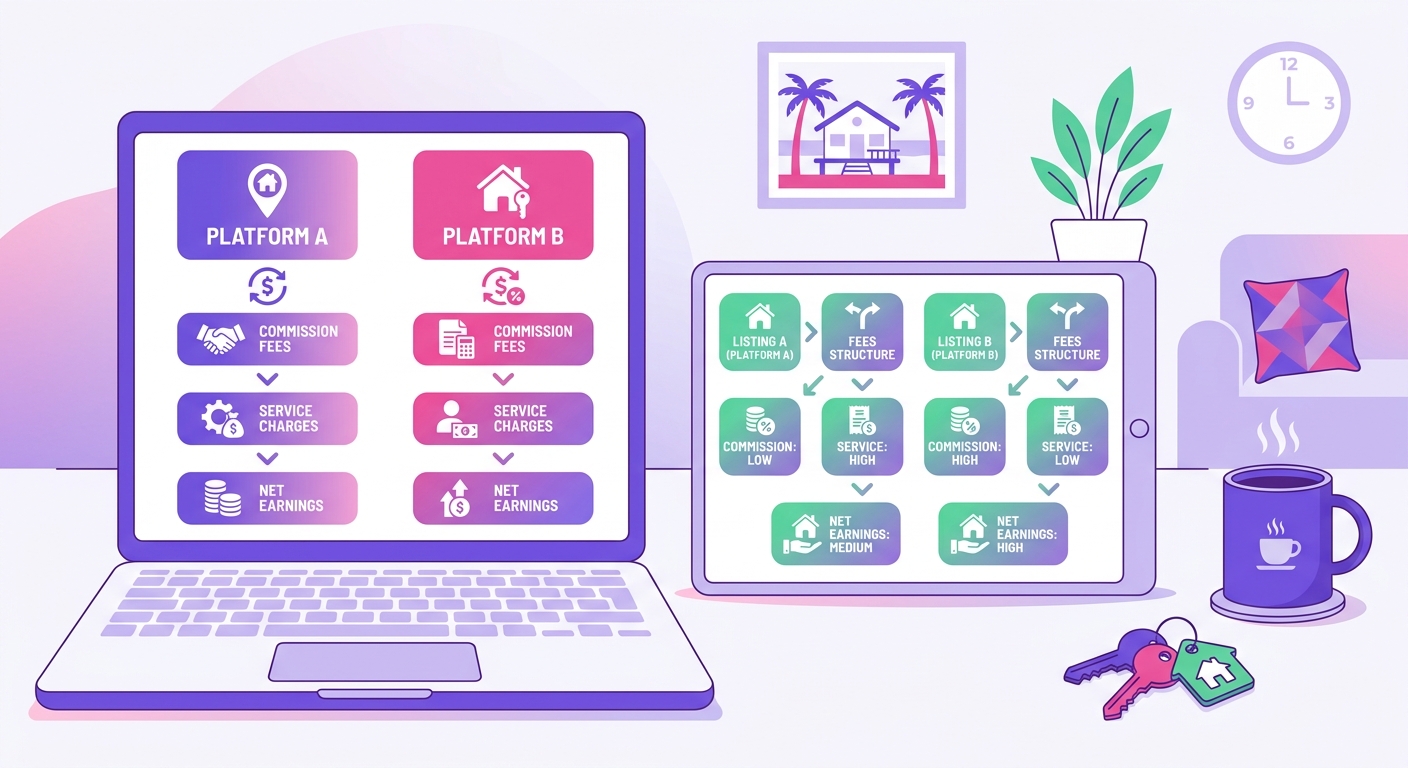
Let's run the numbers for a solid month. At 75% occupancy during a 30-night peak season month like July, you're looking at 22.5 booked nights. That's $3,375 in rent collected before anyone takes a cut.
8% host fee: $270
Net payout from rent: $3,105
Annualized fee impact: $3,240
But what happens when you maintain that occupancy across 12 months? You've handed Vrbo over $3,200. That's enough to buy a brand-new hot tub or cover a full year of professional landscaping for the property. It's real money, and it's coming straight out of your operating margin.
Example: 3-bedroom at $325 ADR
Drop occupancy to 60%, 18 booked nights, and you still collect $5,850 in rent that month. The fee scales hard here.
8% host fee: $468
Net payout from rent: $5,382
Annualized fee impact: ~$5,616
That's $5,600 a year at a property running below peak occupancy. Higher ADR amplifies the fee dollar amount even when nights booked are lower.
Vrbo Fees Hosts Forget to Model
The 8% host service fee is the number everyone quotes. It's also the smallest part of your actual distribution cost once you stack everything else on top of it.
Platform Fees Versus Operating Costs
At a $150/night ADR with 75% occupancy, Vrbo's 8% cut runs roughly $3,285/year on a single property. That's real money, but it's not the full picture. The costs that quietly erode margin are the ones most operators never isolate:
Payment processing: Vrbo routes payments through its own system, so you don't pay Stripe separately, but refund leakage is still your problem. A single disputed stay at $450 that goes to chargeback typically costs $450 plus a $15-$25 dispute fee, with no recovery guarantee.
Channel manager fees: If you're running Vrbo alongside Airbnb and Booking.com, expect $30-$100/month per property for a sync tool. That's $360-$1,200/year before you've touched a guest.
Cancellation cost: Even a no-fault cancellation at 60% occupancy creates a 2-3 night gap that's statistically unlikely to refill. The lost revenue isn't a Vrbo fee, but it lives on the same line as one.
Guest-Facing Fees That Still Hurt Conversion
Vrbo charges travelers a service fee, typically 6-12% of the booking subtotal, that you don't pay directly. But it affects you.
When a guest sees your $150/night listing priced out at $195/night after Vrbo's traveler fee, they compare that total against competitors. If similar properties net out cheaper all-in, you lose the booking.
The operational response most hosts land on is lowering the base rate by $10-$15/night to close the total price gap. That discount doesn't show as a Vrbo charge. It shows as lower revenue. The platform fee is visible; the rate compression it forces is not.
Vrbo Versus Airbnb Fee Structure
Airbnb's effective host cost ranges from 3% (split-fee model) to 14-16% (host-only, common when you connect via channel manager), while Vrbo's pay-per-booking plan lands near 8% effective host cost after the service fee is applied to the full booking value, including taxes.
That gap matters more than it looks on paper. A $150/night listing at 75% occupancy generates roughly $3,375/month in rental revenue. At 3% host fee, Airbnb takes $101. At 8%, Vrbo takes $270.
At 15% host-only Airbnb, the cut jumps to $506. Same property, same nights booked, $405 difference in monthly take-home depending on which channel and which fee model you're running.
Why Net Payout Matters More Than Headline Fee
Advertised commission rates don't account for everything that reduces your actual deposit. Vrbo's rate parity requirement means you can't list lower on Airbnb to offset a higher fee; your base nightly rate has to stay consistent.
So the only variable you control is which channel's fee structure eats less of that fixed rate.
Calculate net payout per channel: (nightly rate × nights) minus service fee minus any pass-through taxes the platform retains
Run the same 30-day scenario on both platforms before deciding where to push availability
Factor in that Vrbo's annual subscription ($499/year) changes the math entirely at lower booking volumes, fewer than ~6 bookings annually, and pay-per-booking wins
Channel mix decisions shouldn't be based on which platform feels cheaper. They should be based on which one deposits more money after every deduction, specific to your property type, booking cadence,
When the Annual Subscription Makes Sense

The math here is straightforward. Divide the annual subscription fee by the pay-per-booking commission rate, and you get the booking revenue threshold where the two options cost the same.
Break-even formula: Annual fee ÷ Commission rate = Break-even revenue
At roughly $699 per year and an 8% per-booking rate, that threshold sits around $8,738 in annual booking revenue. Below that number, pay-per-booking costs you less. Above it, the subscription saves you money. (Vrbo adjusts plan availability periodically, so confirm current terms directly before committing.)
Break-Even Math by ADR
Translating $8,738 into nights sold makes the decision concrete:
$100 ADR (budget market): 88 nights to break even, roughly 24% occupancy on a full year
$150 ADR (mid-tier): 59 nights, about 16% occupancy, achievable in most markets
$325 ADR (premium or resort): 27 nights, a single strong month covers the annual cost
High-ADR hosts get the clearest case for the subscription. At $325 per night, you're past break-even by February if the property performs at all. At $100 per night, you need consistent volume first.
Who Should Avoid the Subscription
Three operator profiles should stay on pay-per-booking:
Seasonal hosts running fewer than 60 nights annually, the fixed cost rarely pays off
New listings in their first 90 days, before occupancy data exists to model against
Low-occupancy operators averaging under 50% in markets where demand is uncertain
Locking in $699 before you know your actual booking pace is a bet on optimism, not data. Run one full season on pay-per-booking, pull your revenue numbers, then decide.
How to Protect Margin on Vrbo
Matching gross nightly rates across Airbnb, Vrbo, and Booking.com feels logical. Each platform takes a different cut, so identical rack rates produce different net revenue.
On a $150/night booking at 75% occupancy, a 3% swing in effective fee rate costs you roughly $1,230 annually on a single property. That gap compounds fast across a portfolio.
Channel-specific Pricing Rules
Set rates per channel, not per property. If Vrbo's combined host fee runs 5% and Airbnb's split-fee model nets you 3% less after guest-side fees affect conversion, your Vrbo base rate needs to be higher to hit the same net ADR.
Build the fee delta into your channel manager as a percentage markup before rates publish. (This is where most operators lose margin quietly, not in big fee changes, but in the slow drift of identical rates across unequal-cost channels.)
Minimum stay settings also affect net margin. A 2-night minimum at $150/night with a $45 cleaning fee yields a $157.50 effective nightly rate.
Drop to 1-night minimums, and that same cleaning fee cuts the effective rate to $195 gross but increases turnover costs. Run the math per channel before changing minimums during shoulder season.
Monthly Fee Audit Checklist
Pull your owner statement monthly and compare these five line items:
Gross booking value: the total charged to the guest before any deductions
Host service fee: what Vrbo deducted, expressed as a dollar amount and percentage
Refunds and adjustments: any cancellation refunds that reduced your payout
Tax remittance: taxes Vrbo collected and remitted on your behalf versus taxes you owe directly
Payout date and timing: whether the deposit cleared within Vrbo's stated 24-hour post-check-in window
Discrepancies between gross booking value and your expected net are rarely Vrbo errors; they're usually refund adjustments or
Stop Guessing What Vrbo Actually Costs You
The fee percentage is the starting point, not the finish line. Net payout after commission, processing, channel manager costs, and traveler-fee-driven rate compression is the number that determines whether Vrbo earns its place in your channel mix.
Run the break-even math before your next renewal date. Pull your owner statement and compare gross booking value against the actual deposit.
If you're managing multiple properties across Vrbo, Airbnb, and Booking, the margin difference between channels compounds fast, and it rarely shows up until you isolate it.
Mr. Props gives you the calculators, payout trackers, and channel comparison tools to run this analysis on any property, any market, any fee model, so the decision is based on your actual numbers, not platform marketing.
FAQs
What is Vrbo's host fee?
Vrbo charges hosts roughly 8% per booking under the pay-per-booking model: a 5% service commission plus approximately 3% for payment processing.
Is it free to list on Vrbo?
Yes, creating a listing costs nothing. Fees only apply when a booking is processed. Under the commission model, you pay nothing upfront; under the subscription model, you pay a flat annual fee with no per-booking deduction on top.
When does the Vrbo annual subscription make sense?
The subscription pays for itself once your annual Vrbo booking revenue clears roughly $9,980, the point where a 5% commission would have cost the same amount. At a $150 ADR, that's around 67 booked nights. High-ADR hosts at $325/night reach break-even in as few as 27 nights.
How does Vrbo's fee compare to Airbnb's?
On a $150/night booking at 75% occupancy, Airbnb's split-fee model takes roughly $101/month from the host; Vrbo's 8% model takes around $270. Airbnb's host-only model (common with channel managers) can push that to $506/month.
Does Vrbo charge guests a fee, too?
Yes. Vrbo adds a traveler service fee of 6–12% to the guest-facing total. You don't pay it directly, but it inflates the price guests see, which affects booking conversion. Many hosts lower their base rate by $10–15/night to close the total price gap, which shows up as lower revenue rather than a visible fee.