
How to Find Airbnb Cleaners: Hire the Right Cleaning Crew

Contents
Table of Contents
A cleaner who shows up on time and leaves the unit photo-ready is worth more than one who charges $15 less and costs you a 5-star review.
Before you start sourcing anyone, get specific about what you're actually hiring for. Knowing how to find a cleaner for Airbnb the right way starts with knowing exactly what you need them to do.
Where to Find a Cleaner for Airbnb
Let's have a look at some of the most common places where you can find Airbnb cleaners.
Referrals From Hosts and Co-hosts
This is the highest-signal channel available. A cleaner already handling STR turnovers understands checkout-to-checkout windows, linen rotation, and restocking, no training from scratch.
When you ask another host for a referral, don't stop at "are they good?" Ask specifically:
What's their no-show rate over the past six months?
Do they do a walkthrough inspection or just clean and leave?
Who covers if they're sick or double-booked?
Marketplaces and Local Service Platforms
Platforms like Thumbtack and Angi give you volume, not vetting. Don't be fooled.
A five-star rating there usually means someone's great at cleaning a house once a month, not that they have any real STR turnover experience or know how to handle your specific 2,000-thread-count linens.
Treat these sites as lead sources only. Bottom line: they're just for finding names. You still have to run your own screening, asking critical questions like, "Can you guarantee a same-day flip between an 11 a.m. checkout and 3 p.m. check-in?"
Surprisingly, even Craigslist can still produce solid candidates in dense markets, especially independent cleaners who've ditched platform fees to offer you better rates.
Independent Housekeepers Versus Cleaning Companies
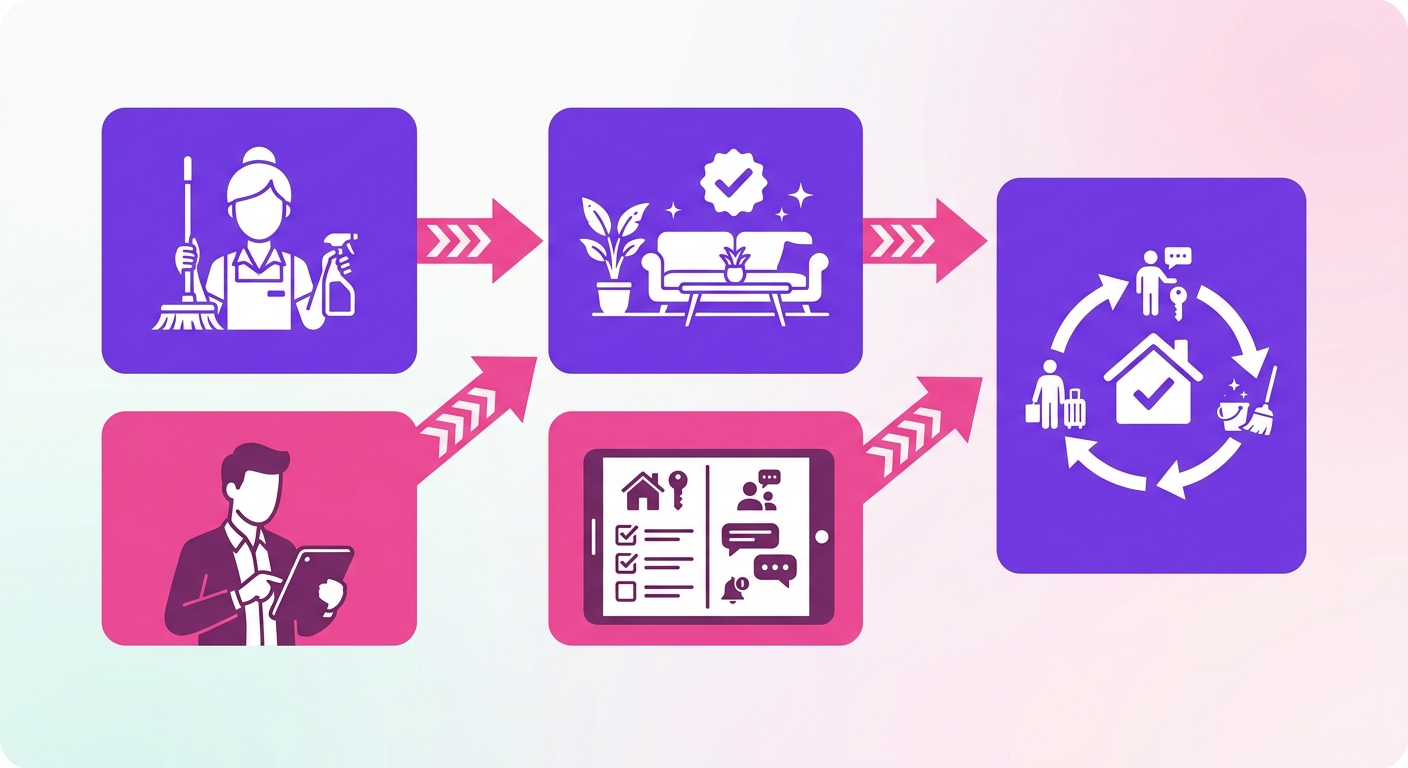
Independent cleaners run $25–$40/hr versus $45–$65/hr for a company and are often more flexible on scheduling. The real tradeoff is backup coverage; if your independent cleaner calls out before a same-day check-in, you're handling it yourself.
Cleaning companies carry liability insurance and send replacement crews, making the reliability premium worthwhile for hosts managing five or more properties. For a single-property host, the math often doesn't support it.
Turnover Standards for 1 to 50 Listings
One solo cleaner works fine for a single unit with predictable checkout patterns. The moment you add a second property or run back-to-back bookings on the same unit, you need a named backup.
No backup means one sick call cancels your clean. This is one of the first things hosts learn when figuring out how to find Airbnb cleaners who can actually scale with their portfolio.
At five or more listings, a solo cleaner becomes a liability regardless of quality. You need either a small crew or a cleaning company with its own staffing redundancy.
The Three Outcomes That Matter More Than Low Price
Hosts chasing the cheapest clean consistently make the same mistake. Here's what actually determines whether a cleaner is worth keeping, and what you should be screening for when researching:
Reliability: Shows up for every scheduled turn, including holidays and short-notice same-day bookings.
Consistency: The unit looks the same after every clean, guests notice variation even when you don't.
Communication speed: Flags damage, low stock, or access issues within 30 minutes of finishing, not the next day.
How to Screen an Airbnb Cleaning Crew Fast
Stop wasting 90 minutes on screening calls only to hire the wrong cleaner anyway. It's a total waste of time. The fix isn't asking more questions; it's asking the right ones in the right order.
A structured 30-minute interview, including a non-negotiable question like "What's your backup plan if you're sick on a turnover day?", will tell you everything you need to know.
Run this in two phases: a 10-minute message exchange before you ever call, then a 20-minute phone screen. If they take more than 4 hours to reply to your first message, the screen is already over.
Score each candidate on these weighted criteria before the trial clean:
STR-specific experience (25 pts): Have they done same-day turnovers before, not just weekly residential cleans?
Response time (20 pts): Under 2 hours earns full marks. Over 6 hours is disqualifying.
Backup coverage (20 pts): Can they name a specific person who covers sick days?
Supply and laundry handling (15 pts): Do they restock from a par list or wait to be told?
Proof of work (10 pts): Photos from actual STR turnovers, not residential jobs.
Insurance or business registration (10 pts): General liability at a minimum. (This matters more once you're above 3 properties. A solo host with one unit can sometimes skip it, but the risk scales fast.)
The Questions to Ask Before a Trial Clean
Ask these in sequence. The answers reveal process, not just availability.
What's your minimum notice window for a same-day turnover?
What happens if you cancel, who covers, and how fast?
Do you bring supplies, or do you work from a host-stocked kit?
How do you handle a restock when something runs out mid-stay?
Walk me through what you do when you find a stain on the mattress.
What's your process for items guests leave behind?
What Airbnb Cleaners Cost in 2026
Don't ask for a national average cleaning rate. It doesn't exist. Local markets dictate everything; a one-bedroom in Scottsdale, Arizona, might run you $105 while the same unit in rural Ohio costs just $75.
Expect to pay roughly $70–$110 for a studio or one-bedroom, $110–$180 for a two-bedroom, and $160–$280 for three bedrooms or more. The biggest variable? You'll pay top dollar if the cleaner handles laundry on-site.
Add-ons stack fast. Common line items:
In-unit laundry handling: $15–$30 per turnover
Hot tub cleaning: $25–$50 per turnover
Grill scrubdown: $15–$25
Pet hair removal: $20–$40, depending on severity
Restocking (supplies provided by you): $10–$20 labor only
These aren't add-ons to negotiate away. They're real labor costs, and cleaners who don't charge for them either skip the work or burn out and quit.
Flat Rate Versus Hourly Pricing
Flat rate wins for STR operations almost every time. You know the cost before the booking confirms, you can price your cleaning fee accurately, and turnovers stay on schedule. Hourly billing introduces uncertainty; a slow day or a trashed checkout turns a $120 job into a $200 one with no warning.
Hourly still makes sense for deep cleans between long-term stays, post-renovation cleanouts, or properties with genuinely variable square footage across units. For standard turnovers, push for a flat rate.
A Simple Margin Check for Cleaning Costs
Take a two-bedroom at $150 ADR, 75% occupancy, and a 3-night average stay. That's roughly 91 occupied nights per year, about 30 turnovers. At $140 flat per turnover, annual cleaning costs run $4,200. Annual gross revenue sits around $13,688.
Cleaning eats 30.7% of gross revenue before platform fees, mortgage, or utilities.
Track cleaning cost per occupied night, too. In this example: $4,200 ÷ 91 nights = $46.15 per night. If your cleaning fee only collects $45 per stay (not per night), you're subsidizing every multi-night booking.
That's where most hosts quietly lose margin.
How to Run a Paid Trial Clean

A single bad review citing dirty sheets or a greasy stovetop costs you far more than a $75-$120 trial turnover. Pay for the test clean.
Before the trial, hand the cleaner your written checklist, not a verbal rundown, a printed or PDF document they can work through room by room. Set a clear time window.
For a two-bedroom property turning over in a standard four-hour checkout-to-checkin gap, a competent cleaner should finish in 2.5 to 3 hours, leaving buffer for your inspection.
Require before-and-after photos at the start and end of the turnover. This isn't about distrust; it's your only evidence if a guest later disputes a damage claim. Most professional cleaners working in the space already do this. If a candidate resists, that's a clear signal.
What to Inspect After the First Turnover
Walk the property using the same checklist you gave the cleaner. Score each zone, don't just note pass or fail.
Beds: Check under the bed frame and along the headboard. Hair and dust collect there first.
Bathrooms: Run a finger along the grout line and behind the toilet base. Both are common misses.
Kitchen: Open the microwave, check the stovetop grates for grease, and pull the fridge handle; it collects fingerprints after every stay.
Coffee station: Empty the drip tray, confirm pods or filters are restocked to your standard count.
Outdoor area: Furniture wiped, no debris, grill grates brushed if applicable.
Amenity reset: Toiletries at correct quantities, towels folded to
How to Manage Cleaners Once You Hire Them
Hiring is the easy part. Hosts who burn through cleaners aren't failing at sourcing; they're failing at systems. A cleaner without a clear SOP is guessing, and guessing shows up in reviews.
Use keypad access with unique codes per cleaner so you can audit entry logs and revoke access instantly. Run a par level of three sets per bed: one on the mattress, one in the dryer, one in the supply bin.
A tool like Turno or Properly handles automated scheduling directly off your calendar, removing the back-and-forth that causes missed turns.
The Minimum SOP Every Cleaner Needs
Every property needs a written SOP that the cleaner signs before their first turn. At a minimum, it covers:
A room-by-room checklist with specific task sequences (strip beds before vacuuming, never after)
A photo list, entry, each bedroom, bathrooms, kitchen, and supply bin, submitted via app before they leave
A damage escalation path: photograph it, text the host immediately, do not move or discard anything
Pay within 48 hours of turn completion; cleaners who wait two weeks leave.
Backup Coverage and No-show Planning
A single cleaner is a single point of failure.
Every host running same-day turns needs a second cleaner or company on standby confirmed in advance and familiar with the property. Guarantee them one turn per month to stay available; the cost is trivial against a single refund or Airbnb penalty.
When to Switch From One Cleaner to a Cleaning Crew
A single reliable cleaner handles most portfolios up to about 4 properties with standard 1-2 night minimums. Past that, the math shifts fast.
The clearest trigger is more than 10 monthly turns per cleaner. At that volume, a solo operator starts missing details, restocking gaps, and inconsistent staging. Quality drops before availability does, so you'll see it in reviews first.
Here's when to consider hiring a cleaning crew:
Multiple same-day checkouts at different addresses, a solo cleaner can't be in two places
Properties over 2,500 sq ft, where a 3-hour solo clean stretches to 5 under pressure
Listings spread across zip codes or towns, adding 30-45 minutes of drive time per turn
A dedicated short-term rental housekeeping team costs $15-25 more per turn, but that's operationally safer than a missed checkout, canceling a same-day booking at a $150/night ADR.
Platforms like Mr. Props help you coordinate cleaners, track turnover schedules, and flag calendar gaps before they become missed cleans.
FAQs
Where is the best place to find an Airbnb cleaner?
Host referrals are the highest-signal source. A cleaner already handling STR turnovers understands same-day flips, linen rotation, and restocking without training from scratch. Platforms like Thumbtack and Angi work as lead sources, but treat them as a starting point.
How much does an Airbnb cleaner cost per turnover?
Expect $70–$110 for a studio or one-bedroom, $110–$180 for a two-bedroom, and $160–$280 for three bedrooms or more. Add-ons like in-unit laundry ($15–$30), hot tub cleaning ($25–$50), and pet hair removal ($20–$40) stack on top.
Should I hire an independent cleaner or a cleaning company?
For a single property, an independent cleaner at $25–$40/hr usually makes more financial sense than a company charging $45–$65/hr.
What questions should I ask before hiring an Airbnb cleaner?
The non-negotiables: what's your backup plan if you're sick on a turnover day, can you guarantee a same-day flip between an 11 a.m. checkout and 3 p.m. check-in, and do you bring supplies or work from a host-stocked kit?
Should I pay for a trial clean before committing?
Yes, every time. A single $80–$120 trial turnover tells you more than three reference calls. Hand the cleaner your written checklist, require before-and-after photos, and walk the property afterward using the same checklist.
How do I know when to switch from one cleaner to a cleaning crew?
The clearest trigger is more than 10 monthly turns per cleaner. Past that, a solo operator starts missing details, and you'll see it in reviews before you see it in availability.