
How to Become an Airbnb Owner: Choose the Right Model and Start Smarter

Contents
Table of Contents
Becoming an Airbnb owner isn't one job; it's three. You can own the property outright, control it via rental arbitrage, or manage someone else's place as a co-host for a 15-25% cut of the revenue.
Each path has wildly different startup costs, risks, and potential rewards.
Most searchers actually mean "how do I start hosting" rather than "how do I buy property." Knowing that distinction matters before you spend a dollar.
Choose the Best Way to Start Your Path as an Airbnb Owner
Four entry models exist for anyone figuring out how to become an Airbnb owner. Use this framework to pick the one that fits where you actually are.
Buying a property best if you have capital and want asset appreciation alongside STR income.
House hacking best if you already own a multi-unit or have a spare room and want near-zero entry cost.
Rental arbitrage best if you have moderate capital but no mortgage, and the rent-to-revenue spread is wide enough.
Co-hosting or management best if you want to build systems and income before taking on financial exposure.
Buying a Property: Highest Control, Highest Capital
Buying a property for STR use requires serious capital. You'll need a 20-25% down payment for a non-primary residence, plus another $8,000-$20,000 in furnishing costs, where even a decent two-bedroom sofa can eat up $1,500 of your budget.
Don't forget permit fees and at least three months of mortgage payments in cash reserves before you even think about going live. This model is great for building long-term equity with STR cash flow on top.
But if your market’s gross yield is below 8%, it’s a total non-starter.
Rental Arbitrage: Lower Entry Cost, Tighter Margin for Error
Arbitrage lets you skip the massive down payment. It's not free, though. You'll still need $5,000-$15,000 for furnishings and a security deposit equal to 1-2 months' rent.
Before you sign anything, get your landlord's approval to sublet in writing, and have an attorney review that specific clause.
Your fixed rent is the real danger here, because one bad month with occupancy below 60% means you're personally covering the utility bills and then some.
This model only works if projected STR revenue clears all your costs by at least 30%. End of story.
Co-Hosting or Management: the Lowest-cost Way to Learn Operations
No lease risk, no mortgage, no furnishing budget. You earn 10-20% of revenue managing someone else's listing, guest communication, turnovers, and pricing.
The real value is operational: you build playbooks, vendor relationships, and pricing instincts before any of your own capital is at risk. It's the cleanest on-ramp available.
Run the Numbers Before You Sign Anything
Most hosts who struggle in year one didn't pick the wrong property. They skipped the underwriting. Before you commit to a lease, mortgage, or management agreement, build a simple monthly pro forma. It takes 20 minutes, and it'll tell you more than any market report.
A Simple Monthly Pro Forma for One Listing
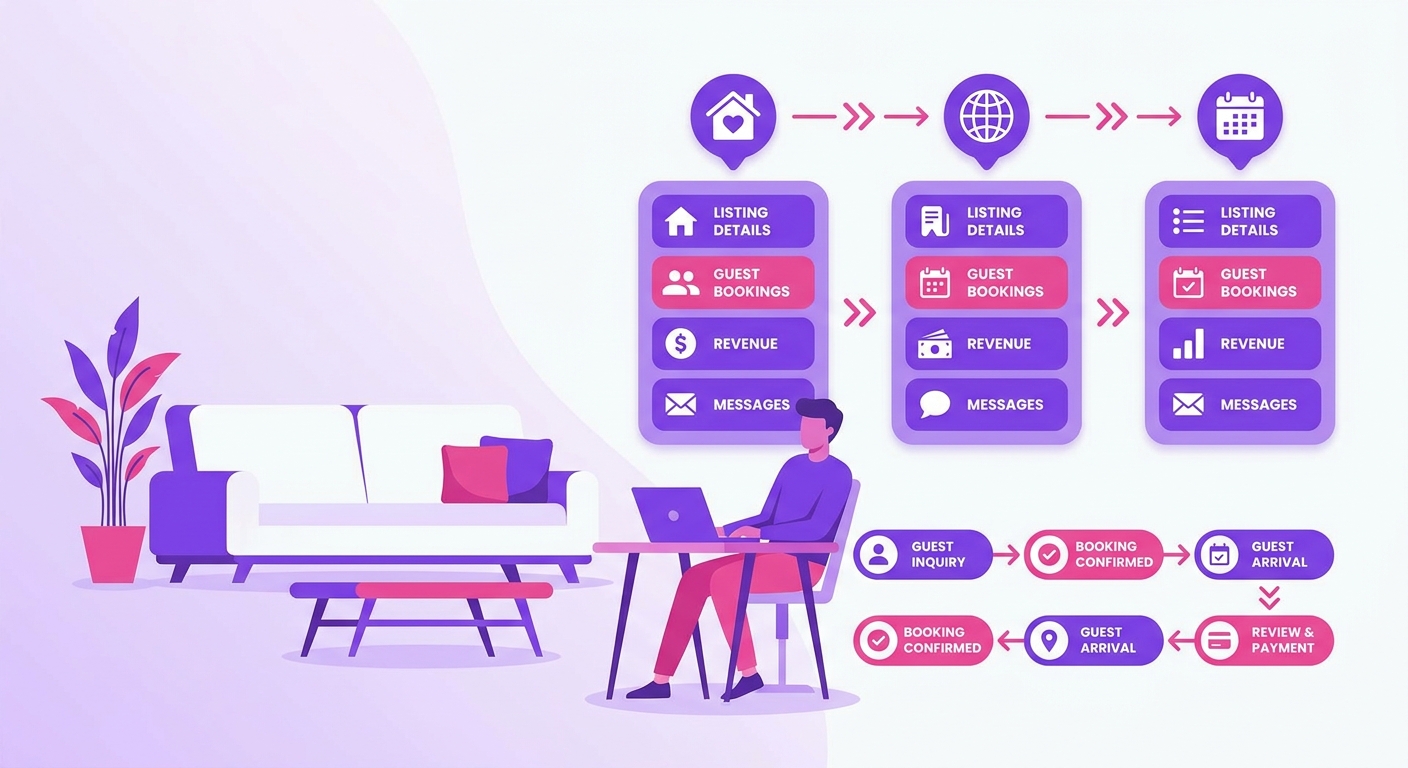
Start with room revenue. At a $150 ADR and 70% occupancy, a 30-night month produces $3,150 in room revenue (30 × 0.70 × $150).
Add a $75 cleaning fee pass-through per stay, at roughly 6 to 7 stays per month, that's another $450 to $525 that flows through but offsets your cleaner invoice directly.
Now subtract your fixed and variable costs:
Rent or mortgage: $1,400–$1,800 (market-dependent)
Platform fee (Airbnb's 3%): ~$95
Utilities + internet: $150–$200
Supplies + consumables: $50–$80
Maintenance reserve (5% of revenue): ~$158
Software + insurance: $80–$120
Total costs land between $1,933 and $2,453. Net operating cash flow at 70% occupancy: roughly $700 to $1,200 per month. Drop occupancy to 55% (a real low-season number in many markets) and room revenue falls to $2,475, and that $700 cushion disappears fast.
The Break-even Occupancy Test Most New Hosts Skip
Divide your total fixed monthly costs by your net revenue per booked night. At $150 ADR minus the 3% platform fee, you net about $145.50 per night. If fixed costs are $2,000, your break-even occupancy is 46% (2,000 ÷ 145.
Market and Compliance Checks That Decide Whether the Deal Works
Before you list a single night, you need to clear four separate permission layers: municipal STR licensing, zoning classification, building or HOA rules, and landlord consent if you don't own the property outright.
But they're not a substitute for your own due diligence. They won't save you. If you get a takedown order from the city's short-term rental enforcement office, maybe because a guest threw an unauthorized party that violated noise ordinances, your listing disappears instantly.
It doesn't matter one bit if that guest was verified.
Permission Stack: City, Building, Landlord, Insurer
One blocked layer kills the model. Common failure points:
HOA CC&Rs that ban rentals under 30 days, often buried in documents you weren't given at closing
Zoning that permits residential use but excludes transient occupancy, which is a different classification in most municipal codes
Landlord leases with a no-subletting clause that voids your tenancy if you host without written approval
Insurer exclusions that leave you unprotected the moment a paying guest enters the property
Pull all four before you run any numbers on projected revenue.
Demand Checks: Comp Set, Seasonality, and Stay Pattern
If the permission stack clears, run a structured demand check. A market with 78% average annual occupancy can still have a four-month shoulder season where rates drop 40%.
Comp-set ADR and occupancy by month, not annual averages
Weekend vs. weekday demand split, a business-travel market books Monday–Thursday; a leisure market books Friday–Sunday
Minimum-night norms and cleaning fee expectations for your unit type, because a studio competing against three-bedroom beach houses is a different market entirely
Set up the Property to Earn, Not Just to Look Good
Hosts who treat setup as a design exercise leave money on the table. The properties that consistently hit 70%+ occupancy aren't the prettiest; they're the most operationally ready. Before you go live, run an operator's checklist, not a decorator's one.
Sleep count accuracy matters more than most new hosts expect. Listing a property as sleeping 6 when the sixth "bed" is a pull-out sofa with a worn mattress generates 1-star reviews that take months to bury. Count only comfortable, dedicated sleeping surfaces, and photograph each one.
Professional photography lifts booking conversion by roughly 20-40% compared to phone photos, but only if the amenities in the photos actually exist on arrival. Mismatched expectations are the fastest path to a bad review.
Amenities That Move Conversion and Review Score
Five amenities consistently show up in guest reviews and search filters: fast Wi-Fi (100 Mbps minimum, tested and displayed in your listing), self-check-in via a smart lock, blackout curtains in every bedroom, a quality mattress, and clear parking instructions.
Climate control, meaning actual thermostat access, not a window unit with no remote, rounds out the shortlist.
Kitchen basics mean a coffee maker, a full set of cookware, and labeled spice storage. Not a gourmet setup. Guests flag missing essentials in reviews far more often than they praise upgraded ones.
Post your Wi-Fi speed in the listing description, not just the password at the property
Install a lockbox or keypad; properties with self-check-in get 15-20% more bookings in most markets
Parking: one sentence in the listing, one laminated card at the door
Turnover Design: Cleaning Speed Matters More Than Trendy Decor
A cleaner who needs 90 minutes instead of 60 costs you money on every single turnover. Design for speed from day one.
That means duplicate linen sets (minimum two full sets per bed), labeled supply storage, so cleaners
Launch the Listing With Pricing and Channel Rules That Protect Margin
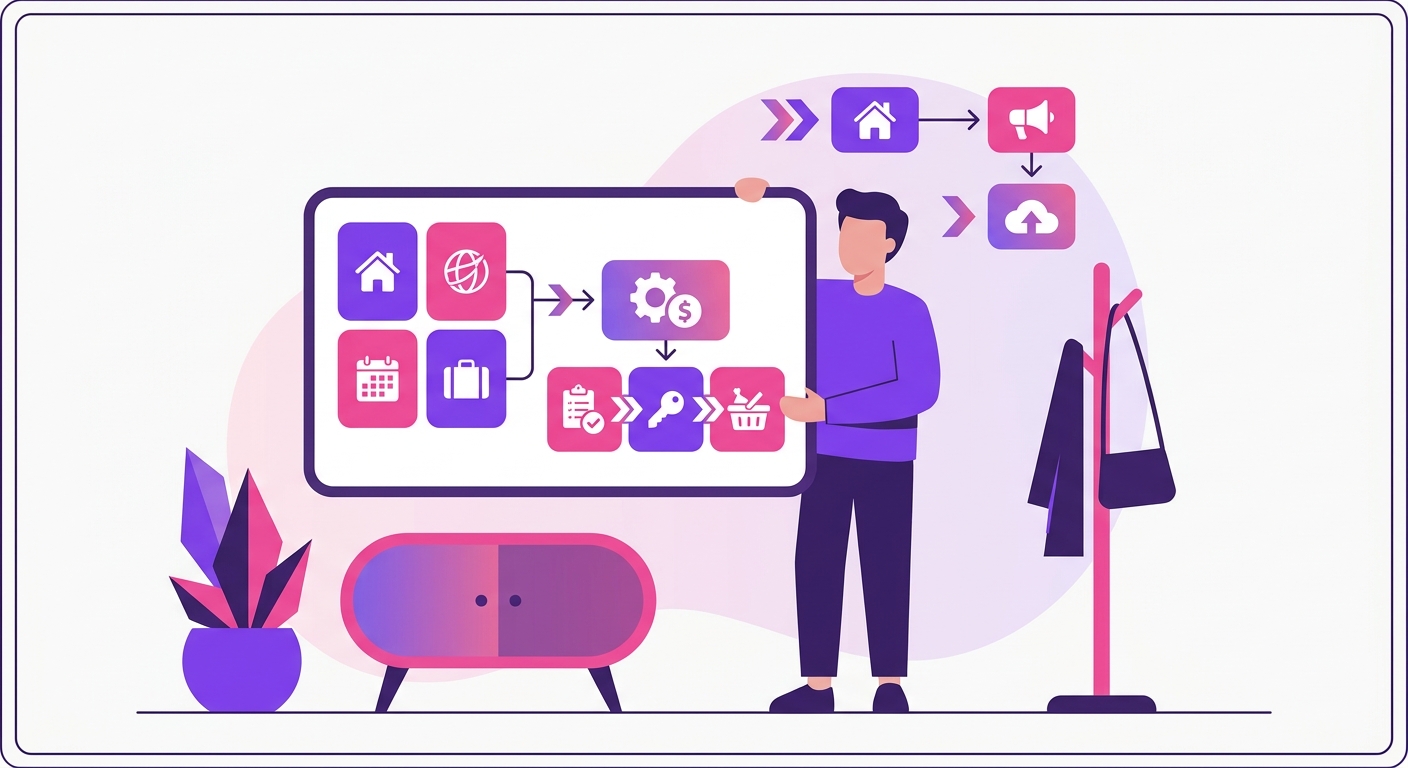
Your first three reviews matter more than your first three bookings. New listings get an algorithmic boost from Airbnb for roughly 14 to 30 days; use that window deliberately.
A 10-15% discount off your target rate drives early bookings. Dropping below variable costs trains guests to expect low rates and poisons your pricing floor permanently.
Photo order is a ranking signal on Airbnb. Lead with the bedroom or the most aspirational space, not the front door. Your title should front-load the specific appeal: "Private Pool Cottage – 5 Min to Downtown" beats "Cozy Home Near Everything."
Opening Price Strategy Without Training Guests to Expect Discounts
Set a minimum night stay of two to three nights at launch to reduce high-turnover risk while your cleaning systems are tested. Enable gap-night settings to auto-fill orphan one-night gaps after the first review period.
Use a flexible cancellation policy for the first 30 days to lower booking friction, then tighten it once you have social proof.
Rules, Deposits, and Verification Settings That Reduce Bad Stays
Require ID verification on every platform that offers it. Set occupancy limits equal to your listed guest count; vague language doesn't hold in a dispute.
Quiet hours: specify a start and end time, not just "please be respectful."
Age minimums: enforceable at 21+ for the primary guest; check your local fair housing rules before setting
Damage deposits: Airbnb uses AirCover. Account for that gap in your house rules
House rules only work if you enforce them. If you won't remove guests for a noise violation, don't list it as grounds for removal.
Ownership, Arbitrage, and Co-hosting Are Different Businesses
Here's how the three models stack up operationally:
Owner-host: highest capital entry (down payment plus furnishing), full control over the asset, long-term appreciation upside, and no landlord risk
Rental arbitrage: lower upfront cost (typically $5,000–$15,000 for security deposit and furnishings), but you're exposed to lease termination and landlord permission requirements
Co-hosting: near-zero capital, fastest to launch, but you earn 10–25% of revenue rather than keeping it all
Don't get confused by the big names. Airbnb, Vrbo, and Booking.com aren't different business models; they're just distribution channels where you can list your property.
In fact, you can (and should) list your property on all of them at once using a channel manager like Guesty to sync calendars and avoid double bookings. They're just storefronts.
The Fastest Path Depends on Cash, Credit, and Local Rules
Financing shapes your options immediately. Conventional mortgages for STR properties typically require 15–25% down, and lenders increasingly scrutinize projected rental income.
Arbitrage operators need landlord sign-off in writing; verbal agreements fail at the worst moment. HOA rules can eliminate short-term rentals, regardless of what the city allows.
City STR regulations vary too much to cover here in detail; check your municipality's permit requirements before committing to any model.
The best way to start an Airbnb business in a regulated market is to confirm permit availability before signing anything, not after
Mistakes That Kill Cash Flow in the First 90 Days
Most new hosts track gross revenue and feel good about it. That's the first mistake. A listing pulling $4,200/month with $1,800 in mortgage, $600 in cleaning, $300 in supplies, and $420 in platform fees nets roughly $1,080, a margin that evaporates the moment a guest damages something.
The five errors that consistently sink new operators in the first quarter:
Using gross revenue instead of contribution margin to judge performance
Setting flat pricing without accounting for seasonality
Overfurnishing when a leaner setup would perform equally well
Accepting bad-fit bookings to fill gaps, dropping from a 4.9 to a 4.7 score, reduces booking conversion by 10–15%
No cleaner backup plan, Airbnb charges hosts up to $100 per host-cancelled reservation, plus a permanent listing mark
Start With the Model That Fits Where You Are Right Now
Most hosts who struggle in year one didn't choose the wrong market or the wrong property. They chose the wrong entry model for their actual capital position, then skipped the underwriting that would have told them so before they signed anything.
The path matters less than the fit. Buying a property builds equity but requires capital you may not have. Arbitrage moves faster but leaves no margin for a slow month. Co-hosting costs almost nothing to start and teaches you the operational side before any of your own money is at risk.
None of those is universally better; the right one is the one that matches your cash, your risk tolerance, and how much time you can realistically put in.
What stays constant across all three: the numbers have to work before you commit, the compliance stack has to clear before you list, and the operating system has to be in place before the second guest checks in.
Hosts who get those three right in sequence rarely struggle in the first 90 days. Hosts who reverse the order almost always do.
Mr. Props equips you with all the tools you need to run every step of that sequence, without rebuilding the process from scratch every time. Get started today!