
How to Value an Airbnb Property Using NOI, Cap Rates, and Real STR Data

Contents
Table of Contents
Most sellers quote gross revenue screenshots. That number is close to meaningless for valuation purposes.
Knowing how to value an Airbnb property correctly means working from net operating income (NOI) market-specific cap rates, and comparable STR sales, not top-line bookings.
If you've ever asked "what's my place worth as a short-term rental," the answer starts with NOI, not gross revenue.
This guide walks through the exact inputs, formulas, and benchmarks that determine a defensible STR property value in 2026.
What Sets Airbnb Value Apart From Long-term Rental Value
A standard 2-bed unit in a market like Scottsdale might rent long-term for $2,200/month, giving you a respectable $26,400 in annual gross revenue.
But that same unit, run as a short-term rental at 68% occupancy with a $185 Average Daily Rate (ADR), suddenly produces $45,900 gross. It's a huge difference.
Apply a conventional cap rate to that long-term figure and you completely miss the upside; apply it to the STR gross and you'll wildly overpay for a business that's one city council vote away from getting shut down.
STR valuation rests on four variables: stabilized net operating income, channel mix, permit status, and operational complexity. None appear in a standard residential appraisal.
Why Gross Annual Revenue is the Wrong Starting Point
Two properties both reporting $120,000 gross can show a $28,800 gap in actual income depending on expense ratio. NOI drives value, not topline revenue.
Owner-managed properties with no documented SOPs carry an implicit discount, buyers can't underwrite a business that breaks on handoff.
How Buyers Adjust for Permit, Platform, and Operator Risk
Licensing exposure: An unpermitted STR in a restricted municipality loses 100% of its revenue overnight, so buyers apply discount rates sometimes 2-3 cap rate points higher to properties without a transferable license.
Platform and operator risk: A listing generating 90% of bookings through Airbnb alone is a single-point-of-failure, and diversified channel mix with documented operations signals stable, acquirable income.
The Numbers You Need Before You Estimate What Your Place is Worth
When someone asks "airbnb what's my place worth," the answer starts with twelve months of actual operating data, not last month's payout, not a single peak-season number. Pull these metrics before running any valuation method.
Metric | Source | Adjustment |
|---|---|---|
Trailing 12-month booked revenue | Platform earnings dashboard | Subtract owner-use nights |
Average Daily Rate (ADR) | Platform or channel manager | Exclude outlier single-night spikes |
Occupancy rate | Platform stats or PMS report | Annualize if listing is under 12 months old |
RevPAN | PMS or manual calc | See full RevPAN breakdown in the linked guide |
Cleaning income minus cleaning costs | Booking records vs. cleaner invoices | Net only, cleaning fees rarely profit |
Platform fees | Host fee line on payouts | Typically 3% host-side on Airbnb |
Utilities, consumables, maintenance | Bank statements | Annualize monthly averages |
How to Calculate Net Operating Income for an Airbnb
NOI is the number that actually tells you what a property is worth as an income asset. Get it wrong and every valuation method downstream cap rate, GRM, cash-on-cash, gives you a bad answer.
NOI Formula for Single-unit Strs
Gross Booked Revenue + Net Ancillary Income − Operating Expenses = NOIDebt service, depreciation, and one-time remodels stay out. NOI measures the property's earning power, not your financing structure.
Worked Example With Adr, Occupancy, and True Operating Costs

A one-bedroom at $185 ADR with 68% occupancy over 365 nights produces roughly $45,922 in gross booked revenue (before cleaning pass-through). Add $1,200 in net ancillary income (late checkout fees, gear rentals) for a $47,122 gross figure.
Operating Expense | Annual Cost |
|---|---|
Cleaning (net of guest fee) | $4,800 |
Supplies & consumables | $900 |
Utilities | $2,400 |
STR taxes & licensing | $1,800 |
Insurance | $1,500 |
Repairs & maintenance | $1,200 |
Software & channel fees | $600 |
Management labor | $4,600 |
Total Operating Expenses | $17,800 |
NOI: $47,122 − $17,800 = $29,322.
How to Choose the Right Valuation Method
Three methods exist for valuing a short-term rental. Which one you lead with depends on the asset's operating status, local market depth, and how recently it was renovated.
Income Approach for Stabilized Short-term Rentals
For an active, permitted STR with 12+ months of booking data, the income approach is the most reliable starting point: divide annual net operating income by a market cap rate to get implied value.
Valuation all comes down to Net Operating Income (NOI). Let's say your property generates $48,000 in gross revenue; you'll then subtract operating expenses, often around 35% for management, cleaning, and utilities, to arrive at your NOI. Don't overthink it.
At a 6% cap rate, a $30,000 NOI implies a solid $500,000 valuation. Some buyers prefer to frame this as an earnings multiple, which for well-located STRs in 2026 is trending between 14x to 18x annual NOI.
Sales Comps and Replacement Cost as Reality Checks
Sales comps work as a secondary check only when comparable properties actually operated as STRs.
Owner-occupied sales and long-term rental conversions don't reflect STR-specific layout premiums, a property with two en-suite bedrooms and a separate guest entrance commands 20–30% more per night than a standard 2-bed.
For mixed-use or partially permitted assets, comps show what the market pays if STR income disappears, that's the floor, not the ceiling.
Replacement cost matters most in thin markets with few recent sales. If a gut-renovated property in a low-transaction rural market cost $180,000 to acquire and $95,000 to renovate
Cap Rates, Multiples, and the Range Your Airbnb Might Actually Trade at
Individual STR properties and STR businesses don't trade the same way, conflating them is where most sellers leave money on the table.
When to Use a Cap Rate on Property NOI
A single property with stable STR income and a transferable permit trades as real estate. Legal, stabilized assets in strong leisure markets trade at cap rates between 5% and 8%; riskier or seasonally dependent markets push that to 9% or higher.
Regulatory risk moves value more than revenue gains, one permit change outweighs a 10% jump in average daily rate.
When an Earnings Multiple Matters More Than Real Estate Comps
Portfolios with branded operations, direct booking channels, and documented SOPs are selling something beyond bricks, and buyers apply an EBITDA multiple based on revenue concentration and contract durability.
Single asset, transferable permit: cap rate on NOI
Portfolio with brand equity and diversified channels: EBITDA multiple layered on top of real estate value
Management-only business (no owned properties): pure earnings multiple, often 1.5x to 3x
Market Comps That Matter for Airbnb Value
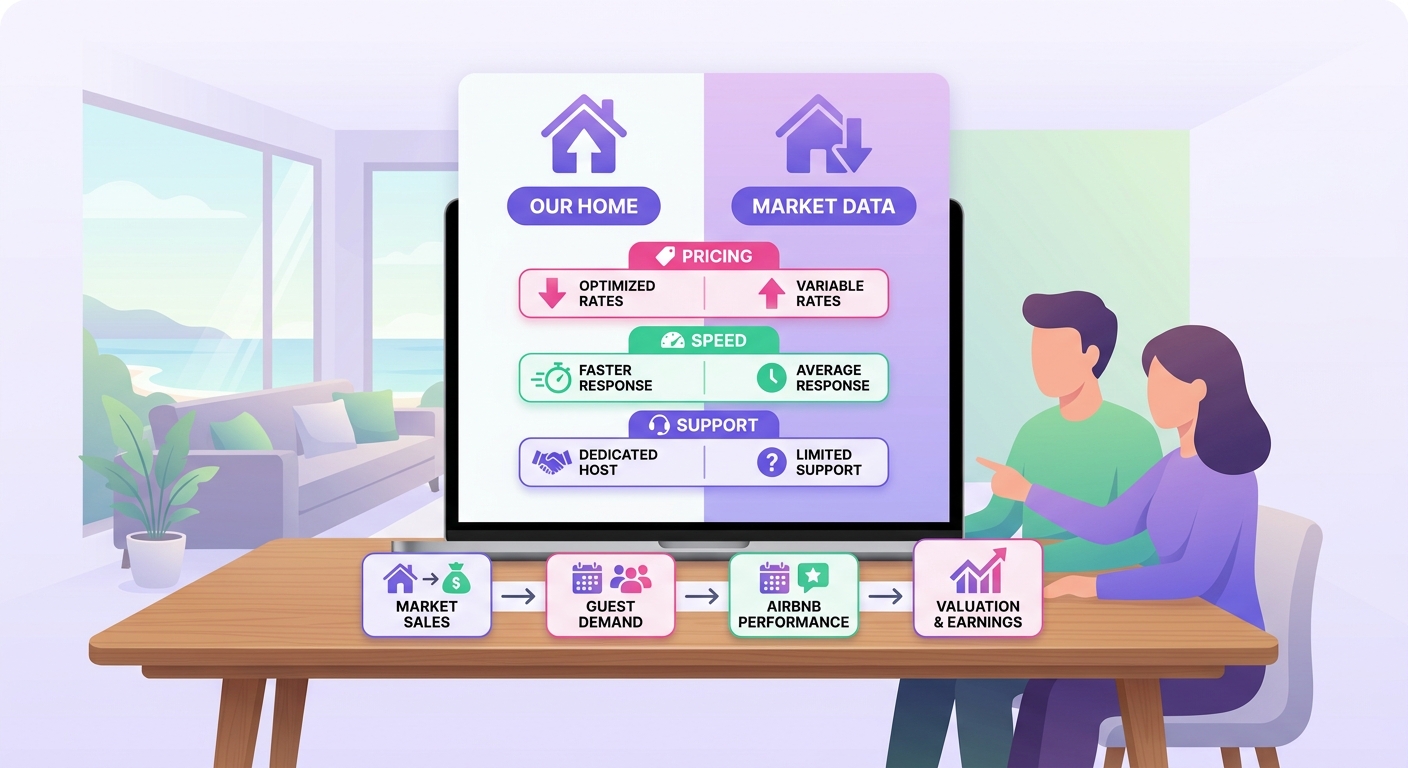
A comp is only useful if it's actually comparable. Most hosts pull five nearby listings based on bedroom count alone, that's a shortlist, not a comp set.
Apply these filters before you look at a single revenue number: same bedroom count, matching guest capacity within two guests, similar parking access, and equivalent amenity tier.
A 3-bedroom with a private pool isn't a comp for a 3-bedroom without one, ADRs can diverge by 35% or more in the same zip code.
Permit status matters here too. A listing without a valid short-term rental permit faces shutdown risk a compliant property doesn't. Don't benchmark against it.
Also distinguish listing comps from sale comps. Listing comps tell you what a property earns as an STR; sale comps tell you what buyers paid for similar real estate. You need both, but they answer different questions.
Airbnb Comp Set Checklist
Pull 5 to 10 listings. A single outlier skews a small set badly.
Same bedroom count and guest capacity (±2 guests maximum)
Within 1 mile in urban markets; within 5 miles in rural or resort markets
Matching amenity tier: pool, hot tub, parking, pet-friendly status
Active permit or equivalent legal status in regulated markets
Consistent seasonality: comps in ski towns don't transfer to beach markets
AirDNA and similar platforms give you a useful starting point for market-level ADR and occupancy benchmarks. Treat that data as a directional signal.
The Operational Factors That Increase or Cut Value Fast
A property generating $85,000 gross annually can still sell at a discount if the buyer can't run it without the current owner.
That's the trap most hosts miss when they ask how to value an airbnb property: gross revenue is visible, but operational transferability is what actually moves the multiple.
Transferable Systems Buyers Will Pay for
Buyers price in the cost of rebuilding what you don't document. The assets that hold value are:
Documented SOPs covering check-in, turnover, and maintenance escalation
Cleaner scorecards with reliability history and backup contacts
Automated messaging sequences and pricing rules already live in the PMS
Channel sync across Airbnb, Vrbo, and any direct booking site
Owner statements showing net income separate from gross
Red Flags That Lower Value Even When Occupancy Looks Good
High occupancy hides problems until due diligence. Watch for these discounts:
Review score trending down over 6 months, even if the current average is 4.7+
Single-channel dependence (90%+ revenue from one platform)
Permit uncertainty or pending local STR regulation changes
Deferred maintenance logged but unresolved
Zero repeat guests and no direct booking share
Owner-only knowledge is the quietest value killer. If the cleaner only texts the owner, if the gate code lives in someone's phone, if pricing adjustments require manual intervention every week, that's not a business, it's a job. Buyers discount accordingly.
A Simple Airbnb Valuation Example You Can Rebuild in a Spreadsheet
Start with a concrete NOI figure. Say your property generates $78,000 in gross revenue, with $46,000 in operating expenses (cleaning, management, utilities, insurance, supplies). That leaves an NOI of $32,000.
Run that number through three cap rate assumptions and the value range becomes clear immediately:
Scenario | Cap Rate | NOI | Implied Value |
|---|---|---|---|
Low | 7.5% | $32,000 | ~$427,000 |
Base | 6.5% | $32,000 | ~$492,000 |
High | 5.5% | $32,000 | ~$582,000 |
That's a $155,000 swing from a single percentage point of cap rate movement.
Small ADR or occupancy changes compound this further: dropping average daily rate by $15 across 200 booked nights cuts NOI by $3,000, which at a 6.5% cap reduces value by roughly $46,000.
What to Do Next If You Want a Higher Airbnb Valuation
Buyers and appraisers discount properties with messy financials faster than almost any other factor. Start here before anything else.
Clean up your books: separate pass-through fees (cleaning, pet fees, damage waivers) from rental revenue so your net operating income reads accurately.
Document your SOPs: written turnover checklists, guest communication templates, and maintenance schedules make your operation transferable, which raises what a buyer will pay.
Diversify your booking channels: a listing that pulls 30%+ of reservations from direct bookings or Vrbo carries less platform-dependency risk than one that's 100% Airbnb.
Fix deferred maintenance now: a $600 repair today won't cost you $6,000 in buyer credits at closing.
Stabilize your review score: properties below 4.7 stars sell at a measurable discount relative to their revenue.
Normalize owner labor: log your hours and price them at fair market rate so net income reflects what a third-party manager would cost.
Every one of these steps depends on having clean, consistent data. Spreadsheets make that hard.