
How Much Profit Does Airbnb Take? Host and Owner Fees Explained for 2026
Contents
Table of Contents
Airbnb host fees land at 3% under split-fee pricing and climb to roughly 14%–16% under host-only pricing.
Those two numbers answer the question of what percentage of earnings Airbnb keeps from a host, but the full cost picture is harder to pin down once cleaning fees, currency conversion, and payout timing enter the equation.
This guide breaks down exactly what Airbnb charges owners per booking, how those figures compare to Vrbo and Booking.com, and where operators typically lose money without realizing it.
What You Actually Pay Airbnb
Airbnb doesn't take a cut of your accounting profit. It charges platform fees on gross booking revenue the total a guest pays before any deduction.
That distinction matters because your payout report shows a net figure, and hosts routinely misread it as proof of a lower fee rate than they're actually paying.
Airbnb's fee structure isn't one-size-fits-all; it splits into two main paths that have been the standard since 2020. If you're an owner-operator managing your listing directly, you're almost certainly on the split-fee structure.
But hosts using a property management system or channel manager get funneled into host-only pricing. The numbers are wildly different.
Fee Model | Typical Host Fee | Guest Fee Visibility | Payout Impact on $200/night |
|---|---|---|---|
Split-fee | ~3% | Guest pays separate 14%–16% service fee | Host receives ~$194 |
Host-only | 14%–16% | No separate guest fee shown | Host receives ~$170–$172 |
Split-Fee Pricing: the Standard 3% Host Fee Most Small Hosts See
With the split-fee model, Airbnb charges you a host fee of just 3%. But here's the catch: they're also billing your guest a separate service fee, typically a steep 14.2% of the booking subtotal.
That guest fee is completely invisible on your payout report, which is exactly where so many hosts get confused about Airbnb's total take. All you see is that 3% deduction, making the platform's cut seem way smaller than it really is.
So, is that host fee always a flat 3%? Opting for a Strict cancellation policy can sometimes bump your fee up to 5%, a little surprise we've seen for hosts in Italy. Non-refundable rate plans can also cause some weird variations.
Host-Only Pricing: the 14%–16% Model Many Channel-managed Listings Use
Host-only pricing flips the script by shifting the entire platform fee, usually a flat 15%, directly onto the host.
It's not optional. If you're connecting your listings via a certified property management system or channel manager, Airbnb mandates this model.
This means that hospitality-style operators running 10-plus units through tools like Hostaway, Guesty, or Lodgify almost always fall into this bucket. You don't get to choose.
How Much Airbnb Charge From Host by Fee Type
Airbnb's host service fee sits at 3% for most standard listings, but that number is only one piece of what actually leaves your payout. Several other deductions compound on top of it, and hosts regularly misclassify them in their reporting.
Host Service Fee Versus Taxes, Pass-through Charges, and Cleaning
Your payout statement will show occupancy taxes collected and remitted by Airbnb as a separate line. That money is not Airbnb's revenue. It passes directly to the relevant tax authority.
Counting it as part of what Airbnb takes inflates your perceived platform cost and distorts your net income calculations.
Cleaning fees and pet fees you set yourself are also not Airbnb charges. They flow to you, minus the 3% host fee applied to the total booking value (which includes those fees).
That's the part hosts most often get wrong: Airbnb applies its service fee to the full booking subtotal, not just the nightly rate.
Operational warning: Airbnb's payout statement groups some of these deductions under a single "adjustments" line. If you reconcile at the booking level rather than the line-item level, you'll consistently understate what the platform actually deducted.
Currency Conversion and Payout Deductions Hosts Forget to Count
Here's a sneaky cost that almost no one talks about: the currency conversion spread.
If your listing currency (say, USD for your Miami condo) doesn't match your payout currency (maybe you live in Europe and use EUR), Airbnb applies a spread of around 3%.
On a single $2,000 booking, that's an extra $60 that vanishes into thin air before the money ever reaches your bank account.
Payout method also matters:
International wire transfers carry a flat fee of roughly $20-$30 per payout in many markets.
PayPal payouts can trigger an additional 2% conversion fee on the receiving end.
Fast Pay (where available) adds a $1.99 per-transfer charge.
Real Payout Math on a Typical Airbnb Booking
The number Airbnb reports as its "fee" looks small until you run the actual arithmetic. Here's where the math gets slippery: the 3% host fee is calculated against nightly rent, not your total payout, and those two figures are meaningfully different.
Example: 3% Split-fee Booking on a $150 ADR Stay
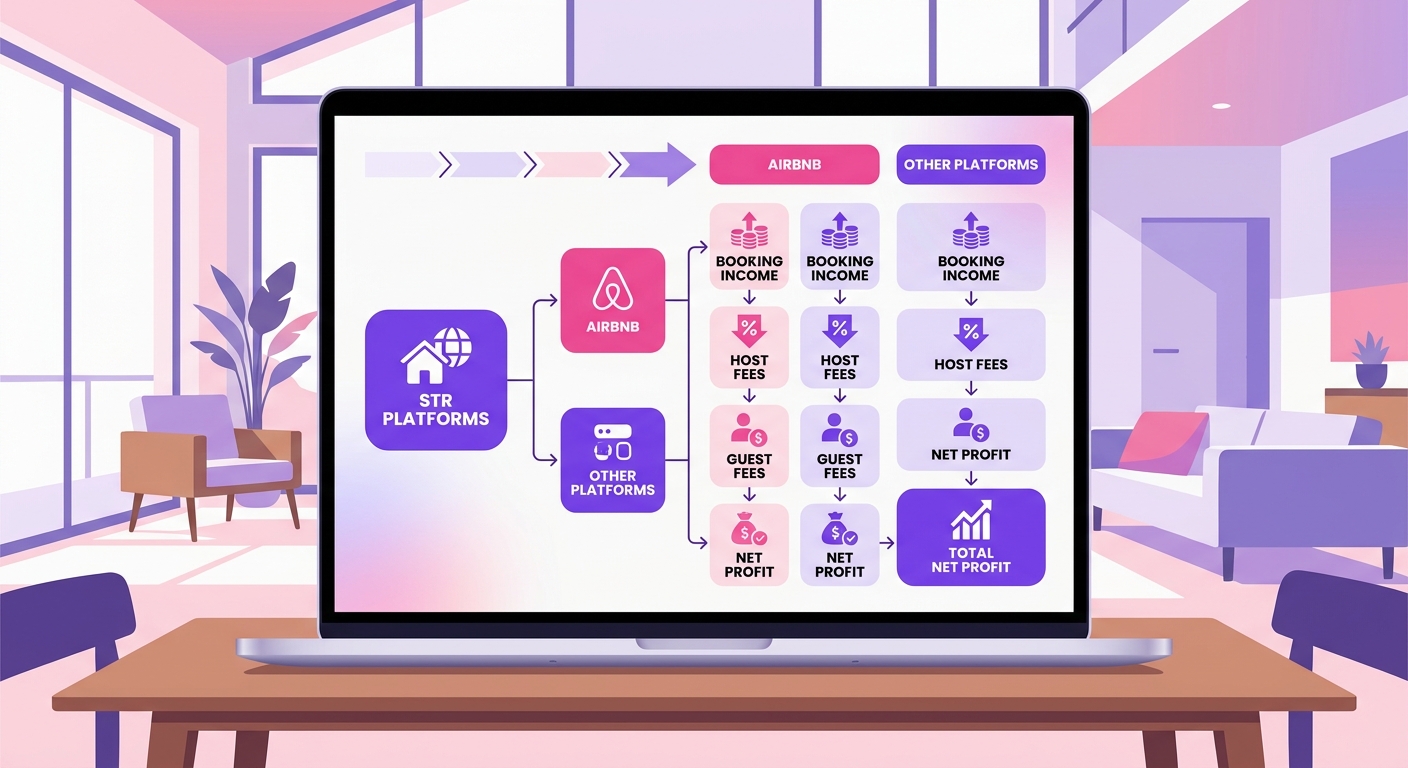
Three nights at $150 ADR plus a $45 cleaning fee. The booking subtotal (rent only) is $450. Airbnb's 3% host fee applies to that $450, producing a $13.50 deduction. Your cleaning fee passes through at full value.
Line Item | Amount |
|---|---|
Nightly rent (3 × $150) | $450.00 |
Cleaning fee | $45.00 |
Airbnb host fee (3%) | −$13.50 |
Host payout (taxes excluded) | $481.50 |
That $13.50 is 3% of rent but only 2.8% of your $481.50 payout, a small gap here, but it compounds across a portfolio running 75% occupancy (~23 booked nights/month).
Example: 15% Host-only Booking on the Same Reservation
Same stay, same rates, but you've switched to host-only pricing. Airbnb now charges guests no separate service fee, so your list price must absorb the full 15% deduction.
Line Item | Amount |
|---|---|
Nightly rent (3 × $150) | $450.00 |
Cleaning fee | $45.00 |
Airbnb host fee (15%) | − |
How Airbnb Fees Compare With Vrbo and Booking.com
Airbnb's fees aren't unusually high, they're just unusually visible. Once you account for what Vrbo and Booking.com actually charge, the gap narrows fast.
Platform | Host Fee Range | Guest Fee | Cash Flow Impact |
|---|---|---|---|
Airbnb (split-fee) | ~3% | ~14–16% | Low; guest absorbs most cost |
Airbnb (host-only) | ~14–16% | None displayed | High; full margin hit on host |
Vrbo (pay-per-booking) | ~8% + 3% payment fee | ~6–12% | Moderate; predictable per booking |
Vrbo (annual subscription) | ~$499/yr + 3% payment fee | ~6–12% | Low at high volume; risky at low |
Booking.com | ~15–18% commission | None | High; payment handling adds ~2–3% |
Vrbo Fee Models for Owner-operators
Vrbo gives you a real choice: pay roughly 8% per booking plus a 3% payment processing fee, or pay a flat $499 annual subscription and only the payment fee per transaction.
The subscription model wins if you're clearing 30+ bookings a year. Below that threshold, pay-per-booking keeps fixed costs down. Neither model charges guests a separate service fee the way
Where Hosts Get Tripped up on True Margin
Airbnb's host fee gets most of the attention, but it's rarely where the real money disappears. A 3% service fee on a $200 night costs you $6. Leaving $20 on the table every Friday and Saturday night costs you $2,080 a year on a single property.
The fee is visible on your payout statement; the pricing miss never shows up anywhere.
Platform Fees Are Visible; Operating Leakage is Not
Run the numbers on a concrete example. A host charges $150 per night, pays a 3% fee ($4.50), and nets $145.50. A host who prices the same weekend at $170 and pays the same fee nets $164.90. The $20 pricing gap outweighs the platform fee by more than 4x.
The four leaks that quietly compress contribution margin:
Underpriced peak nights weekend and event rates set once and never revisited
Cleaning labor creep turnover costs that rise 10-15% annually while nightly rates stay flat
Damage reserves most operators budget nothing, then absorb repair costs as one-off losses
Discount stacking weekly, early-bird, and new-listing discounts running simultaneously and cutting 20%+ off gross revenue
The right metric to track all of this is RevPAN. which captures both occupancy and rate efficiency in a single number rather than isolating the platform's cut.
Local regulation costs, permits, occupancy tax registration, compliance audits, also compress net margin in ways that dwarf the platform fee in high-regulation markets.
How to Protect Profit Without Chasing Fee Myths
The fastest way to lose margin isn't paying 3% to Airbnb, it's setting list prices without accounting for which fee model applies to that channel. Fix the pricing logic first, then audit the numbers monthly.
Rate Setting When Airbnb Takes 3% Versus 15%
Under the host-only fee model (roughly 14–16% deducted from your payout), your list price is what guests see. Under the split model, guests pay a separate service fee on top. That difference changes how you compete on price.
Host-only: set list price 12–15% higher than your target net rate, then confirm the math against your payout report before publishing
Split model: your list price is closer to your net target, guests absorb their own fee separately
Never pad cleaning fees to recover host fees; Airbnb's search algorithm penalizes high-fee listings, and guests increasingly filter by total price
If you manage 10+ listings across Airbnb and Vrbo simultaneously, confirm whether your channel manager forces host-only pricing on Airbnb. Some tools do. That changes your base rate logic for every unit.
Monthly Payout Audits for Owners and Co-hosts

Owner disputes almost always trace back to one missing step: no one separated platform fees from taxes and pass-throughs on the statement. Reconcile these four fields every month:
Gross booking value the amount the guest paid before any deductions
Platform fee what Airbnb withheld (host fee percentage applied to accommodation subtotal)
Occupancy taxes remitted by Airbnb in most U.S. jurisdictions, but verify against your local rate
Net payout what actually hit your bank account
Pull the CSV transaction report from Airbnb monthly, not quarterly. A misclassified pass-through tax looks identical to a fee overcharge until you check the line
Airbnb Fee Questions Hosts Still Ask
Does Airbnb Charge Hosts a Flat Fee or a Percentage?
Airbnb charges hosts a percentage of the booking subtotal, not a flat fee. The standard host-only split takes 3% to 5% of the booking amount before taxes, with the exact rate depending on cancellation policy and listing category.
Are Cleaning Fees Subject to Airbnb's Service Charge?
Yes. Cleaning fees are included in the booking subtotal, so Airbnb's host fee applies to them too. A $150 cleaning fee on a $600 stay isn't exempt, it's part of the total amount Airbnb calculates its cut from.
Does Airbnb Take a Cut From Security Deposit Claims?
No. Security deposits resolved through Airbnb's AirCover process are handled separately from booking revenue, and Airbnb doesn't deduct service fee from damage reimbursements.
How Does the Split-fee Model Affect What Guests Pay Compared to What Hosts Receive?
Under the split model, guests pay a separate guest service fee of roughly 14% on top of your nightly rate, while you absorb a smaller 3% host fee. Your payout looks higher, but your listed price appears lower to guests searching across platforms.
Do Airbnb's Fees Change When You List on Multiple Channels Simultaneously?
Airbnb's fee structure applies only to bookings made through Airbnb, regardless of what you charge on Vrbo or Booking.com. Each channel deducts its own percentage, so your effective margin per booking varies by platform even at identical nightly rates.