
There's a Cleaner Way to Run Your STR Portfolio
Hostaway works, until your portfolio grows past a handful of units and the per-listing fees start compressing your margins. Hosts managing 5 or more properties on Airbnb, Vrbo, and Booking.com are paying for features they don't use while missing the ones they actually need: real-time calendar sync across all channels, automated guest messaging that doesn't require a template degree, and pricing rules that don't need a consultant to configure.
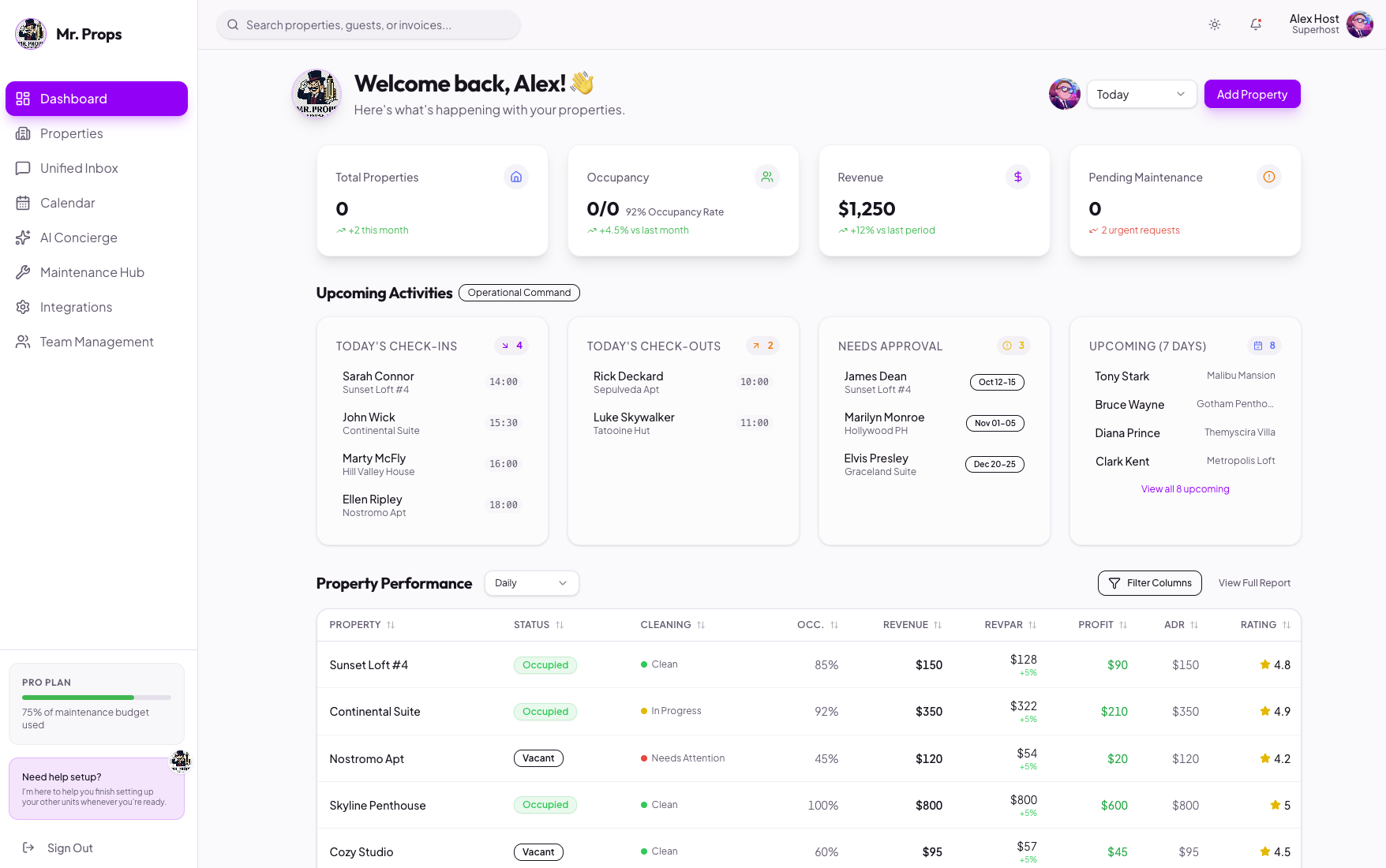
Mr. Props is built for operators, not enterprise sales teams. No bloated onboarding. No locked contracts. Just a property management operating system that handles channel management, guest comms, and revenue tracking from one dashboard.
No credit card required · Join 2,400+ hosts already managing smarter
Mr. Props vs Hostaway: at a Glance
Hostaway built its product for agencies managing 50+ units. If you're running a tighter portfolio on Airbnb, Vrbo, or Booking.com, that architecture shows, in the setup time, the reporting lag, and the number of clicks it takes to action anything.
The workflow map tells the whole story. Hostaway’s design forces you to jump between at least three different screens just to manage one reservation. You've got calendar sync revenue data, and guest communication all living in separate, siloed modules. Mr. Props, on the other hand, pulls all that critical info into a single operator view. It's simple, really. One is a maze; the other is a dashboard.
Less operational drag isn't a feature. It's the difference between catching a pricing gap at 9 AM and missing it entirely.
Why Hosts Switch From Hostaway to Mr. Props
Three specific friction points come up again and again when hosts move away from Hostaway. Each one has a direct operational cost, not just an annoyance.
Per-Booking Fees That Compound at Scale
The problem: Hostaway charges a per-booking fee on top of its monthly subscription. At 20+ properties with high turnover, that fee structure adds up to hundreds of dollars monthly in costs that have nothing to do with your actual revenue growth.
Props: Flat monthly pricing regardless of booking volume. You're not penalized for running a high-occupancy portfolio.
Automation Gaps in Guest Messaging
The problem: Hostaway's message automation requires manual trigger setup for each property and doesn't adapt to booking-window length. A last-minute Airbnb booking gets the same check-in sequence as a 30-day advance reservation, which means guests get irrelevant messages at the wrong time.
Props: Messaging rules adjust automatically based on lead time, channel, and stay length. No per-property reconfiguration required when you add a new listing.
Reporting That Stops at the Surface
The problem: Hostaway's built-in reports show occupancy and revenue totals, but they don't break down performance by channel, listing type, or cleaning cost per stay. Property managers running mixed portfolios (urban apartments alongside vacation homes) can't identify which segment is dragging down overall margins.
Props: Revenue reporting segments by channel, property type, and cost category, so you can see exactly where your net margin is shrinking before it becomes a bigger problem.
Mr. Props vs Hostaway: Feature-by-feature Comparison
Hostaway is a capable platform. It's been around since 2015, it connects to 100+ channels, and it's genuinely well-suited for property management companies running 50+ units with a dedicated ops team. That's exactly the problem if you're a host managing 5 to 30 properties yourself.
The comparison below isn't about which platform has more features. It's about which features you'll actually use, which ones require a support ticket to configure, and where each platform's pricing model stops making sense as your portfolio grows.
Operator Fit: Who Each Platform is Built for
Hostaway targets professional property management companies. Its onboarding assumes you have staff, a dedicated account manager relationship, and time to work through a setup process that typically takes 2 to 4 weeks. The feature set reflects that: deep CRM tools, multi-user permission layers, and a marketplace of 50+ third-party integrations built for enterprise workflows.
Mr. Props is built for owner-operators and small co-hosting businesses. The core assumption is that you're the one answering guest messages, scheduling cleaners, and checking your occupancy rate at 10pm. Setup takes under 48 hours for most hosts, and the automation defaults are configured for single-operator use, not a team of five.
If you're managing a portfolio under 30 units without dedicated staff, Hostaway's depth becomes friction. You're paying for infrastructure you won't use.
Pricing Logic
Hostaway doesn't publish standard pricing. You go through a sales call, get a quote, and the number depends on your unit count, channel mix, and which add-ons you need. Hosts with 10 to 20 properties typically report monthly costs between $400 and $800 after onboarding fees.
Mr. Props uses per-listing pricing with no setup fees. At 10 properties, the monthly cost runs roughly 40% lower than a comparable Hostaway configuration. That gap widens when you factor in features Hostaway gates behind higher tiers, active pricing integration, automated review requests, and direct booking tools among them.
| Factor | Hostaway | Mr. Props |
|---|---|---|
| Pricing model | Quote-based, per-unit | Per-listing, published rates |
| Setup fee | Yes (varies) | None |
| Onboarding time | 2 to 4 weeks typical | Under 48 hours |
| Target operator size | 50+ units, staffed teams | 1 to 50 units, owner-operators |
Automation Differences
Sure, both platforms automate guest messaging but their approaches are worlds apart. Hostaway gives you a message template library and trigger-based scheduling, which is functional. But you don't get any pre-built content, you have to configure every single rule and write every message from scratch. For a 5-property host, setting up just the basic "check-in instructions" message across all listings can easily become a 3-hour slog. It's a real grind.
Mr. Props flips that script completely. It ships with pre-built, professionally written automation sequences for check-in, checkout, mid-stay check-ins, and those all-important review requests. Your job isn't to build a messaging system. You just activate the sequences you want. Maybe you adjust the checkout reminder to send at 9 AM instead of 10 AM. Most owner-operators are fully live and communicating with guests in a single afternoon.
Where Hostaway genuinely wins on automation: multi-step conditional logic. If you're running a portfolio where different properties have different cleaning vendors, different check-in methods, and different guest segments, Hostaway's rule builder handles that complexity cleanly. Mr. Props doesn't match that level of branching logic, and for operators with 50+ units and custom workflows, that matters.
For the host managing 8 beach condos with a single cleaning crew and standard self-check-in, that complexity is irrelevant. The simpler system ships faster and breaks less often.
- Hostaway: full conditional automation, requires manual configuration per property
- Mr. Props: pre-built sequences, activated in minutes, less flexible on complex branching
Reporting and Revenue Visibility
Hostaway's reporting suite is one of its strongest features. You get occupancy breakdowns by channel, revenue by property, payout reconciliation, and exportable data that works with accounting tools like QuickBooks. If your lender or co-owner wants a monthly P&L, Hostaway can produce something credible without a spreadsheet detour.
Mr. Props focuses on the metrics owner-operators actually check daily: occupancy rate, average nightly rate, revenue per available night, and channel performance side by side. The dashboard loads fast and shows what you need without drilling through sub-menus.
The gap shows in portfolio-level reporting. Hostaway can aggregate across 80 properties and slice by region, property type, or channel. Mr. Props handles up to 50 units cleanly but isn't built for the reporting demands of a property management company with investor reporting obligations.
Where Hostaway Still Has an Edge
Hostaway connects to over 100 channels and third-party tools. If your operation depends on a niche OTA, a specific revenue management platform, or a custom API integration, Hostaway's partner network is broader. Mr. Props covers the major channels, Airbnb, Vrbo, Booking.com, and direct booking, which is sufficient for the majority of STR operators.
Hostaway also has a longer track record with enterprise property management companies. If you're managing properties on behalf of institutional owners who require specific compliance documentation or audit trails, Hostaway's infrastructure was built for that. Mr. Props wasn't, and doesn't pretend to be.
One more honest gap: Hostaway's marketplace of vetted third-party integrations means you can connect best-in-class tools for pricing, insurance, and upsells without building workarounds. That flexibility has real value if your operation has already standardized on specific vendors.
Onboarding and Ongoing Support
Hostaway's onboarding typically runs two to four weeks. You get a dedicated onboarding specialist, structured calls, and a setup checklist. That process exists because the platform genuinely needs that much time to configure correctly for a large operation.
Mr. Props promises you can get your listings live in under 48 hours. The tradeoff is you’re doing more of the setup yourself, as there's no dedicated specialist holding your hand through every screen. For a host who's already running a few listings on Airbnb and gets the basics of channel management this isn't a problem at all. But for someone migrating a 40-unit portfolio with complex iCal integrations, that "faster" onboarding can suddenly feel pretty thin.
Support response times matter at 2 a.m. when a guest is locked out. Mr. Props offers live chat support with a median first-response time under 4 minutes during business hours, and email support outside that window. Hostaway provides 24/7 support across chat and email, which matters more as your portfolio scales past 20 units and guest issues stop being predictable.
Where Hostaway Still Has the Edge
Switching platforms costs time, and it's worth being honest about where Hostaway genuinely outperforms Mr. Props rather than pretending the gap doesn't exist.
Hostaway's marketplace of third-party integrations is deeper. As of 2026, it connects to over 100 external tools, revenue managers, active pricing engines, keyless entry systems, cleaning platforms. If your operation is already built around a specific tech stack, that breadth reduces migration friction considerably.
Reporting is also more granular at the enterprise level. Hostaway's analytics suite lets you slice performance by channel, property type, and booking lead time simultaneously. For a portfolio manager presenting monthly numbers to investors or co-owners, that reporting depth has real dollar value. Mr. Props' reporting covers occupancy rate, revenue per available night, and channel breakdown, but multi-dimensional filtering across all three variables at once isn't yet available.
Multi-Currency and International Operations
Hostaway handles multi-currency payouts and international tax reporting better than most platforms in its category. If you're running properties across two or more countries with different VAT or GST obligations, Hostaway's financial reporting gives you a cleaner audit trail.
Mr. Props currently supports USD, EUR, GBP, CAD, and AUD, covering the majority of single-market operators. Cross-border portfolio management is on the product roadmap for late 2026, but it's not live yet. That's a genuine constraint for anyone running listings in, say, the U.S. and Portugal simultaneously.
The Honest Comparison: Who Should Pick Which
The choice between these two platforms comes down to a single question: how much of your monthly cost are you willing to pay for configuration depth you may never use?
| Factor | Mr. Props | Hostaway |
|---|---|---|
| Best portfolio size | 1–30 properties | 20–200+ properties |
| Pricing model | Flat per-unit fee | Custom quote, scales with volume |
| Onboarding time | Under 48 hours | 2–4 weeks |
| Guest messaging automation | Conditional logic, multi-step flows | Rule-based, extensive template library |
| Third-party integrations | Core STR tools covered | 100+ marketplace integrations |
| 24/7 live support | Business hours live chat | Yes, around the clock |
Hosts running 1 to 15 properties who want fast setup, predictable monthly costs, and guest communication that actually adapts to booking context will find Mr. Props more operationally efficient. The platform doesn't ask you to configure what you don't need.
Hosts running 30-plus units with dedicated ops staff, complex integrations, and investor reporting requirements will likely get more from Hostaway's depth, even at the higher price point. The competing property management platforms conversation is really a question of overhead: do you want software that fits your current operation, or software that won't need replacing if you triple in size?
How to Switch From Hostaway to Mr. Props
Most hosts put off switching tools because they're afraid of losing calendar data, dropping a booking, or breaking a channel connection mid-stay. That fear is understandable, and mostly unfounded when the migration is done in a structured order.
Mr. Props pulls your existing listings, future reservations, and channel connections from Airbnb, Vrbo, and Booking.com before you disconnect anything from your current platform. Nothing goes live until you confirm every listing looks correct. Your reviews stay on the channel, they're tied to your listing URL, not your property management software, so they carry over automatically.
The typical migration takes under two hours for portfolios up to 20 properties. Larger portfolios get a dedicated onboarding call to sequence the channel reconnects without gaps in availability.
- Existing confirmed bookings import with guest details and payout dates intact
- Calendar blocks transfer so no double-bookings occur during the switch
- Channel API credentials move in one step, no manual re-listing required
Switching tools doesn't have to mean a disruption to your revenue. Start your migration and keep every booking you've already earned.
Frequently Asked Questions About Switching
How Long Does It Actually Take to Migrate From Hostaway to Another Platform?
Most hosts complete a full migration in 5 to 10 business days, and it's not the data import that takes time. The bulk of that work is the painstaking process of channel reconnection and calendar sync verification. Platforms like Guesty and Lodgify have dedicated onboarding teams that can sometimes compress this to just 3 days for portfolios under 10 properties. But if you're running 20-plus units across Airbnb, Vrbo, and Booking.com? Don't fool yourself, budget two full weeks and do a staged rollout by property group.
Will Switching Cause Calendar Gaps or Double Bookings?
It can, if you disconnect your old platform before the new one has live iCal or API connections confirmed. The safe sequence: activate the new platform, verify all channel connections, run a 48-hour parallel sync test, then deactivate Hostaway. Never cut over on a Friday before a high-demand weekend. Double bookings from botched migrations are the single most common complaint in STR operator forums.
Do Hostaway Alternatives Cost Less?
Often yes, but the gap depends on your property count. Hostaway's pricing starts around $100 per month for small portfolios, while platforms like Hospitable run closer to $30 to $40 per month for the same unit count. At 10 properties, that's a $700-plus annual difference. At 30 properties, per-unit pricing models can flip the math back, so get quotes at your exact portfolio size before assuming savings.
What Integrations Should You Verify Before Committing to a Switch?
Confirm native connections for your active pricing tool (PriceLabs, Wheelhouse, or DPGO), your cleaning operations software, and your direct booking site if you run one. SMS-based guest messaging and review automation are the integrations hosts most often discover are missing only after they've signed up.
Props Built for Solo Hosts or Larger Property Managers?
Mr. Props is built for operators running 1 to 50 properties who handle pricing, guest communication, and turnovers themselves. It's not an enterprise tool with six-figure setup fees. If you're a solo host tired of paying for features you'll never use, that's the fit.
See How Mr. Props Fits Your Portfolio
Run a free side-by-side comparison of your current platform costs against Mr. Props, no sales call required.
No credit card required. Setup takes under 15 minutes.