
What is Seasonality in Short-Term Rentals?
Seasonality in Short-Term Rentals Seasonality in short-term rentals is the predictable fluctuation in demand, nightly rates…

Seasonality in short-term rentals is the predictable fluctuation in demand, nightly rates, and occupancy across different times of year, driven by local events, school calendars, weather patterns, and travel trends specific to your market.
A beach listing in the Florida Panhandle might command $320/night in July and drop to $110/night in January. That $210 swing isn't random.
It's seasonal demand, and if your Airbnb pricing doesn't account for it, you're either leaving money on the table at peak or sitting empty in the shoulder months.
Why Seasonality Matters for Your STR Bottom Line
The gap between your peak and off-peak revenue isn't a minor variation. It's often the difference between a profitable listing and one that barely covers its costs.
Seasonality is everything. A two-bedroom condo in Myrtle Beach earning $250/night at 85% occupancy in July generates roughly $6,500 that month, while the same property at $110/night and 40% occupancy in January brings in just $1,360.
That's a staggering $5,140 swing from a single seasonal shift. It’s a brutal difference.
Hosts who treat every month the same leave serious money on the table. Flat pricing across your Airbnb calendar means you're either undercharging in high demand or overpricing yourself into vacancies during slow periods.
Seasonality in Short-term Rentals: Visual Breakdown

The diagram below shows how peak, shoulder, and off-peak periods translate into real nightly rate differences for a typical Airbnb listing earning $150/night at baseline.
A 40% rate increase during peak season isn't aggressive, it's standard for markets with clear demand cycles. The risk isn't raising rates too high.
It's leaving them flat and watching your peak-season revenue match what you'd earn in February.
When to Use Seasonality: Seasonal Guidance
Your listing's peak and off-peak windows should directly trigger specific pricing and operational decisions, not just inform them. Here's where hosts get tripped up: they acknowledge seasonality exists but never set hard rules around it.
Peak season (occupancy above 85%): It's time to get aggressive. Don't hesitate to raise your nightly rate by a full 30-50% above your base price, so a listing that sits at $150/night in shoulder season should be running at least $195-$225 during the week of the 4th of July.
You'll also want to tighten your minimum stay to 3 or 4 nights. This blocks those low-value, one-night gaps in your calendar. It just makes sense.
Shoulder season (occupancy 60-75%): Hold rates steady but drop minimum stays to 2 nights. You'll capture last-minute bookings that peak minimums push away.
Off-season (occupancy below 50%): Cut rates 20-25% and consider monthly discounts of 15-20% to attract mid-term guests who reduce your turnover costs.
How Seasonality Affects Other Metrics
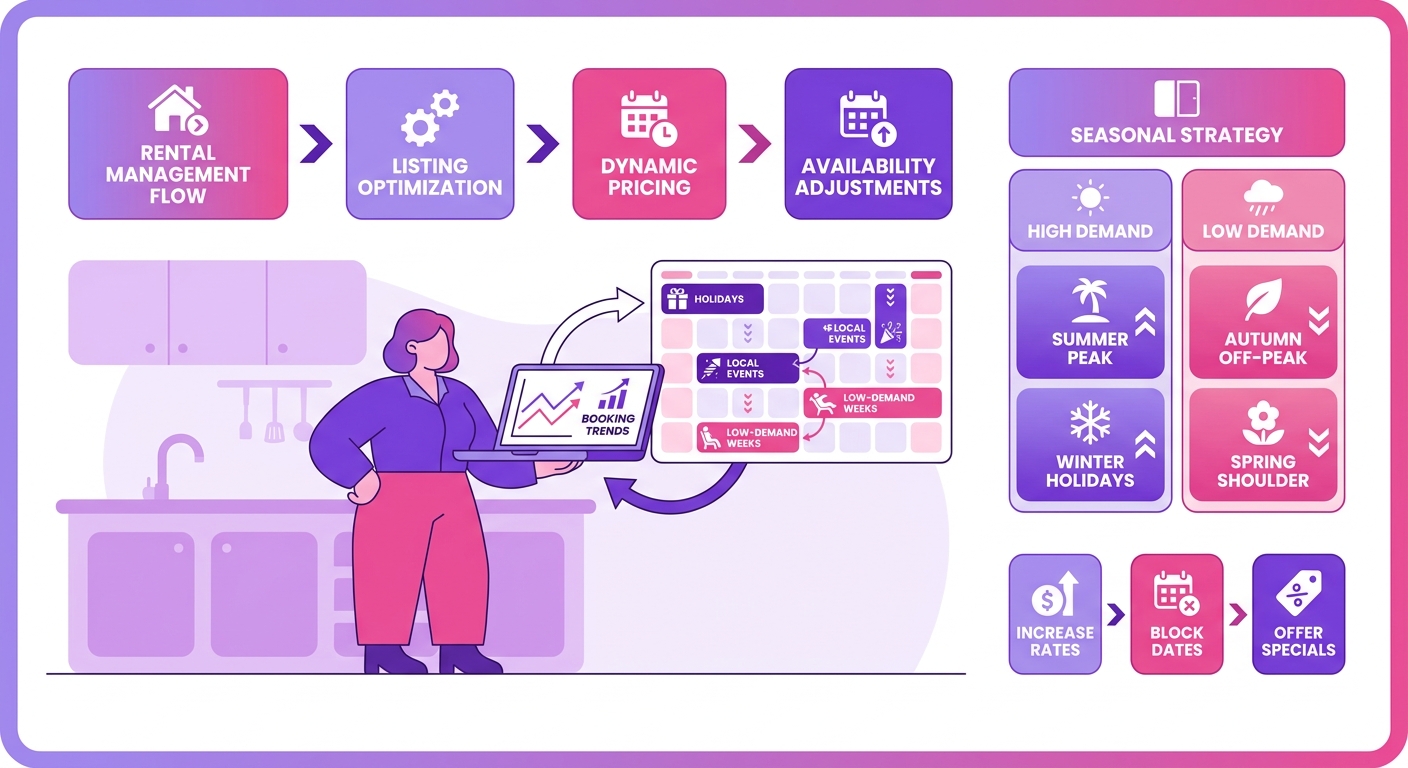
Seasonality doesn't move in isolation. When your peak season arrives and nightly rates climb from $120 to $210, occupancy and revenue per available night shift in ways that aren't always proportional.
The relationship that catches most hosts off guard: occupancy often drops as ADR rises.
A beach property might run 92% occupancy at $130/night in shoulder season, then drop to 78% at $210/night in peak, yet RevPAN still jumps from $119.60 to $163.80. That's the right trade-off. Chasing occupancy during peak by holding rates flat leaves real money behind.
Off-season works the opposite way. Lower ADR paired with aggressive minimum-stay reductions (dropping from 3 nights to 1) can recover occupancy to 65–70%, keeping RevPAN above break-even without discounting into unprofitability.
Find Your Seasonality in Minutes
Stop guessing which weeks to raise your nightly rate. Mr. Props maps your listing's demand cycles so you price peak season at $250 and shoulder season at $140 without leaving money behind.
Start Free Trial See a Sample Report
No credit card required. Setup takes under 5 minutes.