
What is Owner Statement?
Owner Statement An owner statement is a monthly financial report a property manager sends…
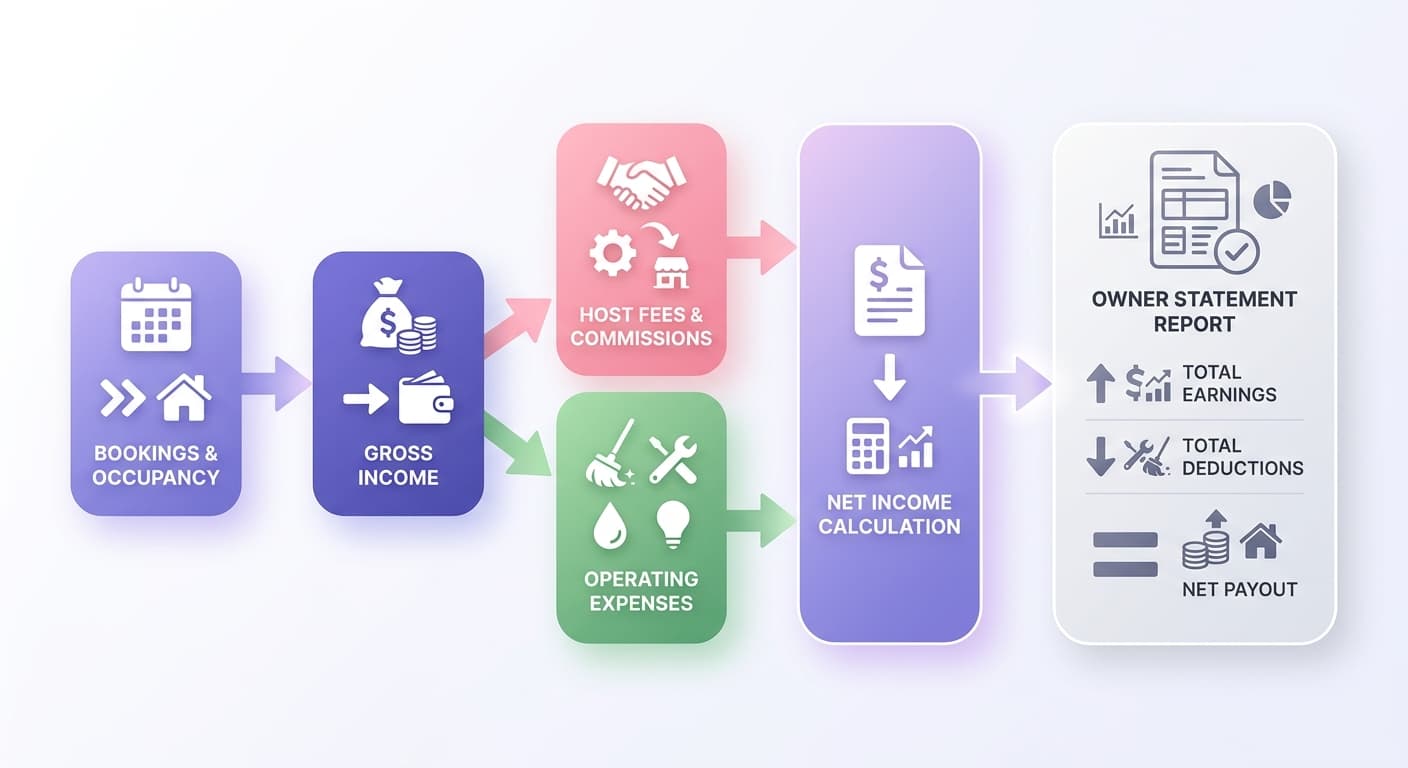
An owner statement is a monthly financial report a property manager sends to a rental property owner, showing every dollar collected and every expense charged against that property during the period.
It's the paper trail between what guests paid and what lands in your bank account.
A typical statement covers gross booking revenue, platform fees, management commissions (usually 15–30% of revenue), cleaning fees, maintenance charges, and the net payout.
Why Owner Statements Matter for Your STR Bottom Line
A property running at 75% occupancy with a $150 nightly rate generates roughly $3,375 in gross revenue per month.
Your owner statement is the only document that shows how much of that actually reaches you after the $45 cleaning fee passthrough, platform commission, and management cut are removed.
Without a clear rental statement, you're guessing at your actual yield.
Most hosts who audit their statements for the first time find at least one recurring charge they'd stopped questioning, maintenance markups, duplicate supply fees, or platform fees applied twice.
On a portfolio of five properties, even a $75/month discrepancy per unit compounds to $4,500 annually.
What an Owner Statement Actually Shows

The statement captures every deduction between what guests paid and what you received.
Most property management statements follow the same core structure:
Gross rental income collected during the statement period
Platform fees, payment processing, and channel charges
Maintenance, cleaning, and supply costs with individual receipts
Management fee (typically 15-25% of gross revenue)
Net owner payout after all deductions
The statement period matters.
Monthly statements are standard, but if your property had a $600 HVAC repair in March, you want that repair tied to the month it occurred, not rolled into a quarterly summary where it's harder to dispute or verify.
When to Use Your Owner Statement: Seasonal Guidance
Review your owner statement with the calendar in mind, because acting on issues or opportunities earlier or later in the year can affect budgeting, taxes, maintenance planning, and overall financial results.
Pull your statement at the end of each month, but pay closer attention during these windows:
Pre-peak season (January–February for summer markets): Compare your prior Q4 net owner income against projected Q2–Q3 bookings. If your $150/night average rate held 68% occupancy last summer but costs crept up $400/month, you need to reprice before demand arrives, not after.
Post-peak (September for beach properties): Your statement will show the gap between gross revenue and net payout most clearly here. A property earning $9,200 gross in July but netting $5,800 after fees, cleaning, and maintenance isn't unusual, but that 37% spread deserves a line-by-line review.
Tax prep (December–January): Twelve monthly statements give you the expense documentation your accountant needs without reconstruction.
How an Owner Statement Affects Other Metrics

Your owner statement doesn't just report what happened, it exposes relationships between key numbers.
Three cross-metric signals worth tracking:
Net revenue per available night (RevPAN): divide your net payout by total nights available, not just booked nights. A $2,700 net payout across 30 nights is $90 RevPAN, more honest than ADR alone.
Expense ratio: if deductions consistently exceed 35% of gross revenue, your ADR or occupancy needs adjustment.
ADR drift: flat or rising ADR alongside a shrinking net payout signals rising costs, not a pricing problem.
Find Your Owner Statement in Minutes
Mr. Props pulls your booking revenue, cleaning fees, and management deductions into a clear owner statement automatically, no spreadsheets required.
Start Free Trial See a Sample Statement
No credit card required. Set up in under 10 minutes.