
What is Same-Day Turnover?
Same-Day Turnover A same-day turnover is a property reset completed between a departing guest's…
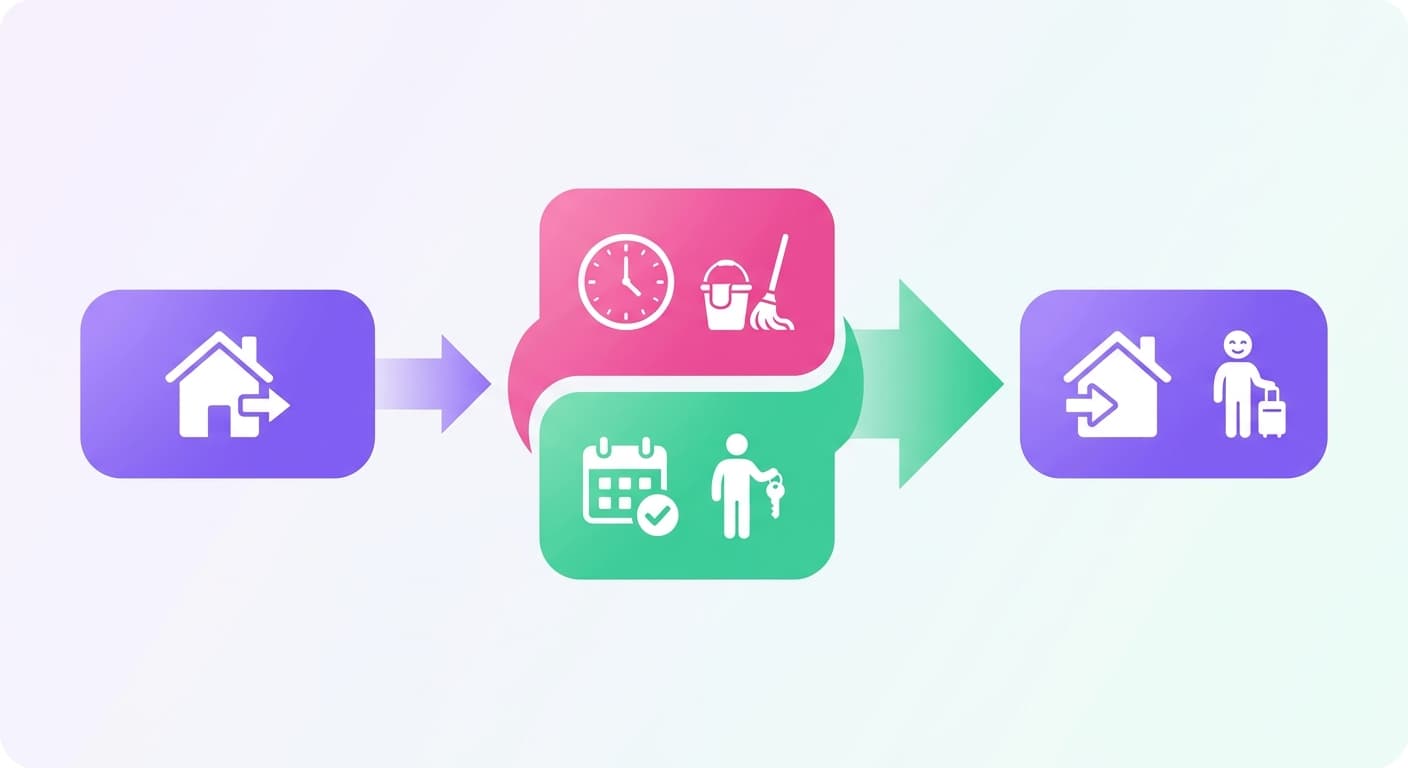
A same-day turnover is a property reset completed between a departing guest's checkout and an arriving guest's check-in on the same calendar date, leaving zero buffer days to clean, inspect, and restock your listing.
Most guides treat this as a scheduling quirk, but it's a distinct operational constraint.
It compresses a task typically spread across 24 hours into a window that, on a standard Airbnb with an 11 a.m. checkout and 3 p.m. check-in, runs exactly four hours - often less once the cleaner travels to your property.
Why Same-day Turnover Matters for Your STR Bottom Line
A same-day turnover is the difference between a booking gap and a booked night.
At $150/night, every gap you eliminate is $150 back in your pocket, and at 75% occupancy across 30 nights, that's roughly 22 paid nights. Tighten your calendar with back-to-back bookings and that number climbs toward 28 or 29.
The math isn't complicated. A 3-bedroom Airbnb charging $150/night loses approximately $4,500/month if it sits empty every Sunday because the cleaner can't turn it in time.
Same-day turnovers solve that specific problem by compressing the gap between checkout and the next check-in to under four hours.
That $45 cleaning fee isn't what you think it is. Most hosts treat it as a simple cost offset, but it's really a guest subsidy that hides a much bigger risk.
The real cost of a failed same-day turnover isn't the cleaning invoice, it's the lost $250 nightly rate you forfeit from the next guest.
What a Same-day Turnover Looks Like in Practice
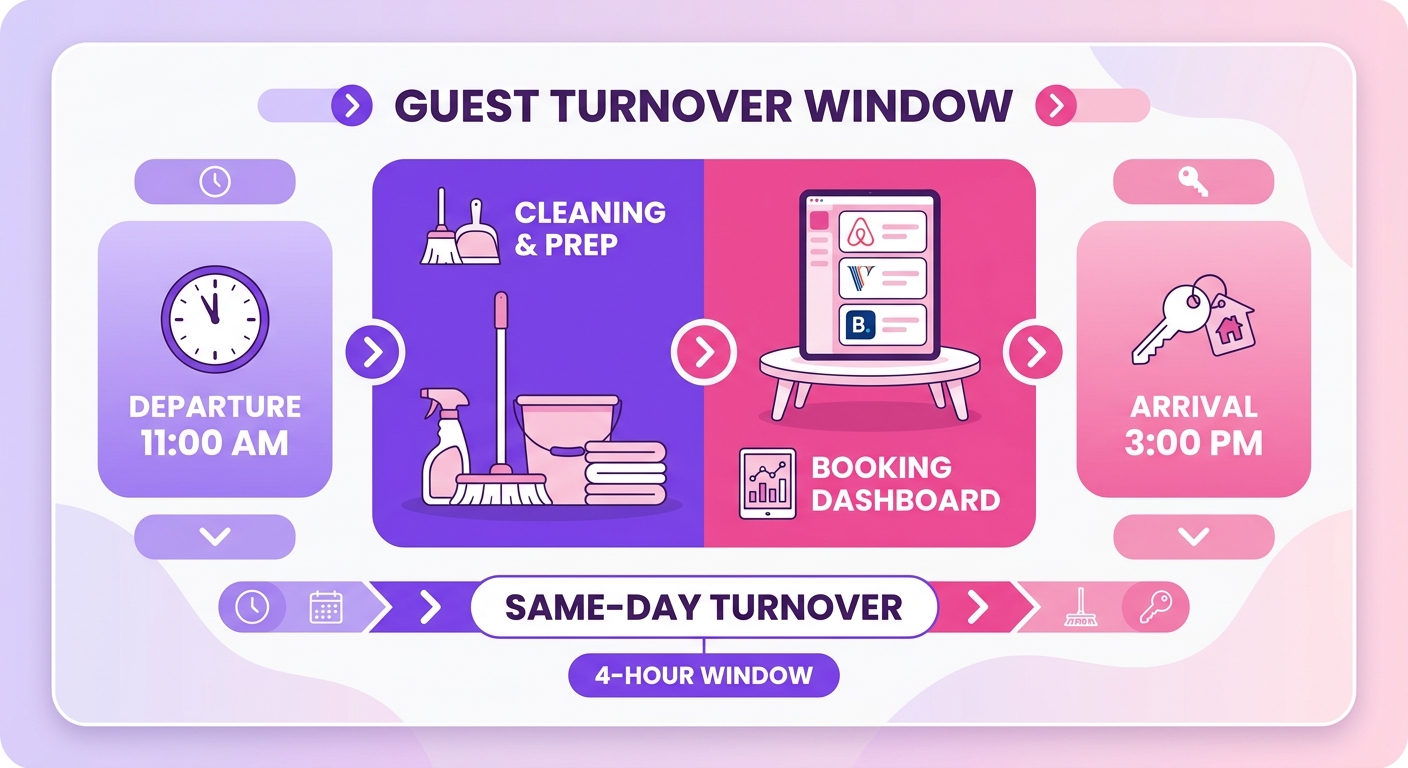
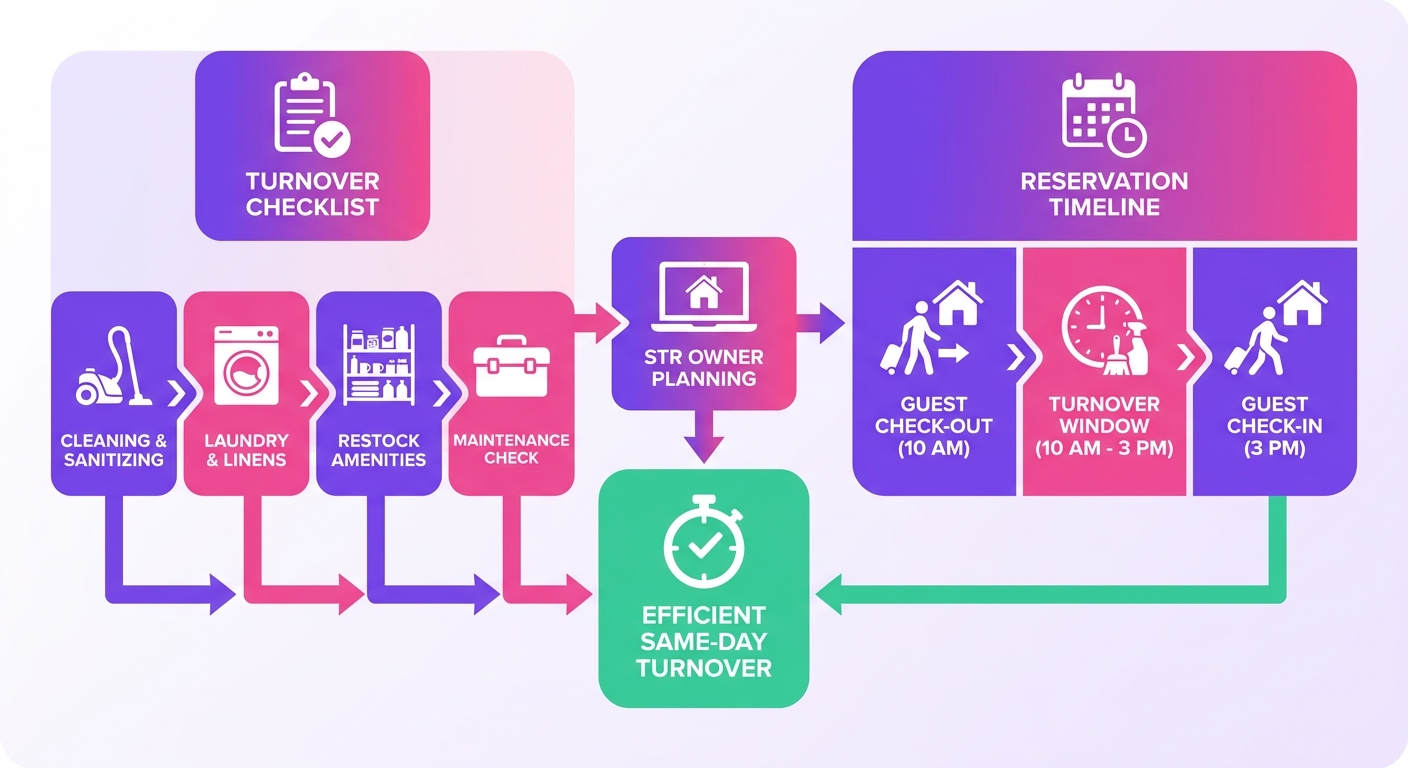
A checkout at 10:00 a.m. and a check-in at 3:00 p.m. gives your cleaner five hours. That sounds generous until you factor in a late-departing guest. The real working window is closer to three hours.
Here's the sequence that actually fits inside that window:
0:00–0:30 Walk-through and guest damage check before stripping beds
0:30–2:00 Full clean: bathrooms, kitchen, floors, surfaces
2:00–2:45 Restock consumables (toilet paper, coffee pods, dish soap), reset linens
2:45–3:00 Final inspection and lockbox or smart lock reset
A two-bedroom Airbnb averaging $175/night with a $55 cleaning fee can absorb a professional cleaner at $35–$40/hour for that window.
At three hours, you're at $105–$120 in labor, tight but workable. A four-bedroom property at the same nightly rate almost certainly can't complete a same-day turnover without a two-person crew, which changes the math entirely.
When to Use Same-day Turnover: Seasonal Guidance
Same-day turnover isn't a year-round default, it's a tool you deploy when your calendar demands it. The situations where it changes your behavior are specific.
Peak season compression: When your Airbnb is running 85%+ occupancy in summer months, back-to-back bookings become the norm. A 4-hour window between an 11am checkout and a 3pm check-in is your only option, there's no buffer day to absorb a slow clean.
Event-driven markets: If your listing sits near a stadium or convention center, demand spikes can push nightly rates past $300. Accepting that revenue means accepting same-day turns, often on consecutive nights.
Off-season: skip it when you can. At 40% occupancy with $120 average nightly rates, the math rarely justifies the operational risk. A next-day turnover costs you nothing in lost revenue but gives your cleaner 18+ hours instead of 4.
Your market's booking window matters too. Listings in beach towns often see 90-day-out reservations lock in back-to-back stays before you can block a gap night.
How Same-day Turnover Affects Your Key Metrics
Accepting back-to-back bookings increases your occupancy rate directly, but the effect on revenue per available night (RevPAN) is more complicated.
A same-day turnover means zero vacancy gap between guests, which sounds ideal. The problem: if your cleaning fee is $45 and your cleaner charges $65 for a rushed same-day slot, you're absorbing a $20 loss on every back-to-back booking at a $150/night rate.
Net margin doesn't always follow. Hosts running 75% occupancy with frequent same-day gaps filled by rushed cleans often find their effective RevPAN trails listings with 65% occupancy and standard turnover fees priced correctly into the cleaning charge.
The fix is straightforward: price your cleaning fee to cover the worst-case same-day rate, not the standard one.
Manage Same-day Turnovers Without the Chaos
Mr. Props gives you the scheduling tools to coordinate cleaners, track turnover windows, and protect your listing's review score, even on back-to-back booking days.
Start Free Trial See How It Works
No credit card required. Set up in under 10 minutes.