
What is Pet Policy in Short-Term Rentals?
Pet Policy in Short-Term Rentals A pet policy in short-term rentals is a written set of rules…
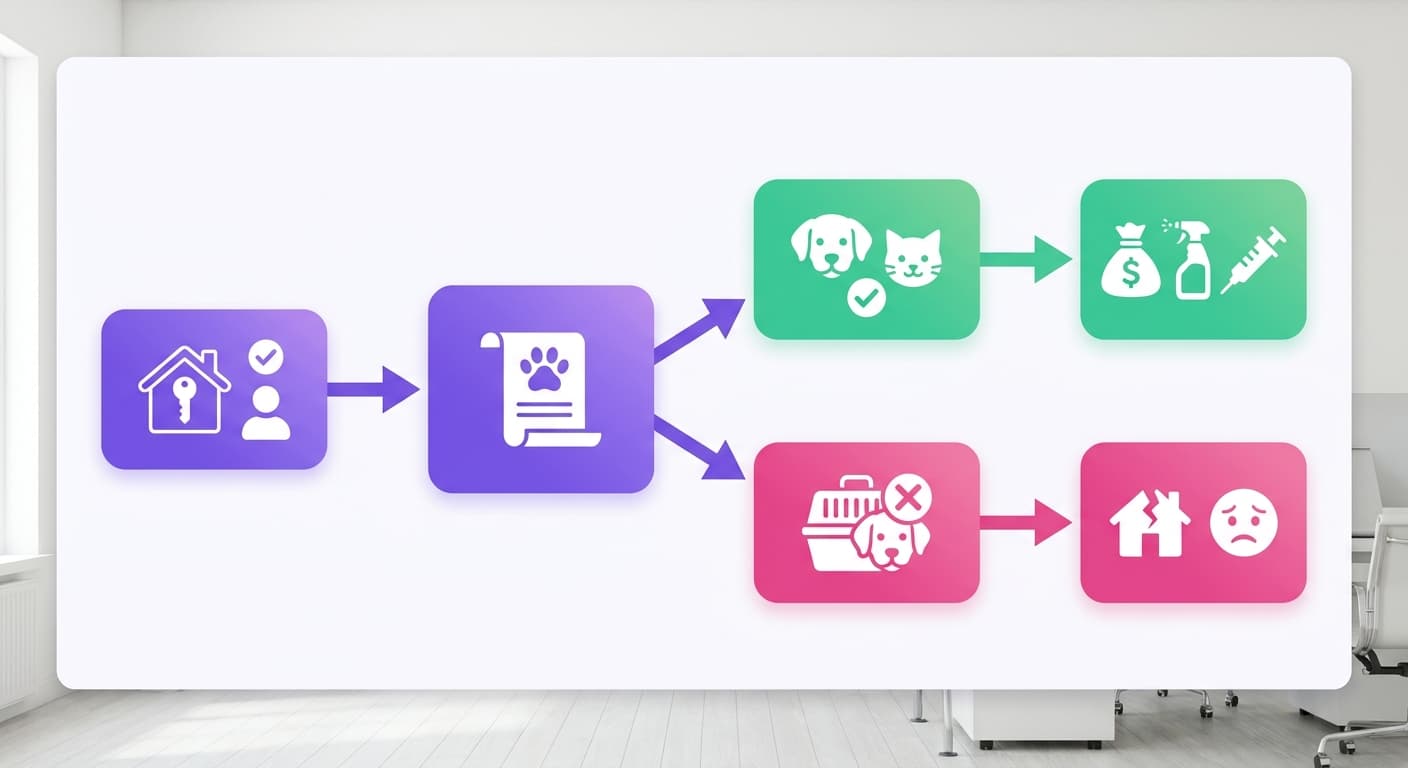
A pet policy in short-term rentals is a written set of rules that specifies whether guests can bring animals to your listing, which animals are permitted, and what fees or damage deposits apply if they do.
Every Airbnb listing defaults to "no pets" unless you actively change it. That default costs you money.
Listings that accept pets command a 10–25% nightly rate premium on average, and pet-friendly properties on Vrbo report roughly 12% higher occupancy than comparable no-pet listings in the same market.
The policy doesn't just protect your furniture. It sets guest expectations before booking, which cuts dispute rates significantly. A missing or vague pet policy is one of the most common reasons hosts lose security deposit claims.
Why Pet Policy Matters for STR Hosts
A pet-friendly listing on Airbnb commands a 10–25% nightly rate premium over comparable pet-free properties in the same market.
On a $150/night base rate, that's $15–$38 extra per night before you've changed a single thing about the property.
The flip side is real too.
A single unreported dog can leave $300–$600 in carpet damage, deodorizing, and deep-clean costs that eat three to four nights of revenue at 75% occupancy.
Stop treating your pet policy like a simple checkbox during your listing setup. It's a powerful financial instrument that can directly impact your bottom line, sometimes boosting revenue by as much as 10% on a single booking.
Visual Breakdown: How a Pet Policy Works in Practice

The diagram above shows the three decision points every pet policy for short-term rentals requires: whether to allow pets at all, how to charge for them, and whether to hold a refundable deposit.
Hosts who skip the deposit step on stays under three nights often find it's not worth the friction, but on stays of five nights or more, a $200 deposit covers most damage scenarios without deterring bookings.
Here's a crucial platform difference you can't ignore. On Vrbo, the pet fee is a separate line item guests see clearly during checkout.
But on Airbnb, it's just bundled into the total price they see at the final step. This little detail massively affects booking abandonment rates. You'll absolutely want to price your pet fee differently on each platform to account for it.
When to Use Pet Policy: Seasonal Guidance
Your pet policy shouldn't stay fixed year-round. Demand shifts, and your rules should shift with it.
Peak summer (June–August) is when pet-friendly listings on Airbnb typically command a 15–20% nightly premium over comparable non-pet properties in beach and lake markets.
Off-season (November–February): Occupancy pressure drops. Accepting pets broadens your eligible guest pool when demand is thin, often filling gaps that would otherwise sit at 0% revenue.
Holiday weekends: Restrict or raise pet fees here. A 3-night Thanksgiving booking at $250/night doesn't need the added turnover complexity a large dog introduces.
Local events: Outdoor festivals and sporting events drive pet-owning travelers. Temporarily opening your listing to pets for those weekends alone can add $300–$600 per event cycle.
How Pet Policy Affects Other Metrics

A pet-friendly setting directly moves three numbers: your average daily rate, your occupancy, and your revenue per available night.
On Airbnb, pet-friendly listings in mid-tier markets typically command a $15–$25 nightly premium over comparable no-pet properties. At 70% occupancy across 30 nights, that's an extra $315–$525 in a single month from one fee adjustment alone.
Occupancy lifts are real but uneven. Properties near state parks or hiking trails see the sharpest gains, sometimes 8–12 percentage points, because pet-owning guests filter aggressively and book early.
Urban apartments with no outdoor space see almost none of that lift.
The risk: higher turnover costs eat into that premium fast. If your cleaner charges an extra $40 per pet stay and you're averaging 12 pet bookings monthly, that's $480 off the top before you count any damage.
Find Your Pet Policy in Minutes
Mr. Props gives you a ready-to-use pet policy framework built around real STR numbers, pet fees, deposit structures, and house rules you can drop straight into your Airbnb listing today.
Start Free Trial Browse Templates
No credit card required. Used by 4,200+ STR operators.