
What is Notice Period for Vacation Rentals?
Notice Period for Vacation Rentals A notice period for vacation rentals is the minimum number of days'…
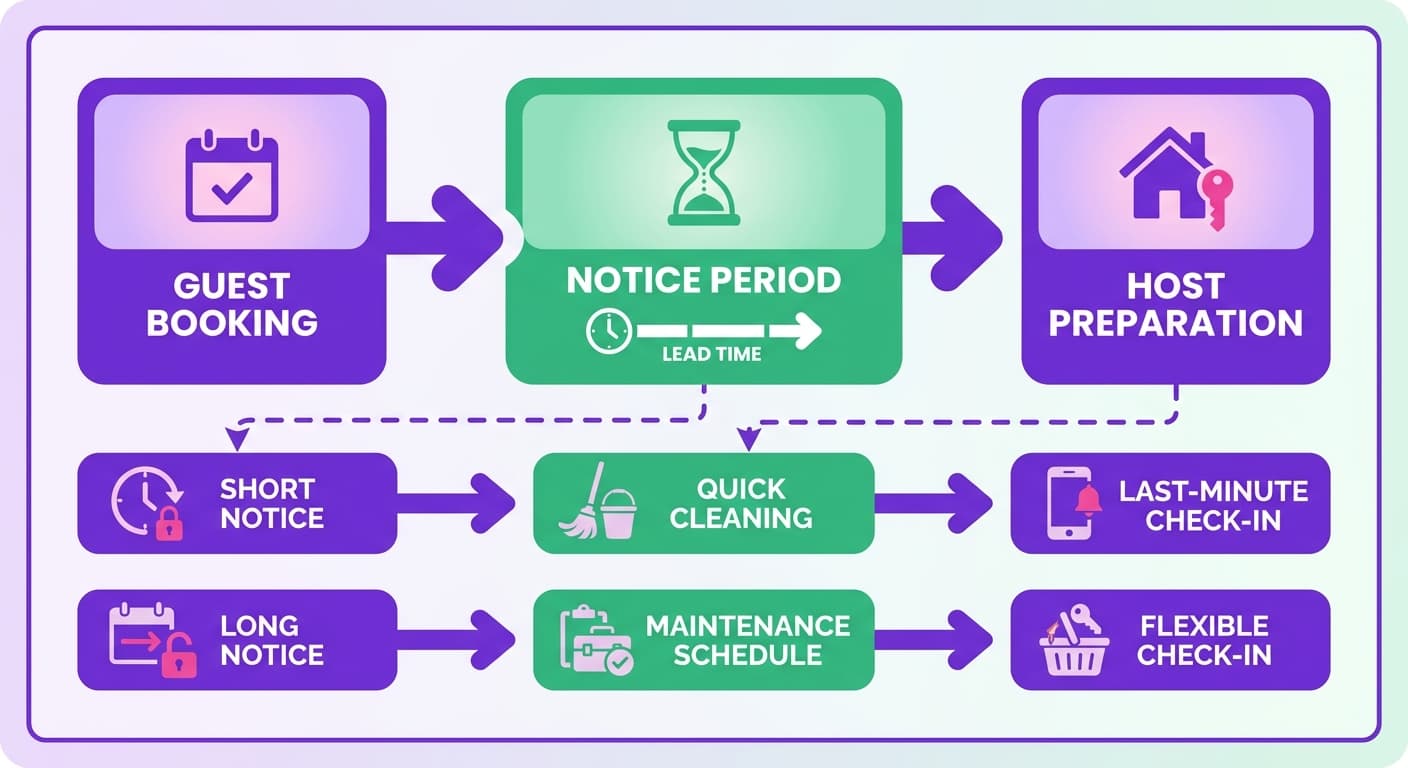
A notice period for vacation rentals is the minimum number of days' advance warning a guest must give before canceling or modifying a confirmed booking, as set by the host in their listing's cancellation and booking policy settings.
On Airbnb and Vrbo, you control this window. Set it too short and a last-minute cancellation on a $150/night property leaves you scrambling to fill a gap.
Set it too long and you'll see booking conversion drop, guests booking 90+ days out don't want to commit to a 30-day notice requirement.
Why Notice Period for Vacation Rentals Matters
A last-minute cancellation on a $150/night listing sitting at 75% occupancy doesn't just cost you one night. It costs you the 1.8 nights average that go unfilled after a same-day drop, based on typical rebooking windows on Airbnb.
That's $270 in lost revenue per incident, before you factor in the $45 cleaning fee your turnover crew may already have scheduled.
The financial stakes are specific:
A $150/night property losing two unbookable nights per month loses $3,600 annually
Unrecoverable cleaning fees average $45 per botched turnover
Rebooking windows under 12 hours drop fill rates by roughly 40% versus 48-hour notice minimums
How a Notice Period Works in Practice

A notice period for vacation rentals is the minimum number of days' advance warning a guest must give before a same-day or near-future booking is confirmed.
Most Airbnb hosts set this between 1 and 3 days. Vrbo hosts running higher-priced properties (say, $250/night and up) often push it to 5–7 days to protect turnover scheduling.
Here's what the window actually controls:
How close to check-in a guest can book without your manual approval
How much time your cleaner has to prepare (a $75 turnover on 4 hours' notice is a different conversation than one with 48 hours)
Whether your active pricing tool has enough runway to adjust rates before the booking locks in
When to Use This Notice Period
Your notice period isn't a set-and-forget setting. Two market conditions should push you to adjust it actively.
Peak season (summer, holidays, local events): Demand is high enough that you can afford to protect your calendar. Set a minimum notice period of 2-3 days. A $220/night beach listing that books out 85% in July doesn't need same-day guests who haven't read your house rules.
Extend to 3-5 days during major local events, you'll still fill the dates.
Tighten your cancellation policy at the same time to protect that revenue.
Shoulder and slow seasons: Drop to same-day or 1-day notice. At 45% occupancy and $130/night, an imperfect last-minute booking beats an empty calendar. The exception: if your turnover requires a professional cleaning crew with 24-hour scheduling lead time, same-day notice will break your operation regardless of occupancy.
How It Affects Other Metrics

Your notice period setting has a massive, measurable impact on occupancy.
At $150/night, that's an extra $1,200–$1,800 in recovered revenue across a month with just 10 empty nights. It's free money, basically.
The connection to ADR is less obvious but real. Hosts who tighten notice periods during peak demand periods (cutting from 48 hours to same-day) report higher average nightly rates because last-minute guests pay a premium, often 15–20% above base price.
Shorter windows capture that demand instead of sending it to competitors.
RevPAN (revenue per available night) reflects both effects. A blocked last-minute night is a permanent loss you can't recover it the way a hotel can with walk-ins. Every notice period decision is also a RevPAN decision.
Find Your Notice Period for Vacation Rentals in Minutes
Mr. Props gives you the tools to set, test, and enforce the right advance notice window for your listing, so you stop losing revenue to last-minute chaos.
No credit card required. Set up in under 5 minutes.