
What is Master Lease in Rentals?
Master Lease in Rentals Master leases in real estate appear across property types, from single-family homes…
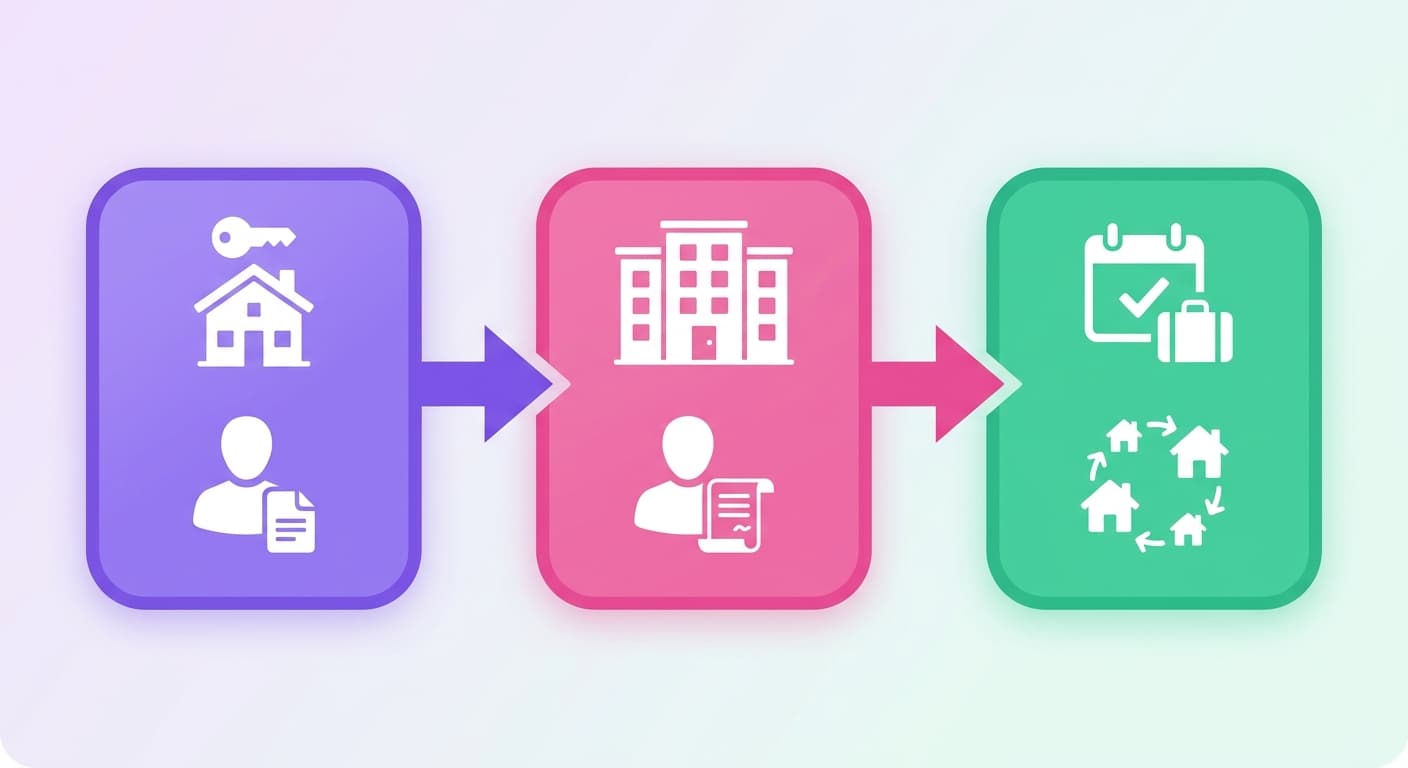
A master lease in rentals is a contract where one party (the master tenant) rents an entire property from the owner, then re-rents individual units or the full space to sub-tenants, keeping the spread between what they collect and what they pay as profit.
Master leases in real estate appear across property types, from single-family homes used for short-term rentals to multi-unit apartment buildings and commercial spaces.
For STR operators, master lease real estate deals typically mean signing a 12-month lease on a property at, say, $2,800/month, then listing it on Airbnb at $150/night.
At 70% occupancy, that's roughly $3,150/month in gross revenue, before cleaning fees, supplies, and platform commissions.
Why Master Lease Matters for Your STR Bottom Line
A master lease lets you generate Airbnb revenue from a property you don't own. That gap between what you pay the owner and what guests pay you is your margin, and it can be significant.
Let's see the math on a single unit. A two-bedroom condo renting at $150/night with 75% occupancy generates about $3,375 a month, so if your fixed master lease payment to the owner is just $1,800, you're clearing $1,575 before any other expenses.
Scale that to five units, and you're looking at a $7,875 monthly gross margin. You don't even have to own the real estate.
The risk sits in the gap. If your occupancy drops to 50%, common in off-peak months, that same unit earns $2,250/month, and your margin shrinks to $450. Thin, but still positive if you've priced the lease correctly.
How a Master Lease Works: the Numbers Behind It
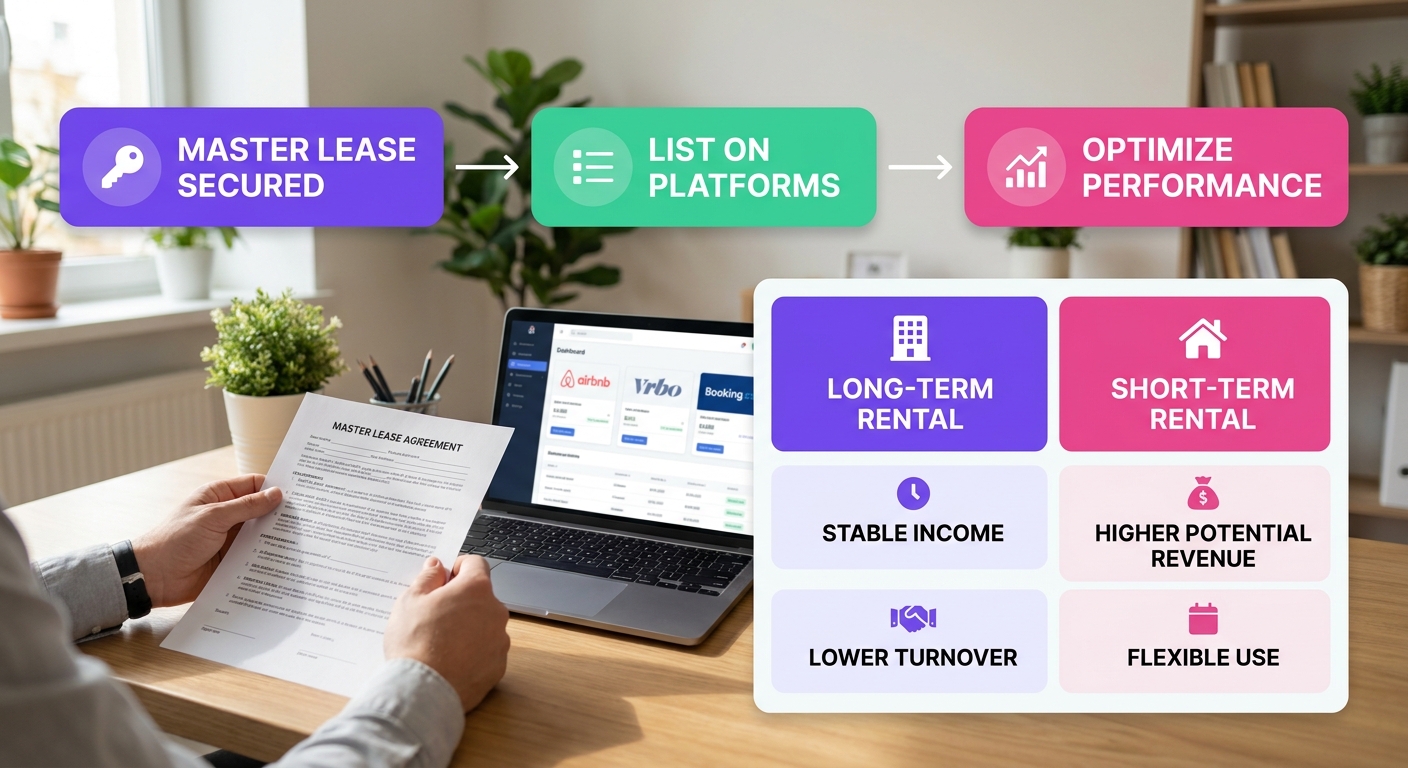
Here's how a master lease agreement actually works. You sign a 12-month lease with the property owner, paying a fixed monthly rent just like a normal tenant.
Then, you turn around and earn variable revenue from all the nightly bookings you can get. It's that gap, between your fixed costs and your nightly income, that becomes your operating margin.
Three variables determine whether a master leasing arrangement makes money:
Occupancy rate (target 68%+ to cover fixed rent reliably)
Average daily rate relative to your monthly lease cost
Turnover frequency, which drives cleaning costs
The break-even threshold on a master lease is fixed. Your revenue isn't.
When to Use a Master Lease: Seasonal Guidance
Timing a master lease agreement matters more than most hosts realize. Sign one at the wrong point in the market cycle and you've locked in a fixed payout during your highest-earning weeks.
Off-peak markets: Beach and ski properties with 3-4 slow months benefit most; the operator absorbs the vacancy risk you'd otherwise carry.
Oversupplied markets: If your city added 20%+ new STR inventory in the past year, a fixed rent stabilizes your income while the market corrects.
Pre-renovation periods: A short-term master lease (6-12 months) keeps cash flowing while you plan a property upgrade.
How a Master Lease Affects Your STR Metrics
Say you lease a downtown apartment for $2,800/month and manage to list it for $150/night. At a solid 75% occupancy (that's about 23 nights), you'll gross $3,450, leaving you a $650 margin before you even account for cleaning, supplies, or platform fees. But what happens if you drop to 60% occupancy?
That margin disappears. Poof. Gone. This is why your break-even occupancy rate is the most critical number you need to track, not just your ADR.
In the rental arbitrage model, small ADR increases have a massive impact, far more than in traditional owner-operated listings. Bumping your rate by just $20 to $170/night, even at a modest 65% occupancy adds an extra $390 to your monthly revenue, enough to completely recover from one slow week. It’s a lifesaver.
This is where metrics like RevPAN (revenue per available night) become essential, because they tell you if your dynamic pricing is actually covering that relentless fixed cost floor.
Find Your Master Lease in Minutes
Mr. Props helps STR operators run master lease agreements without the paperwork headache, so you can focus on filling calendars at $150/night, not chasing contracts.
Start Free Trial See How It Works
No credit card required. Used by 4,000+ STR operators.