
What is Length-of-Stay Discount?
Length-of-Stay Discount A length-of-stay discount is a percentage reduction in your nightly rate that…
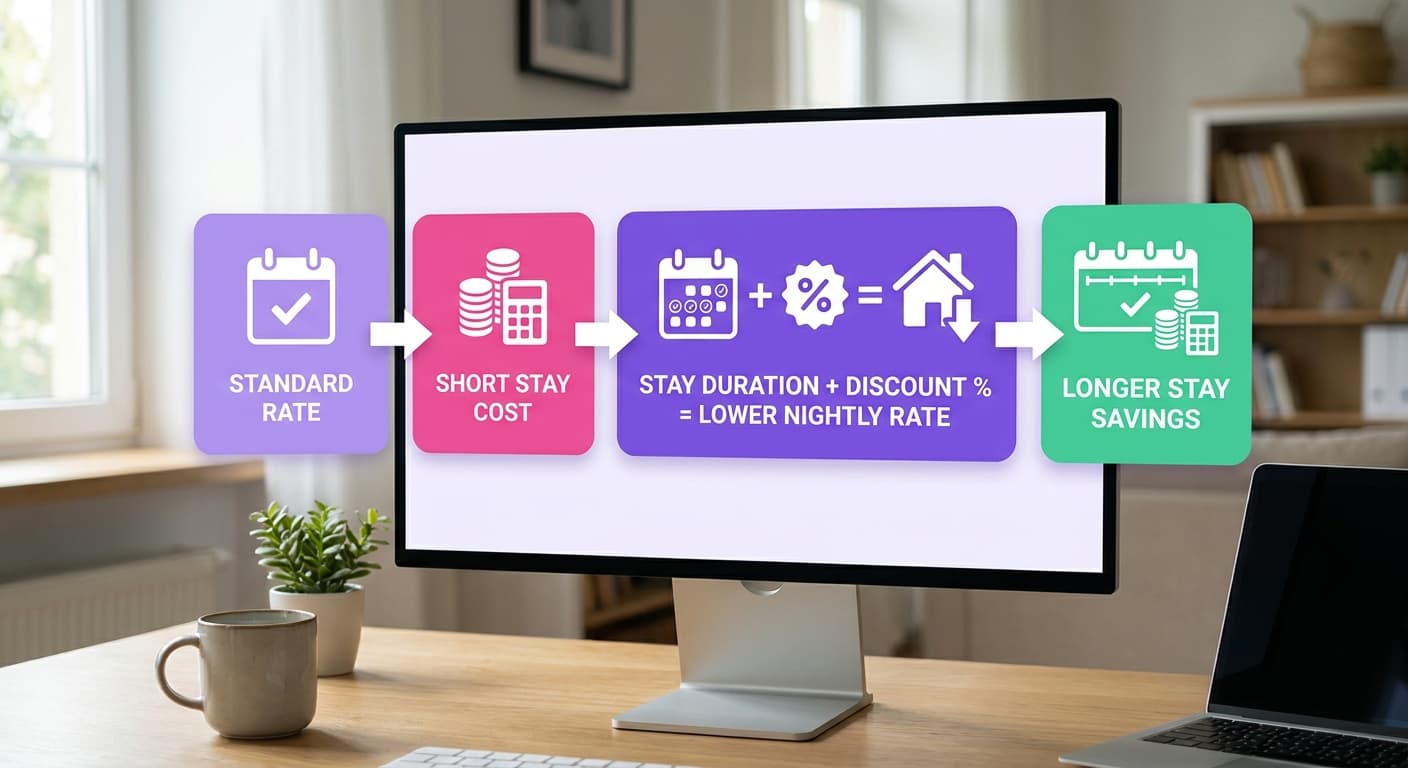
A length-of-stay discount is a percentage reduction in your nightly rate that you offer guests automatically when their booking meets a minimum number of nights, for example, 10% off for stays of 7 nights or more on your Airbnb listing.
Most guides frame this as a simple occupancy tactic. That's not wrong, but it misses the real mechanic: you're trading margin per night for fewer turnovers and a lower vacancy gap between bookings.
A $150/night listing with a 10% weekly discount earns $945 for 7 nights instead of $1,050, but if that discount fills a week that would otherwise sit at 40% occupancy, the net result is higher monthly revenue.
Why Length-of-stay Discount Matters for Your STR Bottom Line

Every turnover costs you money.
At $45 for cleaning plus 1.5 hours of your time, a property running at $150/night with three-night stays burns through roughly $15 per night just in turnover overhead before you count vacancy gaps between bookings.
Shift that same property to seven-night stays and turnover costs drop to about $6.40 per night. That's an $8.60/night gain without touching your base rate.
A length-of-stay discount doesn't just fill calendar gaps. Applied correctly, it shifts your booking mix toward stays that cost less to service and generate more predictable revenue per booking cycle.
When to Use It: Seasonal Guidance
Your discount strategy should shift with your calendar, not stay fixed year-round. A blanket 10% weekly discount that works in February can actively hurt revenue in July when your market fills at full rate without incentives.
A $150/night property dropping to $127 for 7+ nights is still more profitable than three separate 2-night stays with a $45 cleaning fee each time.
Peak season: (summer, holidays): cap discounts at 5-8% or remove them entirely
Shoulder season: 10-15% weekly discounts move stubborn gaps
Off-season: 20%+ monthly discounts can sustain occupancy above 65%
How a Length-of-stay Discount Affects Your Other Metrics

A weekly discount doesn't just change your nightly rate. It shifts three interconnected numbers at once, and hosts who ignore that connection end up pricing against themselves.
Occupancy climbs, but RevPAN can drop. At $150/night with 70% occupancy, adding a 15% weekly discount lowers your revenue per available night from $105 to roughly $89. That's only worth it if extended occupancy offsets the rate cut, requiring at least a 17.6% occupancy gain to break even.
Cleaning costs sharpen the math. One 7-night booking at $892.50 beats five 1-night bookings at $150 only after subtracting five separate $45 cleaning fees. Net revenue flips in favor of the longer stay.
ADR drops are real. Accept that trade-off only when turnover costs and vacancy gaps make shorter bookings genuinely less profitable.
Find Your Length-of-stay Discount in Minutes
Mr. Props calculates the right weekly and monthly discount for your listing based on your nightly rate, occupancy, and turnover costs, no guesswork.
No credit card required. Set up in under 5 minutes.