
What is Booking Buffer?
Booking Buffer A booking buffer is a blocked period between consecutive reservations that prevents…
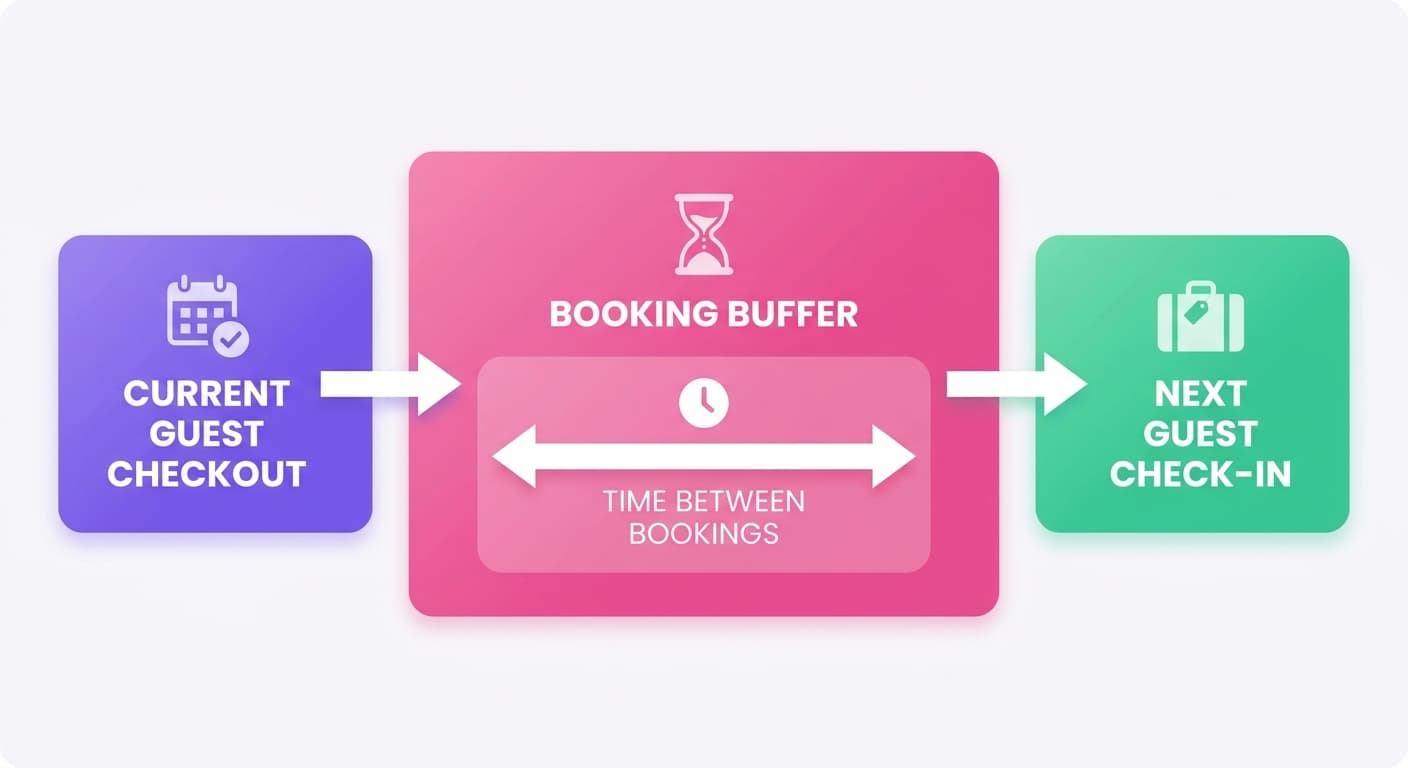
A booking buffer is a blocked period between consecutive reservations that prevents back-to-back checkouts and check-ins on the same day.
The definition most platforms use is straightforward: a set number of days automatically blocked before or after a reservation so no new booking can land immediately adjacent to an existing one.
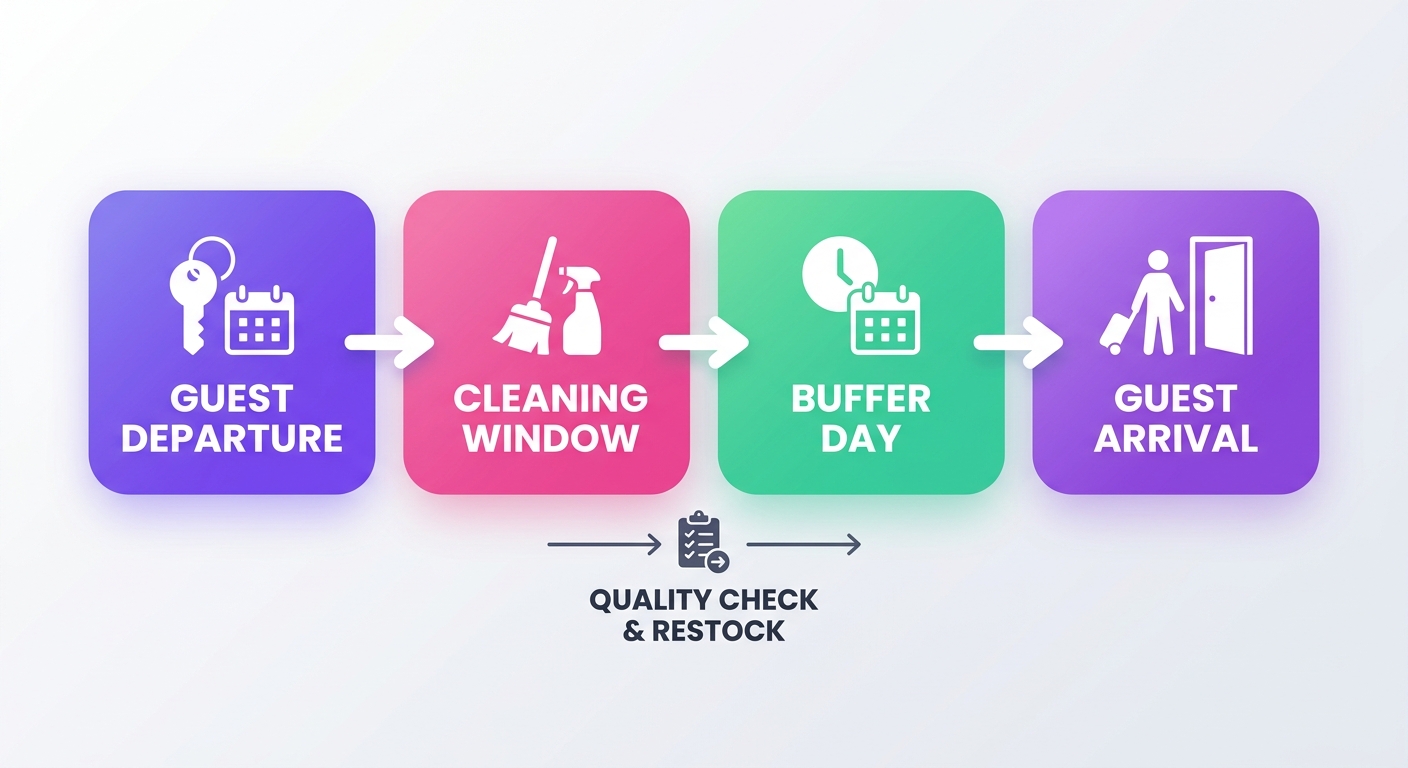
Most hosts set one to give their cleaning crew enough time to turn the property over without rushing; a 24-hour gap after a checkout at 11 a.m. means the next guest can't arrive until the following day at the earliest.
Why Booking Buffer Matters for Your STR Bottom Line
A missed turnover costs you more than just stress. At $150/night with 75% occupancy a single botched clean that forces a same-day cancellation wipes out roughly $150 in revenue plus the $45 cleaning fee you still owe your cleaner.
That's a $195 hit from one scheduling gap.
The buffer period between bookings is where that gap either gets controlled or doesn't.
Without one, you're betting that every checkout happens on time, every cleaner arrives within the hour, and nothing breaks during turnover. That bet loses more often than hosts expect.
Booking Buffer Visualized: the Math Behind the Gap

A booking buffer is your calendar's built-in breather.
The formula is straightforward:
Blocked calendar days = pre-stay buffer + reservation length + post-stay buffer
Worked example: your listing rents at $150/night for a 3-night stay. You set a 1-day buffer before and a 1-day after. The platform blocks 5 total days (1 + 3 + 1).
You earn $450 from those 3 nights, but lose potential revenue on 2 buffer days. At 75% annual occupancy, a 2-day buffer per turnover across 120 bookings per year costs roughly 240 blocked nights, worth knowing before you set it and forget it.
Most hosts apply the same buffer regardless of stay length. That's where the math starts working against you on shorter bookings.
When to Use a Booking Buffer: Seasonal Guidance
Your buffer needs change with your calendar. A fixed 1-night gap that works in January becomes expensive in July, when your listing at $220/night fills 18 days in advance and every blocked night costs real money.
Adjust your buffer period based on these conditions:
Peak season (June–August, holiday weeks): Drop to 0 nights. Demand covers any scheduling risk, and your cleaner should already be on a confirmed schedule.
Shoulder season: 1-night buffer is the standard. Enough protection without blocking bookable inventory.
Off-peak or slow markets: Stay at 1 night maximum. A 2-night gap at $150/night is $300 in lost revenue per turnover, that adds up fast across 20 turnovers.
How a Booking Buffer Affects Your Other Metrics
Every buffer day is a day your listing can't generate revenue. On a property earning $150/night at 75% occupancy, a permanent 2-day buffer costs roughly $225 per month in blocked nights, real money, not a rounding error.
Your occupancy rate takes the first and hardest hit. You simply can't sell nights you've blocked. Even with a modest one-day buffer, you're looking at a potential 5-10% drop in bookable nights over a year, which puts a hard cap on your earnings.
So while your ADR might stay intact, your RevPAN won't. It's a simple, painful calculation: you're making less money per available night.
Find Your Booking Buffer in Minutes
Mr. Props calculates the right buffer period for your listing based on your turnover time, cleaning crew, and occupancy data, no guesswork.
Start Free Trial See How It Works
No credit card required. Set up in under 5 minutes.