
Download the Florida STR Tax Checklist

Florida Short-term Rental Taxes involve more moving parts than most hosts expect, state sales tax, county surtax, tourist development tax, and federal income reporting all land in the same filing season. Missing one line item can mean penalties, amended returns, or money left on the table.
This checklist gives Airbnb, Vrbo, and Booking.com operators a clear pre-filing review: every deduction category worth claiming, every reporting threshold to watch, and the records you need to back it all up.
Use it before you file, before you hand documents to your accountant, or at the start of a portfolio cleanup. The goal is simple: no surprises at filing time and a complete paper trail that holds up if a county auditor comes knocking.
Download the checklist and start your review today.
Rental Income, Occupancy Tax, and Deductions for Florida Hosts
Most hosts mix up the two types of florida short-term rental taxes until a nasty notice from the Department of Revenue arrives. It’s a classic rookie mistake. The first tax is on your income. The second is the transient occupancy tax which you're required to collect from every guest and pass on to the state and county. Confusing them isn't just a paperwork headache; it creates compliance gaps that can trigger a 10% late penalty on every dollar you failed to remit.
Before anything else: Florida has no state income tax. That's a genuine advantage for STR operators, but it doesn't mean your rental income escapes taxation. The IRS still expects a full accounting of what your property earns, and Florida's 6% state sales tax plus county-level tourist development taxes apply to every short-term stay regardless of which platform the booking came through.
How Rental Income Gets Reported
If your property rents for fewer than 15 days in a calendar year, the IRS lets you exclude that income entirely, no reporting required, no deductions allowed either. Most active STR hosts on Airbnb or Vrbo won't qualify for that exclusion, but it's worth knowing for hosts who rent a primary residence occasionally during events like the Super Bowl or Art Basel Miami.
For everyone else, rental income lands on Schedule E (Form 1040) as passive income, unless the host materially participates in operations, in which case Schedule C applies. The distinction matters because Schedule C income is subject to self-employment tax (15.3% on net earnings), while Schedule E income is not. Most co-hosts and property managers who run multiple units actively will find the IRS leans toward Schedule C classification for their activity.
Platforms issue a Form 1099-K when gross payments exceed $600 in a calendar year, a threshold that dropped significantly from the prior $20,000 / 200-transaction rule. Hosts who received a 1099-K for the first time in recent years sometimes assumed the platform had already handled their tax obligation. The 1099-K is an informational form, not a remittance.
Occupancy Tax in Florida: What Hosts Actually Owe
Florida's occupancy tax structure is layered, and that layering is where most hosts get tripped up. There isn't a single "Florida short-term rental tax", there are at least three overlapping taxes that apply simultaneously, each administered by a different authority.
The Three-layer Tax Stack
Florida charges a 6% state sales tax on short-term rental revenue, collected and remitted to the Florida Department of Revenue. On top of that sits the Florida Tourist Development Tax (TDT) a county-level surcharge ranging from 2% to 6% depending on the county. Miami-Dade, for instance, charges a 6% TDT, while Alachua County charges 4%. Some counties also layer on a separate discretionary sales surtax.
- State sales tax: 6% (statewide, administered by Florida DOR)
- Tourist Development Tax: 2%–6% (county-level, rates vary)
- Discretionary sales surtax: 0.5%–1.5% (select counties, applies to first $5,000 of purchase price)
A host in Osceola County renting a vacation home near Disney can face a combined rate above 13%. That's not a worst-case scenario, it's the actual number for a large share of Florida's STR market.
Platform Remittance: What Airbnb and Vrbo Actually Cover
Airbnb collects and remits Florida state sales tax and TDT in most Florida counties under its voluntary collection agreements with the state. Vrbo does the same in many jurisdictions. But "most" isn't "all." Hosts using Booking.com or running direct-booking sites carry full remittance responsibility themselves, no platform intermediary steps in.
Even on Airbnb, gaps exist. If a host uses a third-party channel manager that routes bookings outside Airbnb's standard payment flow, the platform's tax collection may not trigger. Hosts with split-payment arrangements or corporate accounts should verify remittance status directly with the Florida DOR rather than assuming the platform handled it.
When the Platform Doesn't Cover You
Booking.com remits taxes in fewer Florida jurisdictions than Airbnb or Vrbo. Hosts who list exclusively on Booking.com, or who mix it into a multi-channel setup, need to register with both the Florida Department of Revenue and their county's tax collector before their first booking goes live. Waiting until year-end to sort this out means late penalties stack on top of the tax itself.
Direct-booking sites carry zero platform assistance. Every dollar of state sales tax, county surtax, and TDT is the host's responsibility to calculate, collect from the guest, hold in a separate account, and remit on schedule. A host running a direct-booking site on top of Airbnb and Vrbo can easily end up with three separate remittance workflows running simultaneously.
Deductions Florida STR Hosts Can Actually Use
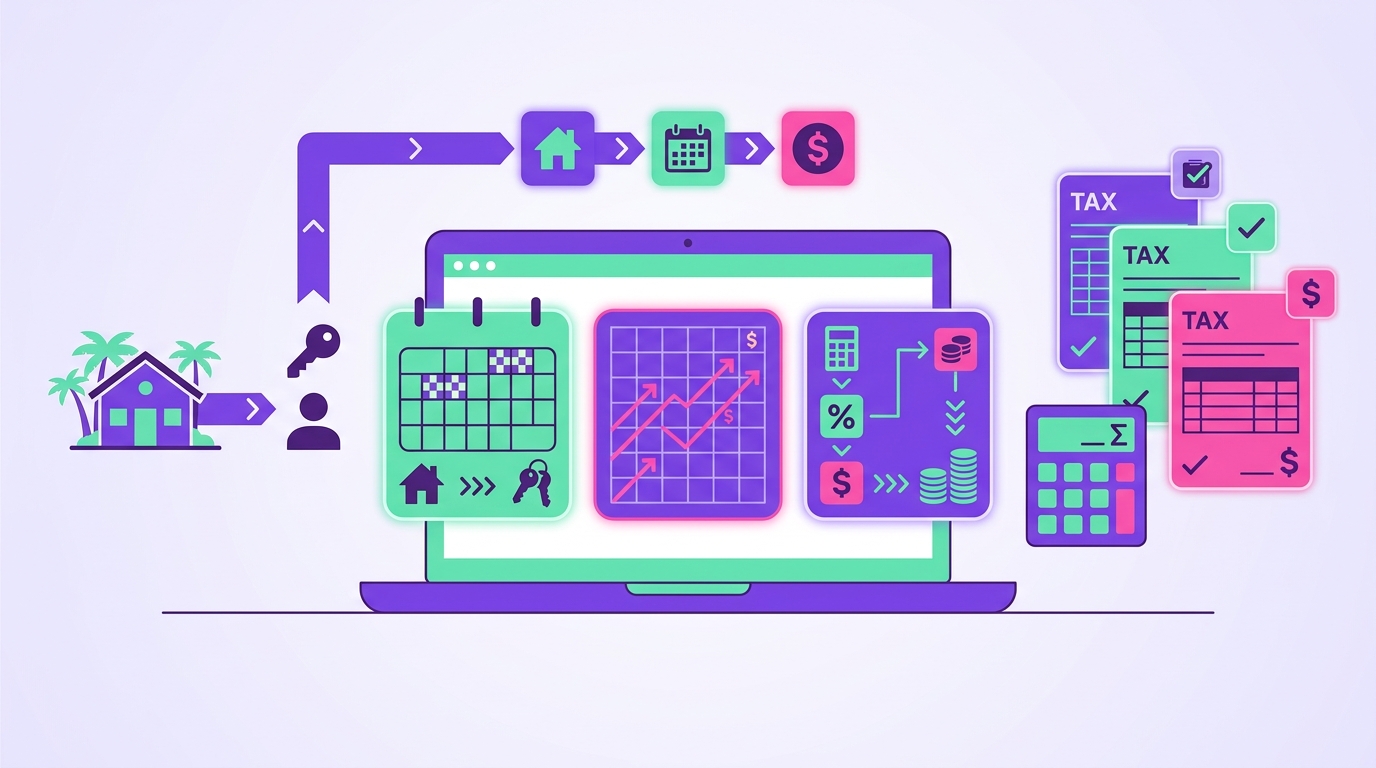
Federal tax law under IRC Section 280A governs what's deductible when a property earns rental income. The 14-day rule is the threshold most hosts hit first: if personal use of the property stays below 14 days per year (or 10% of days rented at fair market rate, whichever is greater), the IRS treats it as a rental business and allows full expense deductions against rental income.
Deductible Expenses for Qualifying Rental Properties
- Mortgage interest and property taxes (prorated if mixed personal/rental use)
- Cleaning fees, supplies, and turnover labor costs
- Platform service fees charged by Airbnb, Vrbo, or Booking.com
- Property management or co-host fees
- Repairs and maintenance (not capital improvements)
- Depreciation on the structure (27.5-year straight-line schedule for residential rental property)
- Insurance premiums, utilities, and internet service attributable to rental periods
Depreciation alone can offset a significant portion of net rental income on paper. A property with a $400,000 depreciable basis generates roughly $14,500 in annual depreciation deductions, before a single repair or platform fee is counted.
What Happens When You Sell: Depreciation Recapture
Depreciation is one of the most valuable deductions available to Florida STR hosts, but it comes with a cost that most guides skip past. When you sell a rental property, the IRS recaptures all depreciation you've claimed (or were entitled to claim) at a rate of up to 25%. On that $400,000 depreciable basis, a host who held the property for ten years and claimed the full depreciation schedule would owe recapture tax on roughly $145,000, regardless of whether the sale nets a profit.
Hosts who stop claiming depreciation to "avoid" this don't avoid recapture. The IRS calculates it on depreciation allowed or allowable meaning you owe it whether you took the deduction or not. Claim it every year.
Filing Workflows and Remittance Timelines
Florida STR hosts deal with three separate filing obligations that run on different schedules and go to different agencies. Conflating them is the most common compliance mistake.
State Sales Tax: Florida Department of Revenue
The Florida Department of Revenue collects a 6% state sales tax on the total rental charge, which includes things like your cleaning fees. Yeah, they tax those, too. Most hosts file this monthly using Form DR-15 although the DOR might let you file quarterly if your annual state tax bill is under $1,000. Your return is due on the 1st of the month after the reporting period, but you've got a grace period until the 20th before penalties kick in.
- Register through the Florida Business Tax Application (Form DR-1) before collecting any rental revenue
- File even in months with zero rental activity, a $0 return keeps your account in good standing
- Late filing triggers a minimum $50 penalty plus 10% of unpaid tax per month
County Tourist Development Tax: Local Tax Collector
Each county administers its own tourist development tax independently. Orange County hosts file with the Orange County Tax Collector; Miami-Dade hosts file with the Miami-Dade Office of the Tax Collector. There's no consolidated portal. Rates range from 2% in some Panhandle counties to 6% in Monroe County, and filing deadlines vary slightly by jurisdiction, most fall on the 1st with a 20th-of-the-month cutoff, but verify with your specific county.
Platform collection creates a remittance gap worth watching. Airbnb remits state sales tax and, in participating counties, the tourist development tax on behalf of hosts. Vrbo remits state tax in Florida but does not universally remit county taxes, responsibility shifts to the host depending on the county agreement in place at the time of the booking. Hosts using Vrbo should confirm their county's current remittance status directly with the local tax collector before assuming the platform has covered the obligation.
Federal Schedule E: Annual Filing
Rental income and expenses flow to Schedule E (Form 1040) for most individual hosts. Hosts who provide substantial services, daily cleaning, concierge, or linen service comparable to a hotel, may need to report on Schedule C instead, which subjects net income to self-employment tax (15.3%) but also allows contributions to self-employed retirement accounts.
Estimate Your Florida Short-term Rental Taxes

Knowing your tax exposure before filing season arrives is the difference between a manageable bill and a cash-flow emergency. The calculator below estimates what you owe across state sales tax, county surtax, and tourist development tax based on your gross rental income, whether revenue comes through Airbnb, Vrbo, Booking.com, or a direct-booking site.
Enter your monthly or annual rental income, select your county, and the tool breaks down each layer of florida short-term rental taxes so nothing catches you off-guard at remittance time.
Key Filing Deadlines to Track
Missing a deadline triggers penalties that compound fast. Confirm with the Florida Department of Revenue if your county runs a separate collection cycle.
- Monthly filers: returns due by the 20th of the following month
- Quarterly filers: due January 20, April 20, July 20, October 20
- Annual reconciliation: due January 20 for the prior calendar year
Estimate Your Tax Exposure Now
Run your numbers in under two minutes.
Primary CTA: Open the STR Tax Calculator | Secondary CTA: Download the 2026 Deadline Checklist
Used by 4,000+ Florida hosts to avoid late-filing penalties.