
Short Term Rental Taxes New York: Income, Occupancy Taxes, and Deductions for Hosts
Download the STR Tax Checklist
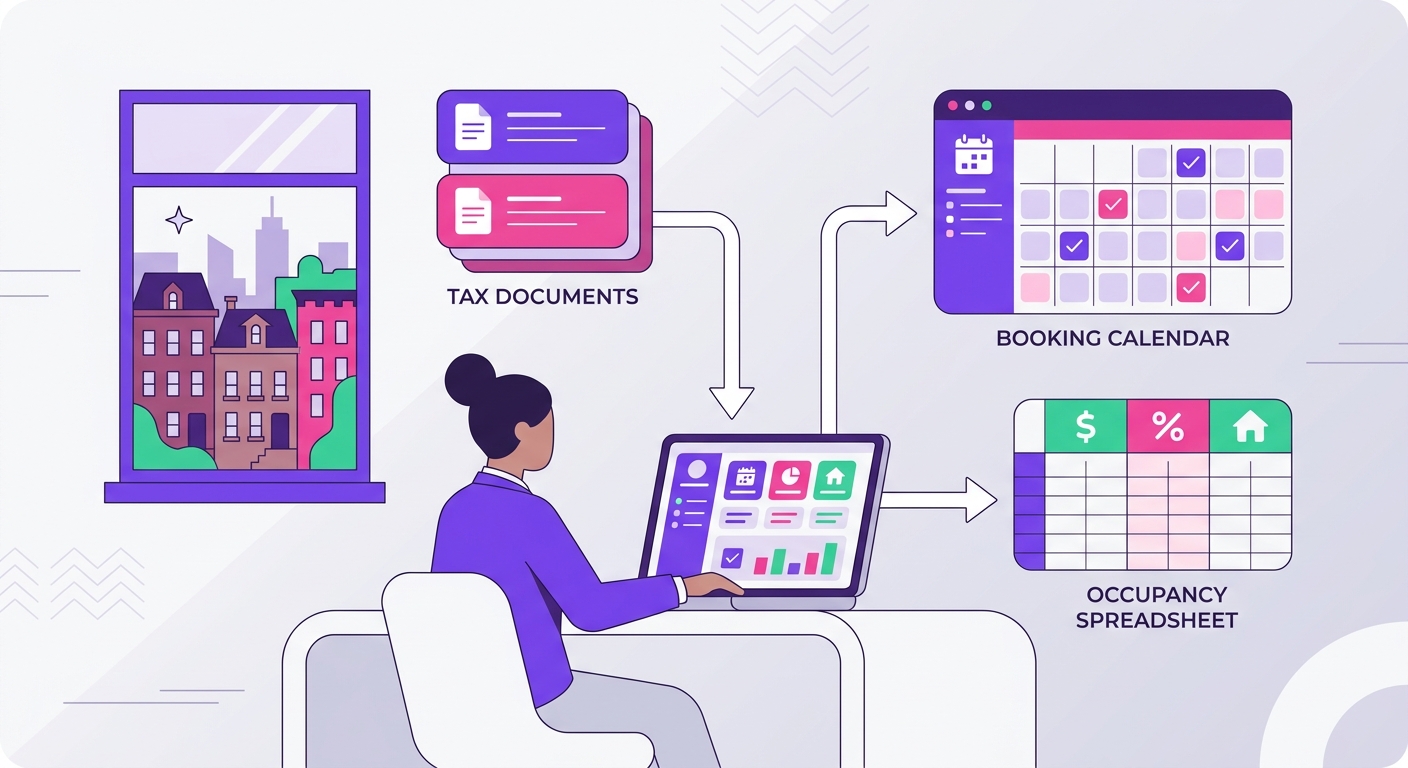
Short term rental taxes in New York involve enough moving parts that missing one deduction or filing the wrong form can cost you hundreds. This checklist pulls together every category hosts on Airbnb, Vrbo, and Booking.com need to confirm before filing: income reporting, platform remittance records, deductible expenses, depreciation schedules, and local occupancy tax payments.
Use it before your accountant meeting, not after. Having your records organized in advance cuts prep time and reduces the risk of leaving legitimate write-offs on the table.
The checklist covers:
- Deduction categories specific to short-term rental properties, including cleaning fees, supplies, and platform commissions
- Reporting readiness for federal Schedule E and state returns
- Record-keeping requirements for multi-platform operators
Download it, run through it once per quarter, and your year-end filing gets significantly easier.
Rental Income, Occupancy Tax, and Deductions for Hosts
New York hosts collecting rent from short-term guests face three distinct tax obligations: federal income tax on net rental income, New York State income tax on the same, and occupancy taxes collected from guests and remitted to local governments. Most guides treat these as one topic. Each has different thresholds, different filing deadlines, and different consequences for getting it wrong.
How Rental Income Gets Reported
The IRS uses the 14-day rule (also called the "vacation home rule") to determine whether your rental activity is a business or a personal use property. If you rent your unit for 14 days or fewer per year, that income is tax-free at the federal level and doesn't need to be reported. Rent it for 15 days or more, and every dollar becomes reportable income.
Most active Airbnb hosts in New York clear 15 days easily. A single decent weekend in Manhattan or a week in the Catskills typically covers that threshold before February ends.
You report net rental income on Schedule E of your federal return if you're not providing substantial services to guests. If you are (think daily cleaning, concierge-style check-ins, meals), the IRS may treat your activity as a business, pushing income to Schedule C which also means self-employment tax on top of ordinary income tax. That's a 15.3% hit on net profit that Schedule E hosts don't pay.
New York State mirrors the federal treatment closely. Rental income reported on your federal return flows through to your NY State return. The state tax rate ranges from 4% to 10.9% depending on your total income bracket. For a host netting $40,000 from short term rental taxes new york compliance requires reporting that income on Form IT-201 (residents) or IT-203 (part-year or nonresidents renting out a property they don't live in full-time).
Deductions That Actually Reduce Your Tax Bill
Most hosts undercount their deductions. The IRS allows you to deduct expenses proportional to the time your property is rented versus personally used. If you rent 200 days and use the property 50 days yourself, 80% of eligible expenses are deductible against rental income.
Deductible expenses include:
- Mortgage interest and property taxes (prorated to rental days)
- Cleaning and turnover labor, including any third-party cleaning services
- Platform fees charged by Airbnb, Vrbo, or Booking.com (typically 3–5% of gross bookings)
- Property management software subscriptions
- Depreciation on the structure itself, not the land, calculated over 27.5 years for residential rental property
- Repairs (not improvements) made during the rental period
- Supplies, linens, toiletries, and guest amenity costs
Depreciation is the deduction most hosts miss entirely. On a property with a $400,000 structure value, that's roughly $14,545 per year in paper losses, real tax savings, no cash outlay required. Applied at the prorated rental percentage, it can push a profitable rental into a paper loss for federal purposes.
The 14-day Rule: When Rental Income is Tax-free
If you rent your primary residence for 14 days or fewer per calendar year federal law exempts that income entirely, you don't report it, and you can't deduct expenses against it either. New York follows the same rule. This applies to whole-home rentals of your primary residence, not investment properties you never occupy.
Once you cross day 15, the full year's income becomes reportable. There's no partial exemption. Hosts in high-demand markets near events, think New York City during the UN General Assembly or the US Open, sometimes deliberately cap rentals at 14 days to stay under the threshold. That's a legitimate strategy, though it limits annual revenue to whatever those 14 peak nights generate.
Occupancy Tax: What New York Collects on Top of Income Tax

Rental income tax and occupancy tax are two separate obligations. Plenty of hosts file their federal and state income returns correctly and still get a compliance notice because they missed the occupancy tax layer entirely.
New York City charges a 5.875% hotel room occupancy tax on short-term rentals, on top of the state's 4% sales tax on hotel occupancy and an additional NYC hotel unit fee of $1.50 per unit per day. In practice, a guest booking a Manhattan apartment for five nights pays roughly 14.75% in combined occupancy-related taxes before the city's local hotel surcharges are factored in.
Platform Remittance Vs. Host Remittance
Airbnb collects and remits New York City occupancy tax automatically for listings in the five boroughs. Vrbo does not have the same blanket agreement with NYC, which means hosts on that platform are responsible for collecting and filing themselves.
This is where hosts get tripped up. If you run the same property on both Airbnb and Vrbo, Airbnb handles its share automatically while your Vrbo bookings remain your problem. Missing those Vrbo remittances doesn't reduce your liability, the city will still pursue back taxes, interest, and penalties if audited.
Direct Bookings and the Remittance Gap
Direct bookings through your own website carry zero automatic remittance. You collect the nightly rate, you owe the occupancy tax, and you file it yourself, typically monthly or quarterly depending on booking volume. New York City requires registration through the NYC Department of Finance before you can remit.
Hosts running direct booking sites often forget to build occupancy tax into their rate display. Showing a guest $250/night and then adding 14.75% at checkout creates friction and abandoned bookings. Build the gross rate into your advertised price or show the tax line clearly at the first pricing screen.
Filing Workflows for STR Hosts in New York
The filing cadence depends on which taxes you're handling and at what scale. Here's how the layers stack in practice:
- Federal income tax: Annual, reported on Schedule E (passive rental) or Schedule C (active/business rental). Quarterly estimated payments apply if you expect to owe more than $1,000 for the year.
- New York State income tax: Annual filing, with quarterly estimated payments mirroring the federal schedule. NY taxes rental income at rates up to 10.9% for high earners.
- NYC occupancy tax (if applicable): Monthly or quarterly remittance to the NYC Department of Finance, depending on your registered filing frequency.
If you manage properties outside New York City, say, a Catskills cabin alongside a Brooklyn apartment, the occupancy tax rules differ by county. Sullivan County and Ulster County both impose their own hotel and motel taxes, typically in the 3%–5% range, separate from the NYC structure entirely.
Don't treat your properties like one big financial blob. The cleanest approach is to treat each property as a separate tax unit, tracking its individual gross receipts, deductions, and occupancy tax remittances. Mixing revenue streams invites errors that are a nightmare to unwind at filing time. Most hosts have no idea how much documentation a New York State audit requires, but the state's Department of Taxation and Finance has been actively cross-referencing Airbnb 1099-K data against personal income tax returns since 2023. If your reported rental income doesn't align with what the platform reported down to the dollar, you'll get a notice. It's that simple.
A workable filing workflow looks like this:
- Monthly: Download your platform payout statements. Reconcile gross receipts against net payouts. Note any cleaning fee income, which is taxable in New York regardless of how it's labeled on the booking.
- Quarterly: Calculate estimated federal and state tax payments. Use your actual year-to-date net income, not last year's figures, if your occupancy has changed significantly.
- Annually: Reconcile your 1099-K totals against your own records before filing. Airbnb reports gross bookings, including fees it collects and remits on your behalf. Those platform-remitted taxes are not your income, but they inflate the 1099-K figure, so you need to back them out on Schedule E.
The 1099-K reconciliation step is where most hosts’ accounting systems completely fall apart. It’s a classic trap. Airbnb's gross figure will always be higher than what actually hit your bank account because it includes amounts like the 3% host service fee before it's deducted from your payout. You absolutely must document the difference with platform statements, not just memory. Seriously, don't wing it.
Remittance Ambiguity: When Airbnb Pays and When You Pay
New York City is a Voluntary Collection Agreement (VCA) jurisdiction for Airbnb. That means Airbnb collects and remits the city's hotel room occupancy tax on your behalf for most standard bookings. Vrbo operates differently, it collects and remits in some jurisdictions but not all, and its remittance coverage for New York State counties outside NYC is inconsistent as of early 2026.
Booking.com does not automatically remit occupancy taxes for New York State properties. If you accept Booking.com reservations, you're responsible for collecting and remitting every applicable local tax yourself. That's a meaningful operational difference that catches hosts off guard when they switch channel mix.
The safest rule: confirm remittance status directly with each platform for each jurisdiction where you operate. Don't assume that because Airbnb handles it for your Manhattan unit, Vrbo handles it for your Hudson Valley listing.
Deductions You Can Actually Claim
New York follows federal deduction rules for rental income, with no major state-level carve-outs that benefit STR hosts specifically. The deductions that move the needle most for short-term rental operators are:
- Depreciation: Residential rental property depreciates over 27.5 years under MACRS. On a $500,000 property (land excluded), that's roughly $18,182 per year in depreciation, a significant non-cash deduction that reduces taxable income without reducing cash flow.
- Quarterly sales tax returns are due March 20, June 20, September 20, and December 20.
- Annual reconciliation is due March 20 following each calendar year.
- NYC hosts file hotel room occupancy tax separately through the NYC Department of Finance.
Estimate Your Short Term Rental Taxes in New York
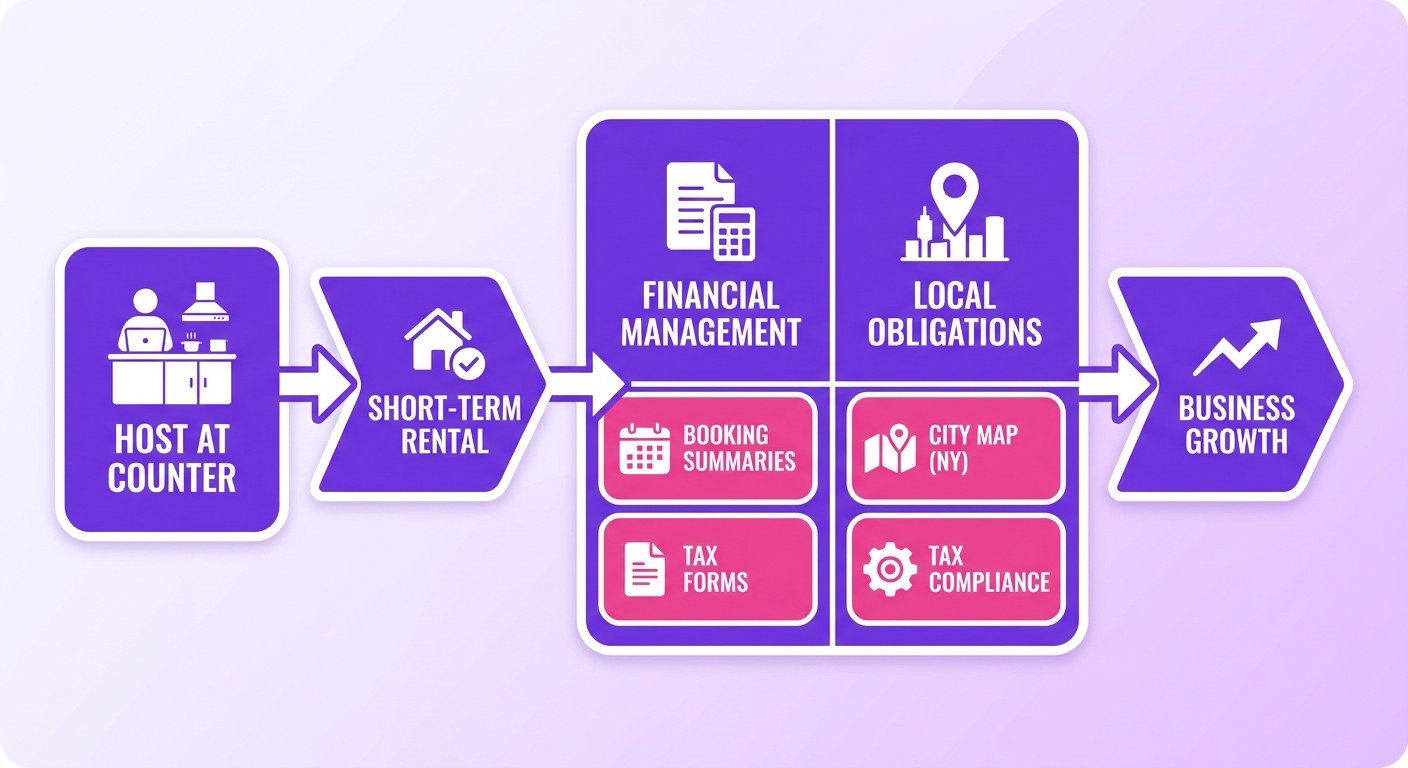
New York STR hosts typically owe tax across three layers: state sales tax (4%), a local county or city rate (up to 4.5% in NYC), and any applicable hotel occupancy surcharge. Airbnb remits some taxes automatically, Vrbo and Booking.com often don't, leaving the balance on you.
The calculator below estimates your total tax exposure based on gross revenue, platform, and location. Run it before each quarterly filing.
Key Filing Dates for New York STR Hosts
Missing a deadline triggers a 10% late penalty plus interest. Reconcile platform remittance reports against your own records before each due date, discrepancies are common and liability falls on the host.
Run your numbers now. Estimate your annual tax exposure in under two minutes.
Open the STR Tax Calculator | Download the NY Tax Deadline Checklist
No email required. Results are estimates only, confirm figures with a licensed tax professional.