
What is Rental Yield?
Rental Yield Rental yield measures how much annual income your short-term rental generates relative…
Rental yield measures how much annual income your short-term rental generates relative to the property's purchase price, expressed as a percentage.
The number that actually matters for your Airbnb isn't gross yield, it's net yield, which strips out platform fees, cleaning costs, and vacancy.
A listing earning $150/night at 65% occupancy looks strong on paper until you subtract Airbnb's 3% host fee, $45 cleaning fees, and $8,000 in annual expenses. That gap between gross and net can be 4–6 percentage points on a typical STR.
Gross yield tells you the ceiling. Net yield tells you the truth.
Why Rental Yield Matters for STR Hosts
Rental yield tells you whether your property is actually earning its keep, or just breaking even while your capital sits idle. For STR hosts, that distinction is worth real money.
Take a concrete example. Your Airbnb generates $150/night at 75% occupancy over 365 days: roughly $41,000 in annual revenue.
Subtract $12,000 in operating costs and you're left with $29,000 net. On a $400,000 property, that's a 7.25% net rental yield well above the 4–5% a long-term rental typically returns.
Rental Yield at a Glance

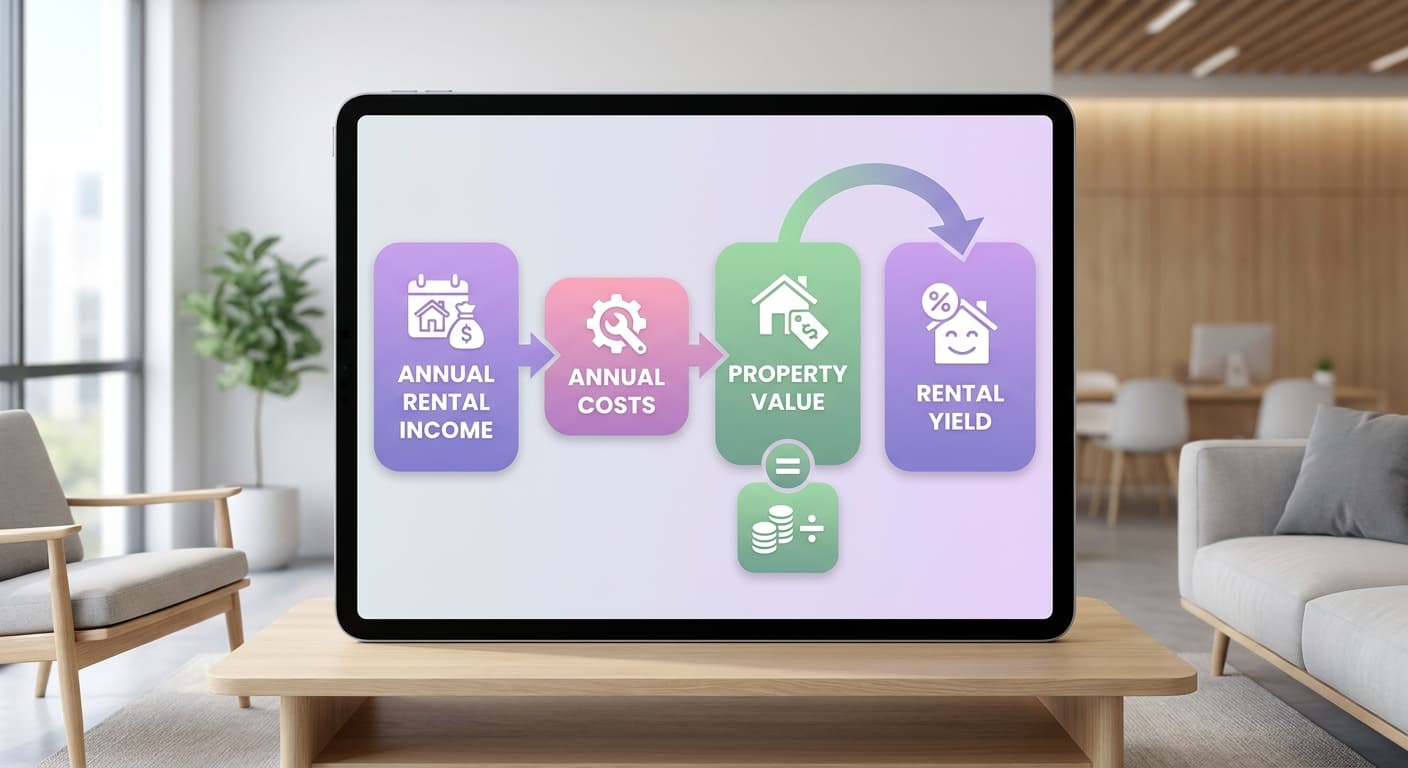
The diagram above maps the rental yield calculation to a real STR scenario. It's surprisingly simple math.
Just take your total annual revenue, let's say it’s a solid $85,000 from your beach house, and divide it by the property's current market value. Multiply by 100. Boom, that’s your rental yield percentage.
A concrete example: a property worth $400,000 generating $150/night at 70% occupancy (roughly 255 booked nights) produces $38,250 in annual revenue.
That's a gross rental yield of 9.6%. Strip out $6,800 in annual costs, platform fees, cleaning, utilities, and your net yield drops to roughly 7.9%.
How Seasons Affect Rental Yield
Your property's income changes month to month, and so does the yield figure you should be benchmarking against.
Two moments when yield calculations change host behavior:
Before peak season pricing adjustments: If your listing runs at $150/night with 60% occupancy in off-peak months, your annualized yield looks weak. Recalculate using your Q3 rate of $220/night at 85% occupancy, the true peak-season yield on a $400,000 property jumps from roughly 4.9% to 10.2%.
When evaluating a second property: Use trailing 12-month income from your existing Airbnb as a baseline. A single high-occupancy summer won't give you an honest yield figure.
How It Influences Key Property Figures
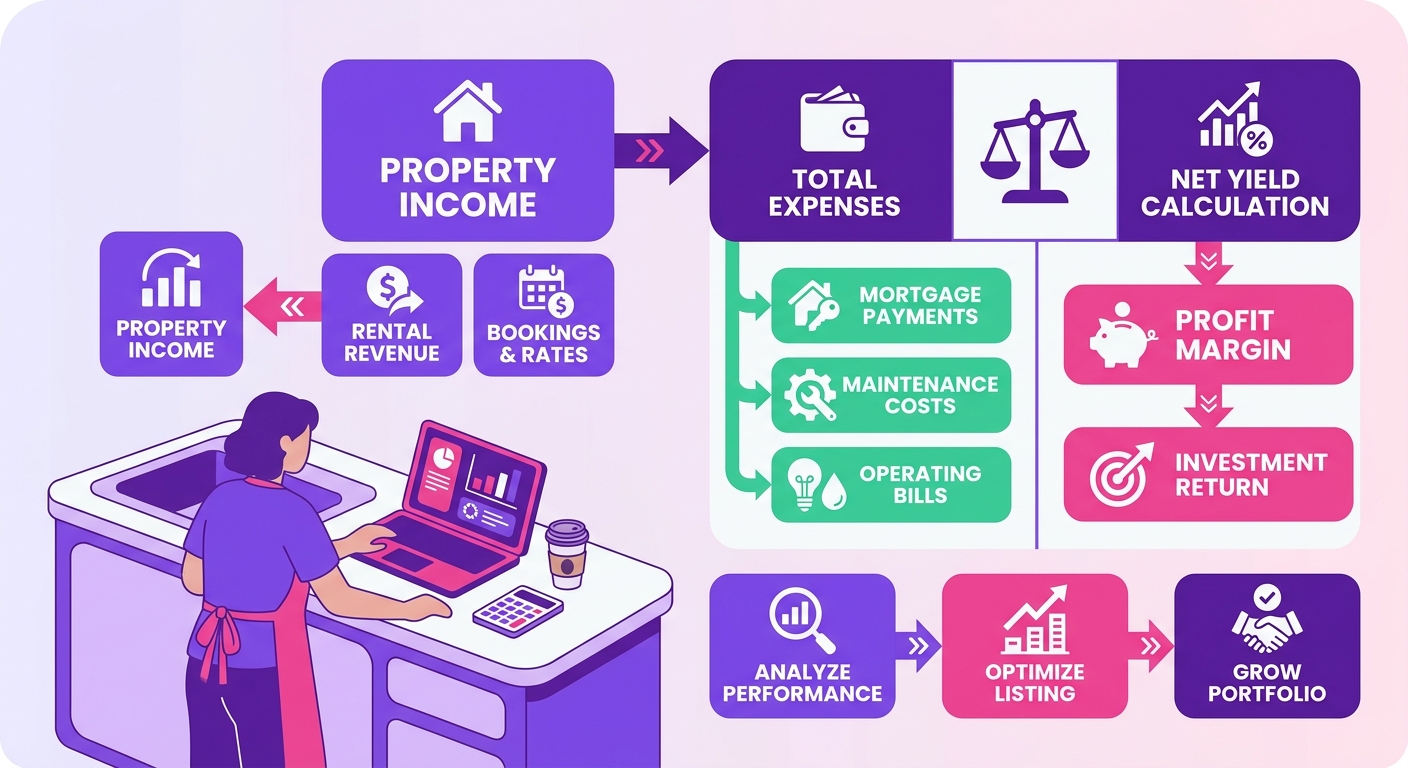
Rental yield doesn't sit in isolation. It's directly shaped by the two numbers STR operators watch most: occupancy rate and average daily rate (ADR).
Take a property earning $150/night. At 60% occupancy, annual revenue hits $32,850. Push occupancy to 75% and revenue climbs to $41,063, a 25% jump that flows straight into your gross yield calculation.
Your ADR is pure leverage. A tiny $20 rate increase across 274 booked nights, maybe from a new dynamic pricing tool you’re testing, immediately adds an extra $5,480 to your annual revenue.
You don't have to change anything else. It's the same property and the same costs, just a much healthier yield.
RevPAN ties both together. It captures whether your pricing and occupancy are working in combination, and it's what yield ultimately reflects.
Find Your Rental Yield in Minutes
Run the rental yield calculation on any property in your portfolio, no spreadsheet required. Mr. Props pulls your real revenue and cost data to give you an accurate yield figure instantly.