
What is Cash Flow in Property Management?
Cash Flow in Property Management Cash flow in property management is the money left over from your…
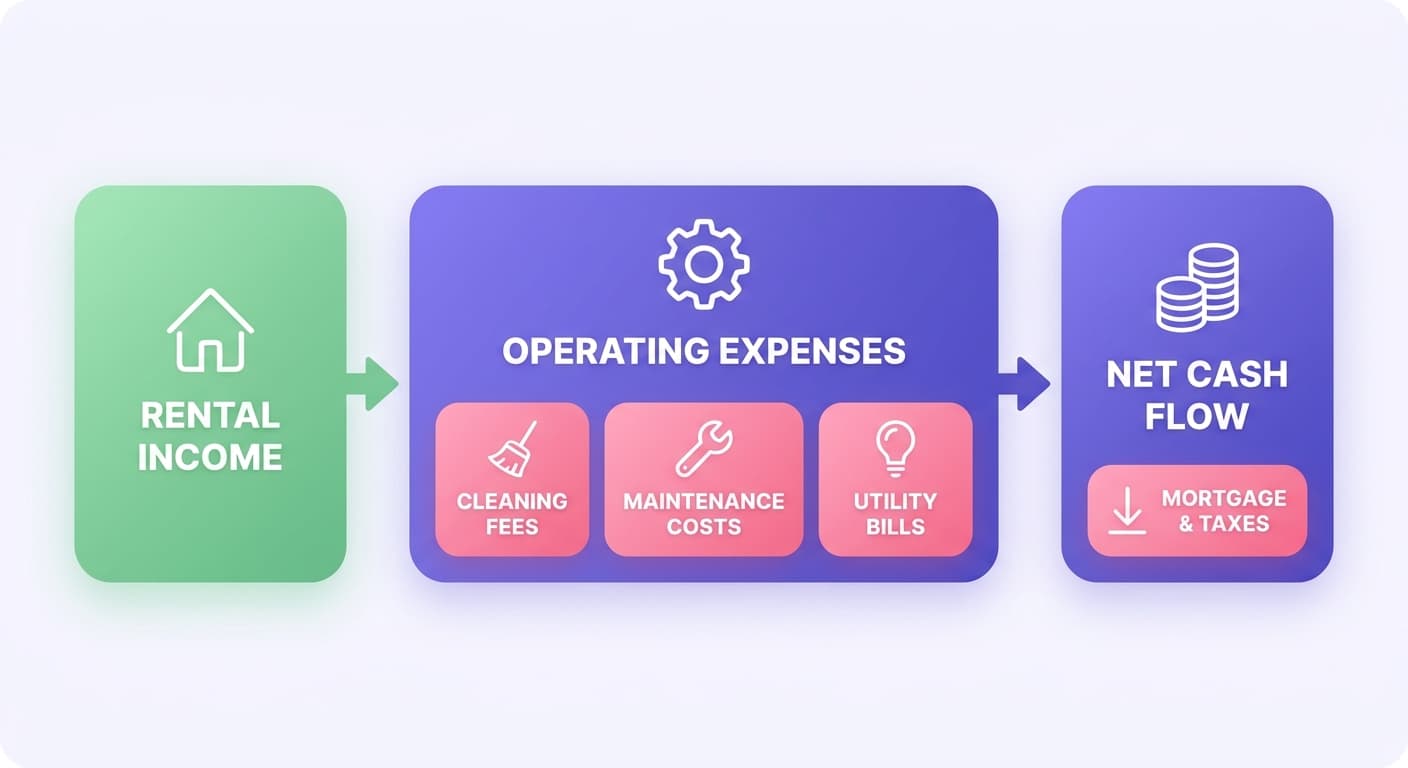
Cash flow in property management is the money left over from your rental income after every operating expense has been paid, mortgage, cleaning fees, platform commissions, utilities, and maintenance included.
Positive cash flow means your STR earns more than it costs to run. Negative means you're subsidizing your guests' stays out of pocket.
The clearest way to see which side you're on is to build a real estate cash flow statement that maps every income source and expense line by line, because, in practice, it is exactly that: a structured accounting of what comes in versus what goes out.
Why Cash Flow Matters in Property Management
Most hosts fixate on occupancy and average daily rate. Those metrics don't pay your mortgage. Net cash flow from your property does.
A listing running at 85% occupancy can still bleed money if cleaning costs, owner utilities, and maintenance eat the margin, and that's exactly where hosts with strong revenue get caught short.
Tracking your real estate cash flow monthly (not quarterly) lets you catch cost creep before it compounds. A $30 rise in laundry costs across eight turnovers is $240 gone before you notice it on an annual review.
Cash Flow in Property Management: Visualized

The diagram above maps the core calculation behind cash flow: what comes in, what goes out, and what's left.
For STR hosts, the numbers move faster than in long-term rentals, a slow week in January can erase a strong December margin in ten days.
Here's how those blocks translate to a real listing:
Gross Revenue: 15 booked nights × $150 ADR + $45 cleaning fee per stay (5 stays) = $2,250 + $225 = $2,475 in guest payments
Operating Costs: platform fees (14%), cleaning payouts, supplies, and utilities typically run $900–$1,100 on a property at 75% occupancy
Net Cash Flow: the remainder after costs, in this example, roughly $1,375–$1,575 per month
When to Use It: Seasonal Guidance
Your listing's net income doesn't stay flat year-round, and your cash flow tracking shouldn't either. The metric earns its keep when conditions change fast enough to require a decision.
Peak season ramp-up: When your nightly rate jumps from $150 to $220 and occupancy hits 90%, recalculate monthly net income before committing to extra cleaning hires or supply orders. Higher revenue doesn't automatically mean proportional profit if turnover costs spike.
Shoulder season pricing reviews: At 55% occupancy and $130/night, your property may still cover fixed costs, but only if you've stripped discretionary spend. Run the numbers monthly, not quarterly.
Market disruptions: New local regulations, a competitor property opening nearby, or a platform algorithm change can shift your occupancy by 10-15 percentage points inside 60 days. That's when real estate cash flow tracking catches a problem before it compounds.
How It Influences Other Metrics
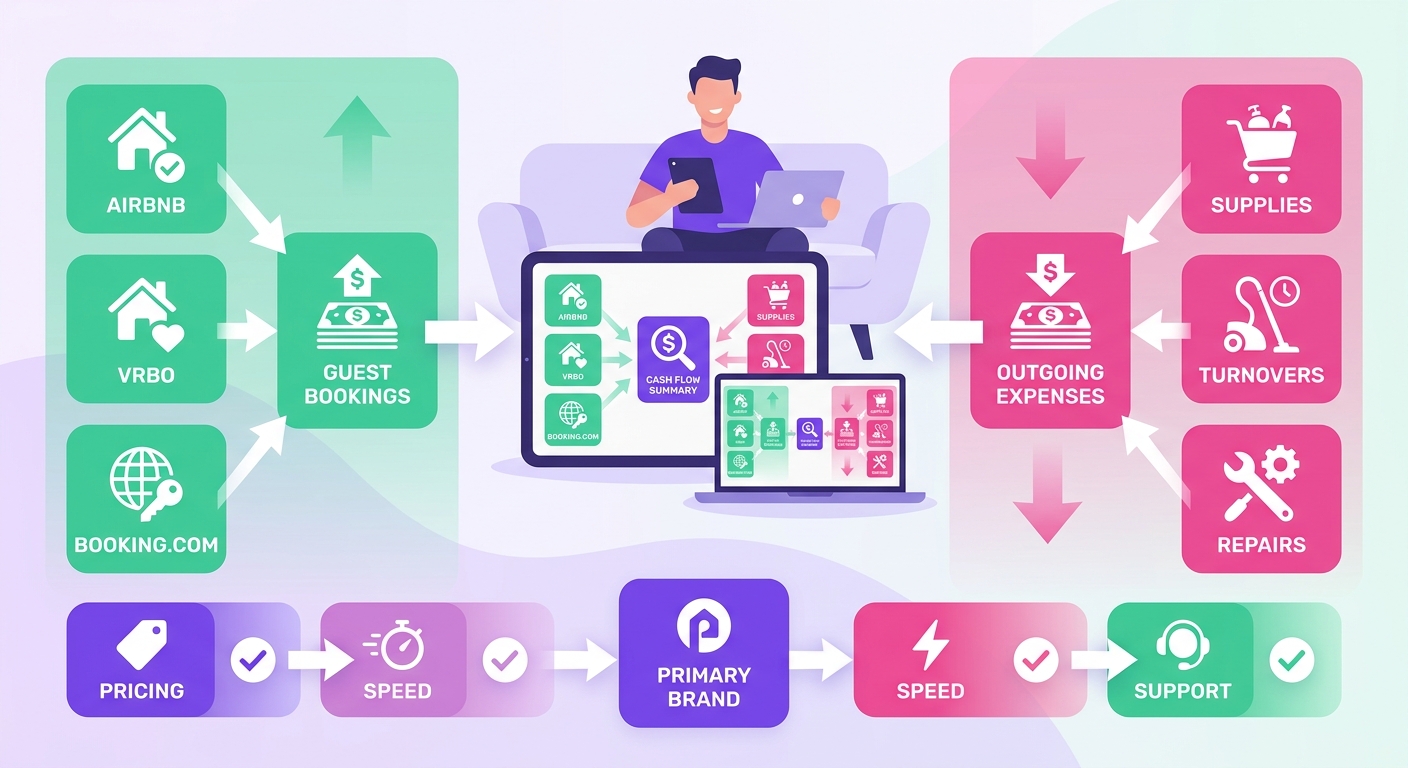
Cash flow is the output of every other number your listing produces.
Your occupancy rate sets the revenue ceiling. At 75% occupancy on a $150/night listing, you collect roughly $3,375/month before expenses.
Drop to 60% and that same property generates $2,700, a $675 swing that hits net cash flow directly. Empty nights do the damage without any pricing change.
ADR compounds the effect. Raise ADR from $150 to $165 at 75% occupancy and monthly revenue climbs to $3,712, an extra $337 that flows almost entirely to the bottom line, since fixed costs don't move.
RevPAN ties both together. Tracking RevPAN reveals whether a high-ADR, low-occupancy strategy or a moderate-rate, high-fill strategy produces better monthly cash flow after cleaning fees and platform costs.
Find Your Cash Flow in Minutes
Run the numbers on any listing before you commit. Mr. Props calculates your net monthly cash flow automatically, no spreadsheets required.
Start Free Trial See How It Works
No credit card required. Works with Airbnb, Vrbo, and Booking.