
What is Booking Window?
Booking Window Booking window is the time between a guest making a reservation and…
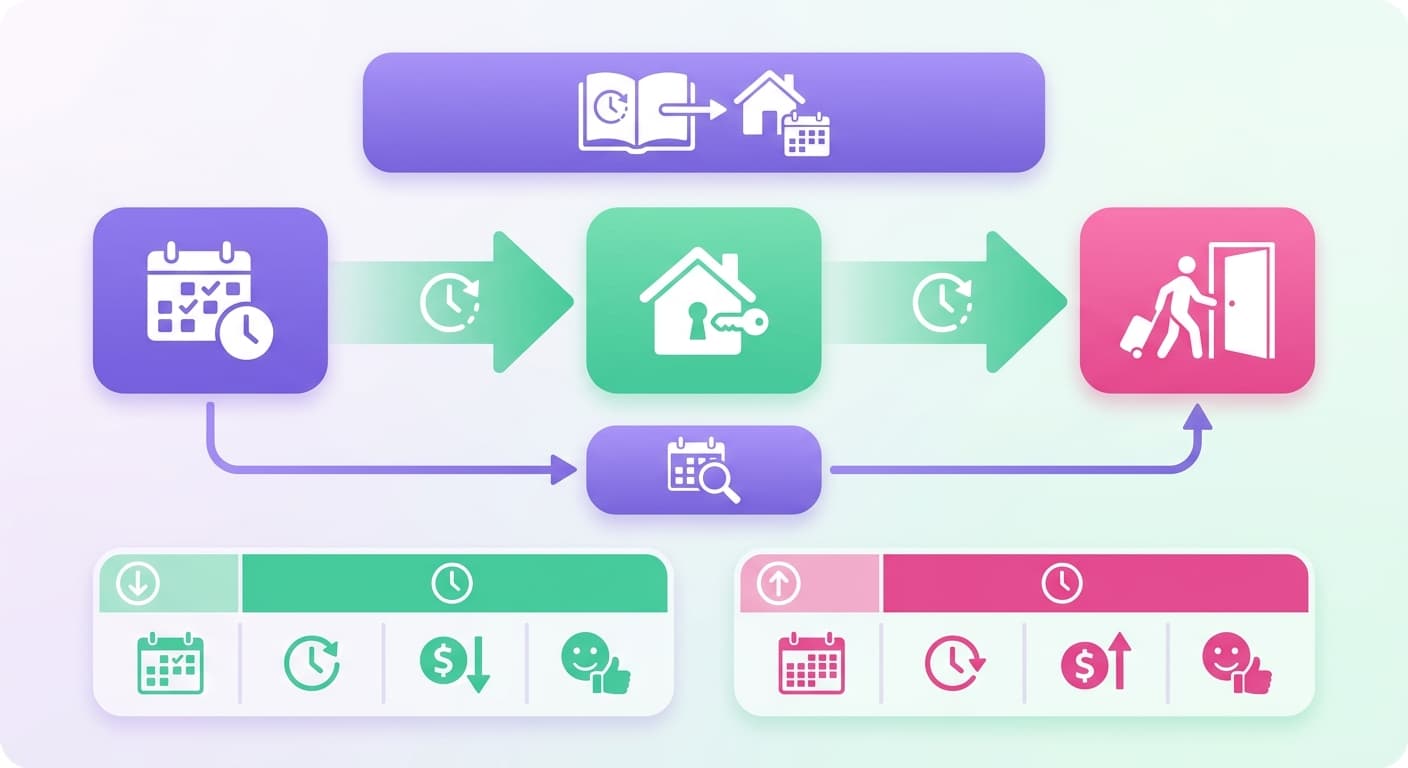
Booking window is the time between a guest making a reservation and their scheduled arrival.
A guest who books your $150/night listing on May 6 for a May 20 check-in has a booking window of 14 days.
That gap tells you how far in advance your property fills, which directly affects when you should adjust pricing, how aggressively to discount last-minute gaps, and whether your minimum stay rules are blocking short-notice demand.
Most hosts track occupancy and nightly rate but ignore lead time entirely. That's the gap where pricing decisions quietly go wrong.
What Your Booking Window Reveals About Your STR Performance
A $150/night listing running at 75% occupancy earns roughly $41,000 a year. Shift that occupancy to 85% by adjusting your pricing to match how far out guests actually book, and you're looking at $46,600 a $5,600 difference from one metric.
That's the real stakes of your booking window. It tells you when demand is landing on your calendar, which directly controls whether you're filling gaps at full price or discounting last-minute to avoid zero-revenue nights.
Short booking windows (under 14 days) push hosts into reactive pricing. It's a scramble. But when your calendar fills up 60+ days out, you have the leverage to hold your rate and wait for the perfect booking.
Unfortunately, most hosts treat both situations the same. It's a rookie mistake, and it easily costs them 10-15% in lost revenue.
Booking Window Visualized

The diagram above shows a guest booking 47 days before a May check-in on a $150/night listing. That 47-day gap is the booking window. Your nightly rate at the moment of booking is the rate that guest pays, regardless of what you change later.
Short windows look different. A guest books Thursday for a Saturday arrival: that's a 2-day window. Your pricing strategy for those two scenarios should not be identical, but most hosts treat them the same way.
Two patterns dominate STR data:
Long windows (30-90+ days out): leisure travelers, peak-season stays, multi-night bookings averaging 4-6 nights
Short windows (0-7 days out): last-minute guests, 1-2 night stays, often lower average daily rate unless you hold firm on price
A Season-by-Season Guide to Booking Window Strategy
Your booking window shifts with your market, calendar, and guest behavior throughout the year.
High season: Expect a 45-75 day average booking window. If you're not filling 60+ days out, drop your rate 10-15% and test demand.
Shoulder season: Windows compress to 14-30 days. Last-minute discounts of 8-12% move inventory without gutting your baseline.
Off-season: Same-week bookings often dominate. A 7-day window is normal, panic-discounting below your floor rate won't help.
How Booking Window Affects Other Metrics

Booking window directly shapes three numbers you watch every week: occupancy, ADR, and RevPAN.
A short booking window (under 7 days) usually signals last-minute demand. If your $150/night listing fills at 85% occupancy through 2-3 day lead times, you're leaving rate on the table, guests booking that close to arrival are often less price-sensitive.
Dropping your nightly rate to chase those fills costs you on nights that would have booked anyway.
A longer booking window is where you make your money. When you've got 21+ days of lead time, you have real pricing power.
You can hold your rate, test a $15/night increase, and still hit a solid 70-75% occupancy without ever touching a discount. It's simple, really. Your RevPAN climbs because you aren't giving away your best dates for cheap.
Find Your Booking Window in Minutes
Mr. Props pulls your real lead-time data across all listings so you can see exactly where your advance reservations sit, and price accordingly.
No credit card required. Setup in under 5 minutes.