
What is Average Daily Rate in Short Term Rentals?
Average Daily Rate in Short Term Rentals
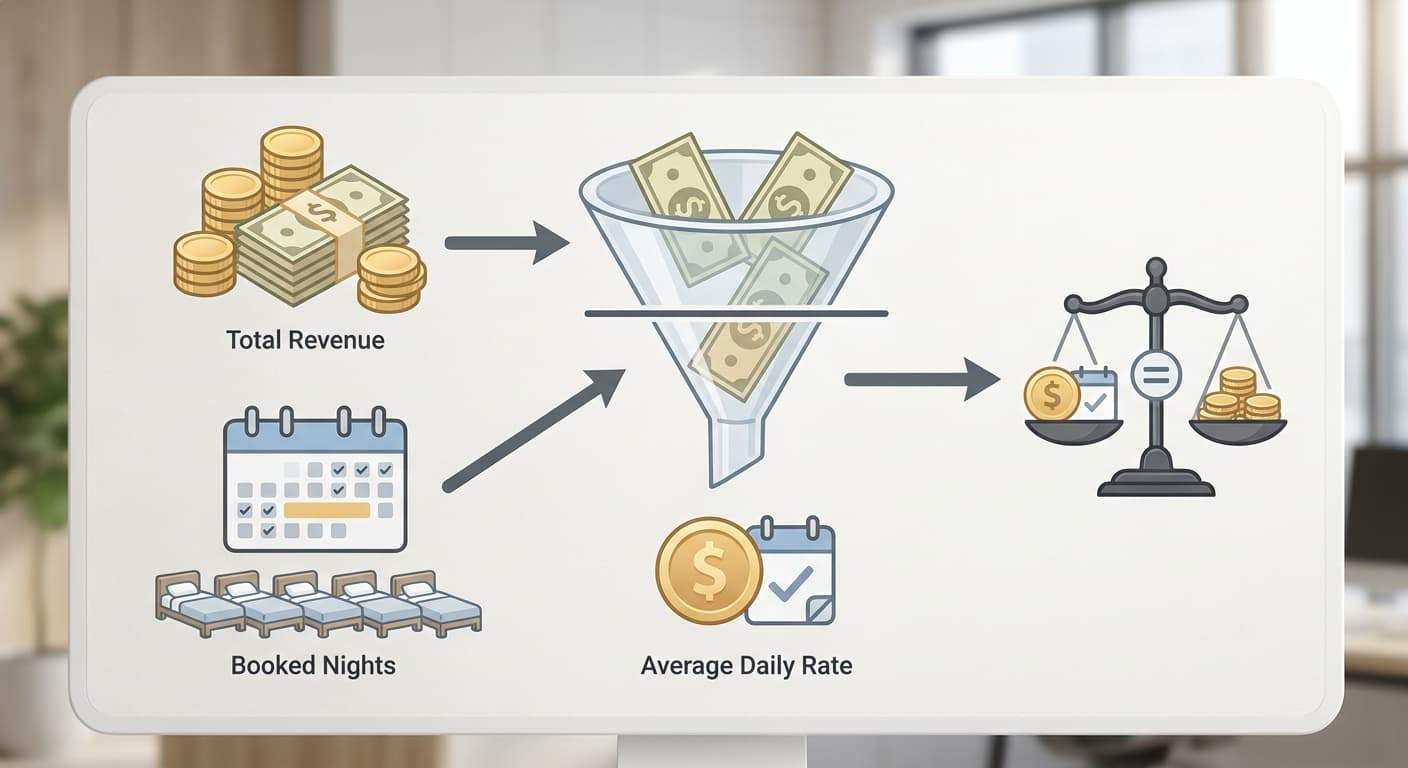
Average daily rate (ADR) is the average revenue your short-term rental earns per booked night, calculated by dividing total rental income by the number of nights actually occupied.
It's one of the two numbers every host needs to know, the other being occupancy rate, because a high nightly price means nothing if your calendar sits half-empty, and a full calendar means nothing if you're charging too little per night.
The Role of ADR in Your STR Success
Underpricing your rental by just $20 costs a fortune. That tiny difference in your ADR might not seem like much, but when you multiply it across 200 booked nights, it suddenly balloons into $4,000 of pure profit.
That’s enough cash for a full bathroom renovation, we’re talking new hex tile, a modern vanity, the works, or six months of property management fees. Don't just give that money away.
Here's the math that makes it concrete. At $150/night with 75% occupancy across 365 nights, your gross rental income is $41,063.
Push your average nightly rate to $170, without changing your occupancy at all, and that same property earns $46,538. The $20 increase did more work than most operational cuts ever could.
Average Daily Rate: A Visual Breakdown

The formula itself is simple. What trips up most hosts is understanding which revenue figure goes into it, and why that number isn't always what you think.
ADR = Total Rental Revenue ÷ Nights Booked
Calculating your daily rate seems simple. Let's say your Airbnb pulls in $4,500 of rental income across 30 booked nights in a busy July.
That's a clean $150 per night. It's not complicated, until you have to decide what actually counts as "rental revenue."
Cleaning fees, pet fees, and Airbnb service charges paid by guests often inflate that revenue figure if you're pulling numbers directly from your payout summary.
Strip those out before you divide. Your nightly rate should reflect only what guests pay to stay not what they pay to check in.
Include: nightly base rate, length-of-stay discounts applied
Exclude: cleaning fees ($45-$85 typically), platform service fees, damage deposits
Watch for: weekly or monthly discount adjustments that lower effective nightly revenue
When to Use Average Daily Rate
Your nightly rate shouldn't stay flat all year. The whole point of tracking your daily rate is to know when to move it and by how much.
Three situations should prompt an immediate rate review:
Peak season approaching: If your market runs 90%+ occupancy in July, your $180/night base rate has room to climb. Properties in coastal markets routinely push $280–$340/night during an 8-week summer window without losing bookings.
Shoulder season softness: When occupancy drops below 60%, a lower nightly rate often recovers more revenue than holding firm. A drop from $165 to $140 that fills 4 extra nights nets $560 you'd otherwise miss.
Local event surges: A single festival weekend can support 2–3x your standard rate. Missing that window is a permanent loss.
How ADR Affects Other Metrics

Your nightly rate doesn't operate in isolation. It pulls two other numbers with it: occupancy and revenue per available night (RevPAN).
Here's where hosts get tripped up. Raising your ADR from $150 to $180 feels like a win, but if occupancy drops from 78% to 61% as a result, your RevPAN actually falls. RevPAN = ADR × occupancy rate so a 20% rate increase paired with a 17-point occupancy drop is a net loss, not a gain.
The relationship runs the other direction too.
Cutting your rate to fill gaps can inflate occupancy while quietly gutting revenue. A listing at $110/night with 90% occupancy earns less per available night than one at $155 with 72% occupancy.
Neither metric tells the full story without the other.
Find Your Average Daily Rate in Minutes
Stop guessing what your listing should charge. Run the numbers on your property and see exactly where your daily rate stands against your market.
Start Free Trial See a Sample Report
No credit card required. Setup takes under 5 minutes.