
What is Short Term Rental?
Short Term Rental
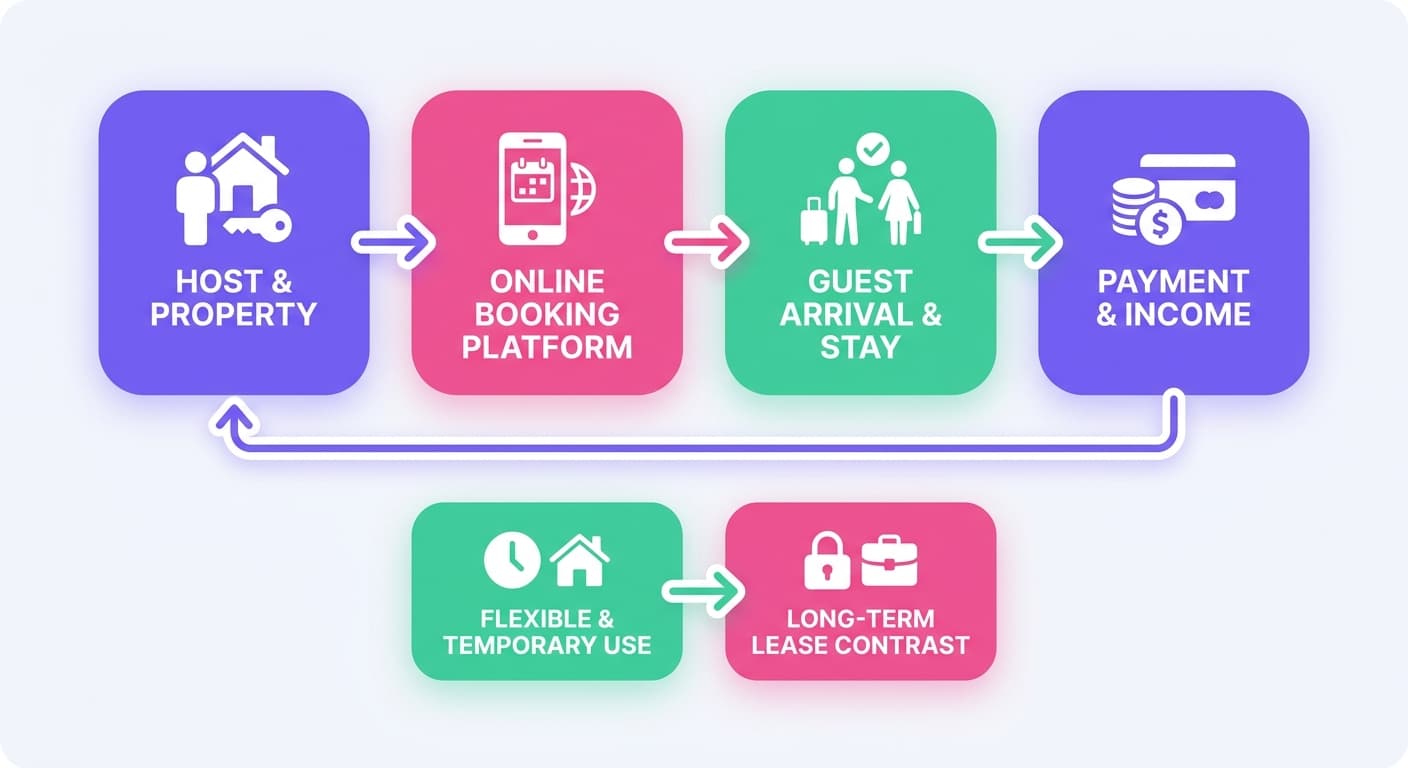
A short-term rental is a furnished residential property rented to guests for stays typically under 30 nights, listed on platforms like Airbnb, Vrbo, or Booking.com and priced per night rather than per month.
That 30-night threshold isn't just a number; it’s the legal line separating a short term rental from a traditional lease.
Cross it, and your guests might suddenly acquire full tenant rights in places like California or New York, forcing you into a formal, months-long eviction process. It’s a huge deal.
Most hosts don't even get close, sticking to nightly rates between $100–$300, running 60–80% occupancy, and tacking on a separate cleaning fee that averages about $65.
Short Term Rental's Role in Your Overall Financial Picture
A property renting at $150/night with 75% occupancy, a pretty standard goal for a decent listing, generates roughly $41,000 a year.
The same unit on a 12-month lease at $1,800/month?
It only brings in $21,600. That’s a staggering $19,400 difference on a single property. You could renovate a whole kitchen with that cash.
That spread is why hosts accept the added complexity: turnovers, active pricing, guest comms, and platform fees. The math only works if you're running the listing actively. Passive management kills the premium.
Three numbers drive your STR revenue:
Average daily rate $150/night is a realistic mid-market baseline in most U.S.
Occupancy rate 70–80% is achievable; below 60% and the long-term lease often wins
Cleaning fee recovery a $45 cleaning fee covers turnover cost but doesn't pad revenue
Visual Breakdown: Short-term Rental Revenue at a Glance

Gross revenue isn't net revenue. A $3,300 month looks healthy until you subtract the Airbnb service fee (typically 3%), a $55 cleaning fee per stay, and any platform-specific charges.
On 6 turnovers, that's $330 in cleaning costs alone.
You're not just a landlord collecting a fixed $1,800/month check. You’re running a variable-revenue hospitality business. It’s a totally different game.
Gross monthly revenue: $165 × 20 nights = $3,300
Platform fee (3%): -$99
Cleaning costs (6 turnovers × $55): -$330
Net operating revenue: $2,871
Seasonal Patterns
Your strategy as a short-term rental owner can't be static; you have to shift with the calendar. It’s all about seasonality.
Peak season (June–August for most U.S. markets): Raise minimum stays to 3–4 nights to cut turnover costs and protect your $45–$65 cleaning fee margin.
Shoulder season: Drop minimums to 1–2 nights. Filling a Thursday gap at $140 beats a vacant weekend.
Off-season: Some hosts switch to 30-day furnished rentals, technically outside the short-term rental definition, to maintain cash flow without the turnover grind.
Local regulations complicate this. Roughly 40 U.S. cities cap annual short-term rental nights, which forces hosts to plan seasonal windows in advance rather than react to demand.
How It Affects Other Metrics

Your nightly rate doesn't exist in isolation. A $150/night listing running at 60% occupancy generates $2,700/month in revenue.
Push occupancy to 75% without changing your rate, and that becomes $3,375, a 25% revenue gain from one metric shift.
This is where RevPAN matters more than ADR alone.
A host charging $200/night at 50% occupancy ($100 RevPAN) is underperforming a host charging $150/night at 80% occupancy ($120 RevPAN). Higher rates don't automatically mean better returns.
Find Your Short Term Rental Setup in Minutes
Mr. Props maps your property type, nightly rate, and occupancy targets to the setup that actually fits, no guesswork, no generic checklists.
Start Free Trial See How It Works
No credit card required · Setup in under 5 minutes · Used by 4,200+ STR operators