
What is Guest Screening Process?
Guest Screening Process A guest screening process is the set of steps a host takes…

A guest screening process is the set of steps a host takes before confirming a booking to verify a guest's identity, assess risk, and decide whether to accept or decline the reservation.
It's a sequence of distinct decisions, each catching a different category of risk.
Hosts who take the time to understand what the process is in full, rather than skimming the surface, consistently report fewer disputes, lower damage claims, and stronger long-term reviews.
Why Knowing Who's Staying in Your Property Is Non-Negotiable
A single problem guest can cost you more than a month of revenue.
Property damage claims average $1,200 to $3,500 per incident, before factoring in lost bookings during repairs, extra cleaning fees, and time spent filing a claim with Airbnb's AirCover or your own policy.
Consider a typical listing: $150/night at 75% occupancy generates roughly $41,000 annually.
One serious damage event plus two weeks of blocked calendar wipes out $2,100 in direct revenue a 5% hit to annual income from a single bad booking.
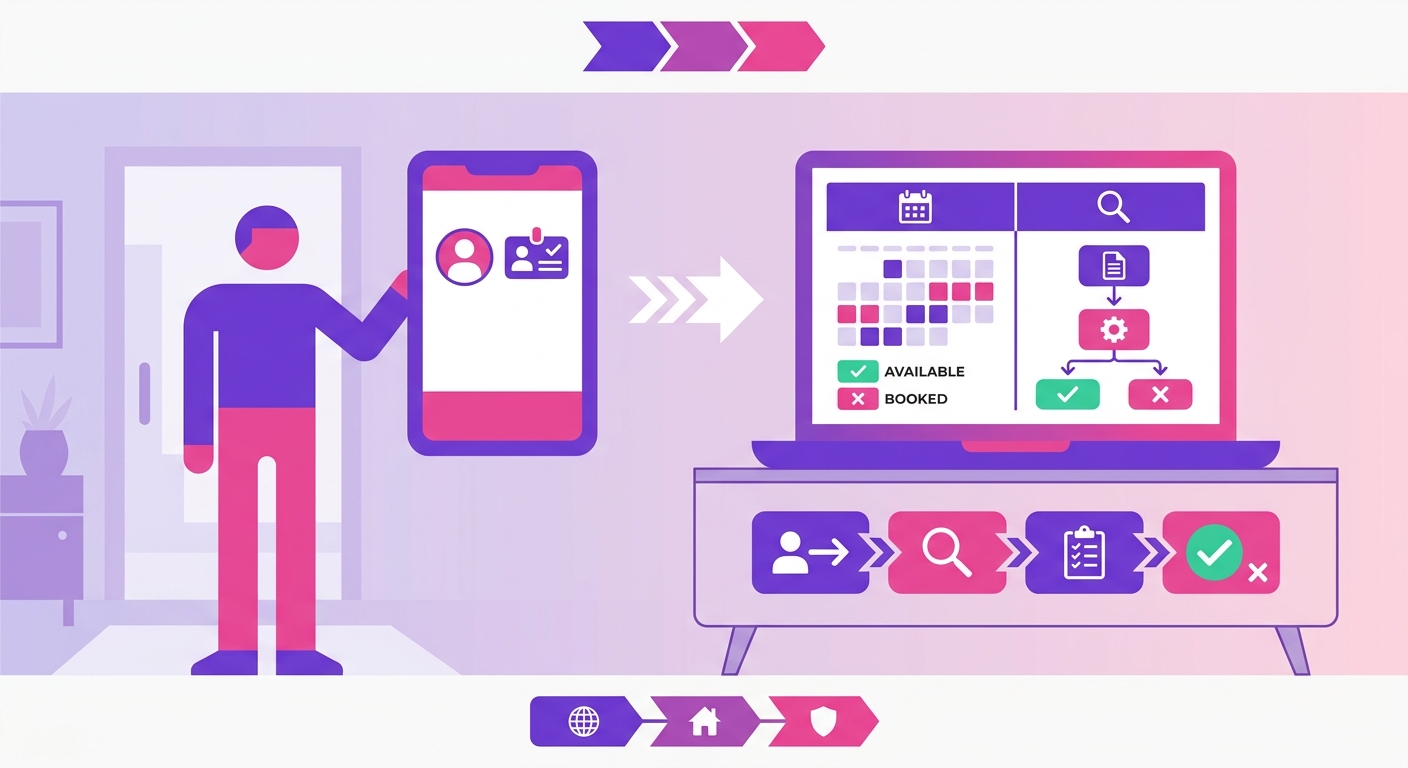
How a Guest Screening Process Works Visually

The five-stage flow above covers roughly 80% of what a standard vetting check looks like on a listing. Each stage is a gate. A guest who clears all five moves to confirmed status; one who fails at stage two never reaches your calendar.
Stage three, the risk score, is where most hosts lose time. Manual checks on a 75% occupancy rate running 20+ bookings per month add up fast.
Automated screening tools typically return a risk score in under 90 seconds, flagging guests with prior damage claims, fraud patterns, or mismatched identity data.
Stage 1-2 catch identity fraud and fake profiles
Stage 3 surfaces behavioral risk from prior STR stays
Stage 5 shifts financial liability back to the guest before check-in
When to Use The Guest Screening Process
Your screening intensity should shift with your booking calendar. A $150/night listing running at 75% occupancy in peak summer attracts a very different guest mix than the same property at 45% occupancy in January.
Tighten your vetting criteria during these windows:
Holiday weekends (Memorial Day, July 4th, Labor Day): Last-minute bookings spike, and so do party-risk reservations. Require government ID verification and add a direct message check before accepting.
Local event weekends: Concerts, sports finals, and graduation weekends draw one-time guests with no review history. A two-booking minimum or manual approval cuts your exposure.
Off-season single-night stays: A $99 Sunday booking in February is disproportionately likely to be a local guest, worth a quick profile review before confirming.
The Metrics That Change When You Screen Guests More Carefully
Screening adds friction to the booking flow.
A listing requiring ID verification will convert at a lower rate than one that accepts instant bookings with no checks, but the hosts who've dropped screening to chase occupancy tend to regret it after one $3,000 damage claim.
The actual trade-off is narrower than it looks. Properties running structured vetting typically see 3–5% lower booking conversion but 18–22% fewer damage incidents which directly protects your net RevPAN.
ADR is largely unaffected. Guests willing to pay $175/night don't balk at an ID check, they expect it. The bookings you lose are disproportionately the ones most likely to cause problems.
Start Screening Guests Confidently
Mr. Props gives you a guest screening checklist built for Airbnb and Vrbo hosts managing 1-50 properties, no guesswork, no wasted time.
Start Free Trial See How It Works
Trusted by 4,200+ STR operators. No credit card required.