
What is Vacation Rental Revenue Management Guide?
Vacation Rental Revenue Management Guide Vacation rental revenue management is the practice of adjusting your nightly rates…
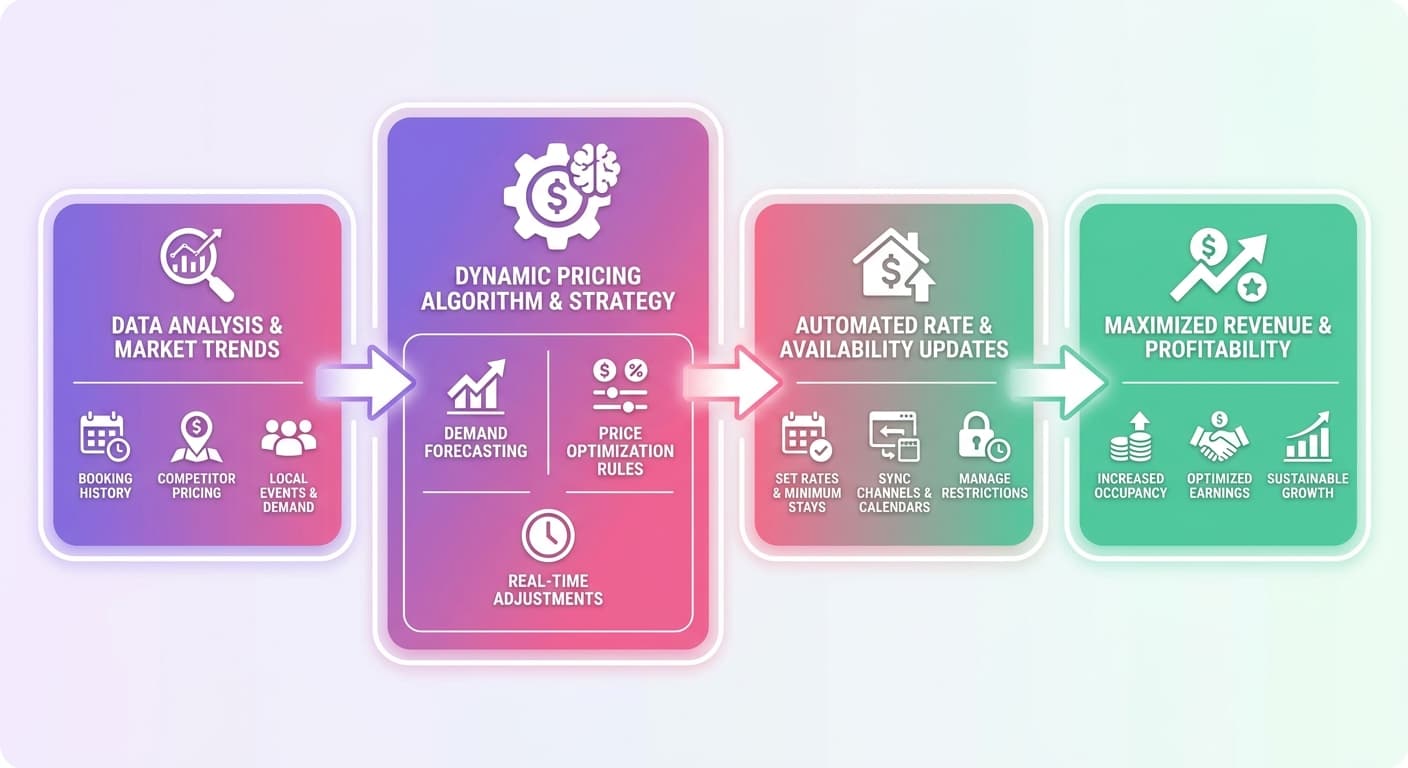
Vacation rental revenue management is the practice of adjusting your nightly rates, minimum stays, and availability windows in response to demand signals, so your listing earns more per available night, not just more bookings.
Hgher rates on the right nights outperform a packed calendar at flat pricing.
The goal isn't a full calendar. It's maximum revenue per available night, with rates that reflect what guests will actually pay on any given date.
Hosts who apply vacation rental revenue management consistently tend to outperform comparable listings in their market, even when their occupancy numbers look lower on paper.
Why Is Vacation Rental Revenue Management Significant?

A property sitting at a flat $150 nightly rate with 75% occupancy earns $41,063 per year. The same property, priced dynamically across demand cycles, can realistically hit $52,000 to $58,000.
Most hosts leave that money on the table not because they're pricing wrong on average, but because they're pricing the same way on a slow Tuesday in February as they are on a holiday weekend in July.
The $45 cleaning fee is fixed. Your mortgage doesn't flex. But your nightly rate does, and it's the single variable you control most directly. A 15% rate increase on your top 30 demand nights adds roughly $675 at $150/night. No new bookings required.
Matching the Vacation Rental Revenue Management to The Right Moment
Your pricing decisions should respond to specific calendar triggers, not gut instinct.
Three situations call for active rate adjustments on your listing:
Demand peaks: Local events, holidays, and school breaks can push nightly rates 40-80% above your baseline. If a regional festival drives your market's average daily rate to $240, your flat $150 is a gift to guests.
Shoulder seasons: Drop rates 10-15% and extend minimum stays to capture longer bookings at 65-70% occupancy rather than sitting empty.
Last-minute gaps: Unbooked nights within 7 days convert better at a 20-25% discount than at full price.
Vacation Rental Revenue Management and the Metrics It Drives

These three numbers move together: ADR, occupancy rate, and RevPAN. Pull one up without watching the others and you'll often find you've hurt your total return.
RevPAN is the only metric that truly shows you the money. For instance, tighten your minimum-night stay to 3 nights for the big Labor Day weekend. You’ll probably see ADR climb while occupancy dips slightly. But don't panic, your RevPAN will almost certainly rise, and that's the number that actually matters.
Put Your Pricing on Autopilot
Mr. Props tracks demand signals, adjusts your nightly rates, and flags revenue gaps before they cost you bookings.
Start Free Trial See How It Works
No credit card required · Set up in under 10 minutes · Works with Airbnb, Vrbo & Booking.com