
What is Vacation Rental Cancellation Policy Guide?
Vacation Rental Cancellation Policy Guide A vacation rental cancellation policy is the set of rules governing whether…
A vacation rental cancellation policy is the set of rules governing whether a guest receives a refund, and how much, when they cancel a confirmed booking at your property.
The policy sits between you and the booking platform.
Whether you list on one platform or several, your short term rental cancellation policy is one of the most consequential settings in your listing, shaping guest trust, booking conversion rates, and your protection against last-minute revenue loss.
Hosts who treat it as an afterthought often discover its impact only after an expensive cancellation. Understanding how the policy works across different platforms helps you make a deliberate choice rather than defaulting to whatever a platform pre-selects.
What Your Cancellation Policy Is Really Costing You
A last-minute cancellation on a $150/night listing doesn't just sting; it's a $450 hole in your confirmed revenue. If your calendar runs at 75% occupancy across 200 available nights, you're looking at around $22,500 in annual gross income.
Losing just 4% of that to unprotected cancellations costs you $900, and that’s before you eat the non-refundable $125 you already promised your cleaner. It’s a cash-flow killer.
The only lever you can pull to protect that revenue is your cancellation policy. It's that simple. A strict policy means you keep the nightly rate when guests cancel within 14 days of check-in, protecting your bottom line.
But a flexible one? It hands that entire $450 back to the guest if they cancel up to 24 hours before their stay, leaving your $45 cleaning slot empty and your calendar unfilled. You're left holding the bag.
Visual Breakdown: How Cancellation Policy Timing Works

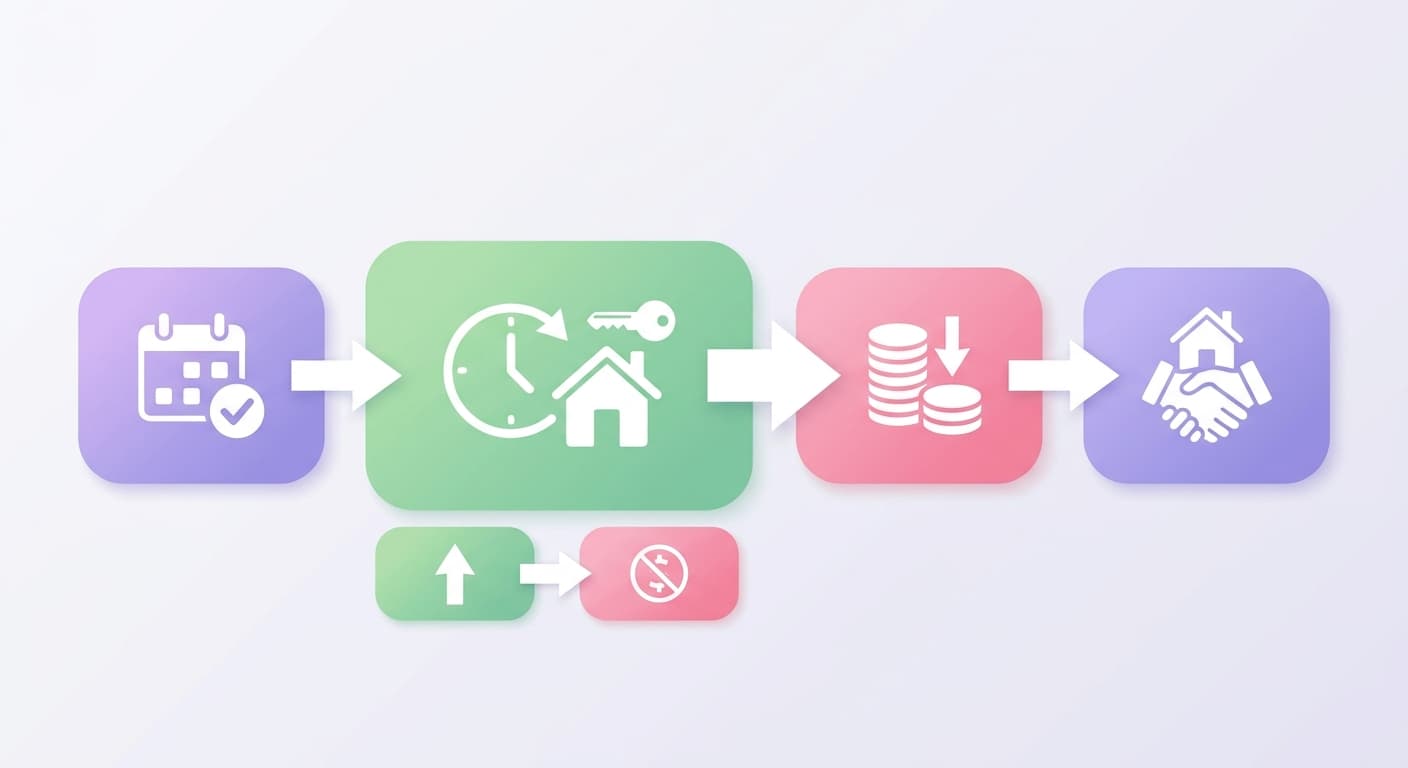
The diagram above maps the three points that determine how much revenue you actually keep when a guest cancels. Most hosts focus on the policy label, Moderate, Strict, Firm, and miss the math underneath it.
Here's what the numbers look like on a real booking:
Nightly rate: $150 × 4 nights = $600 base revenue
Cleaning fee at risk if cancelled inside the window: $65
Total exposure on a last-minute cancel under a Flexible policy: up to $665
When to Use Vacation Rental Cancellation Policy
Your cancellation terms aren't a set-and-forget decision. Market conditions should push you to revisit them at least twice a year.
Peak demand: use Strict or Firm to protect high nightly rates
Off-peak: use Moderate to reduce vacancy drag
Local events (festivals, conferences): treat like peak season regardless of calendar month
Cancellation Policies and the Numbers You're Not Watching Closely Enough

Your cancellation policy doesn't sit in isolation. It directly shapes three numbers that determine whether your listing is profitable: occupancy rate, average daily rate, and revenue per available night.
A strict policy on a $150/night listing can push your ADR up by 8-12% because guests who book non-refundable rates tend to commit earlier and hold the booking.
That's an extra $12-$18 per night. But the same policy can suppress occupancy by 5-10 percentage points if your market has strong competition from flexible listings.
The exception: high-demand markets with <70% supply availability.
There, strict policies rarely hurt occupancy because guests have fewer alternatives. In softer markets, a moderate cancellation policy often produces better RevPAN than a strict one, even at a lower ADR.
Set Your Policy in Minutes, Not Hours
Mr. Props gives you a ready-to-use the cancellation policy framework built for Airbnb and Vrbo operators, no blank-page drafting required.
Start Free Trial Browse Templates
Trusted by 4,200+ STR operators. No credit card required.