
What is Rental Turnover?
Rental Turnover Rental turnover is the process of preparing your short-term rental property for…
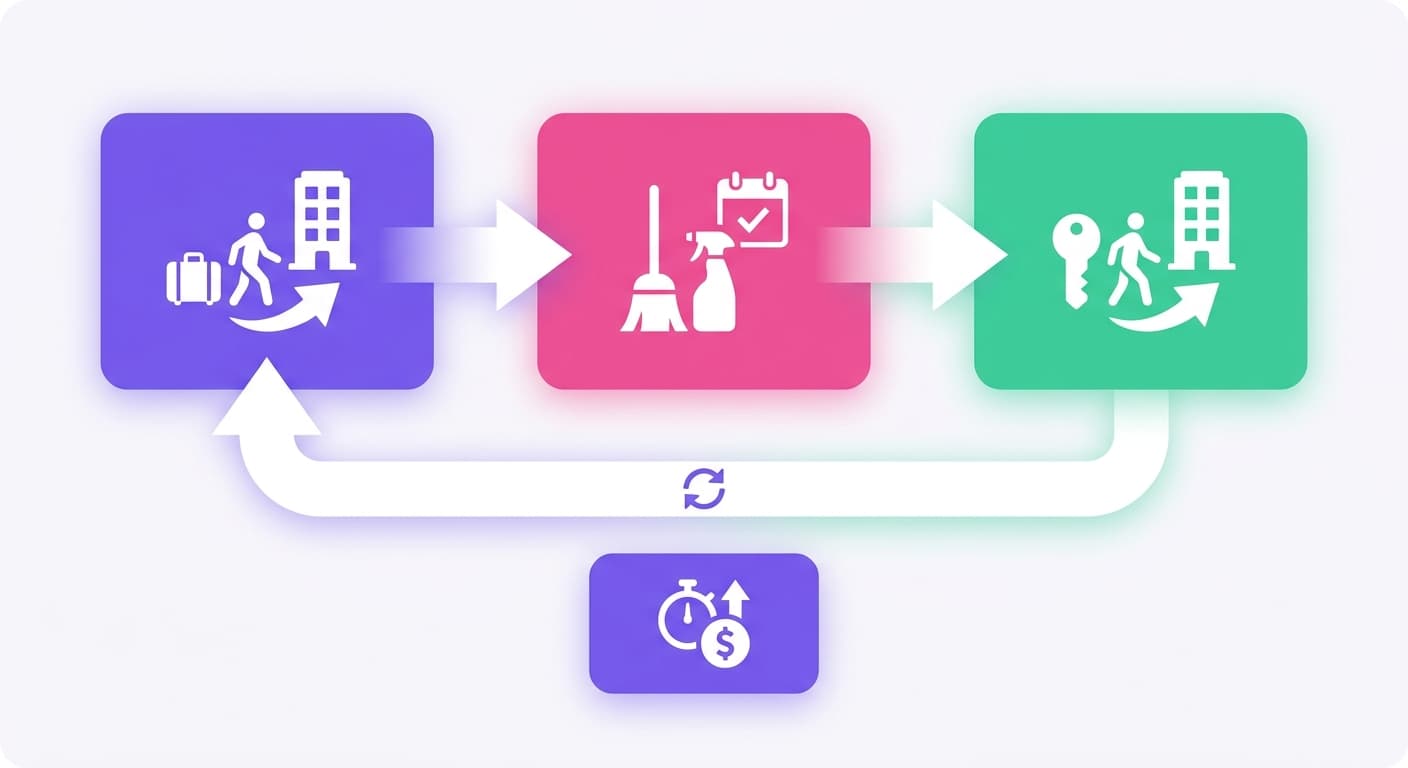
Rental turnover is the process of preparing your short-term rental property for the next guest immediately after a checkout, covering cleaning, linen changes, restocking, and inspection before the next check-in window opens.
Where long-term property managers track tenant turnover rate as an annual vacancy metric, STR hosts measure turnover in hours.
A listing running at 75% occupancy with a $150/night average rate can lose $150 in revenue for every turnover that delays a same-day check-in.
The faster and more consistent your turnover, the more back-to-back bookings your calendar can hold.
The Business Case for Taking Rental Turnover Seriously
Every checkout triggers a hard cost. At a $150/night average rate with a $45 cleaning fee, a property running 75% occupancy generates solid revenue, but poor turnover execution eats into that faster than most hosts expect.
A single missed checkout damages more than one booking. A late or incomplete turnover that delays check-in by two hours can cost you a 5-star review and on Airbnb, dropping from a 4.9 to a 4.7 rating correlates with lower search placement.
Less visibility means fewer bookings at full price.
STR turnover doesn't behave anything like long-term rentals. Your property flips every 2-4 days, not once a year, and even tiny misses stack up fast. Miss one cleaner handoff on a Friday in July, and suddenly you're scrambling. That's the whole problem.
A 20-minute cleaning overrun per turn costs 10+ hours monthly across 30 bookings
Restocking gaps drive guest complaints disproportionate to their actual cost
Inconsistent inspection checklists miss damage you can't claim after the next guest checks in
How Rental Turnover Looks in Practice
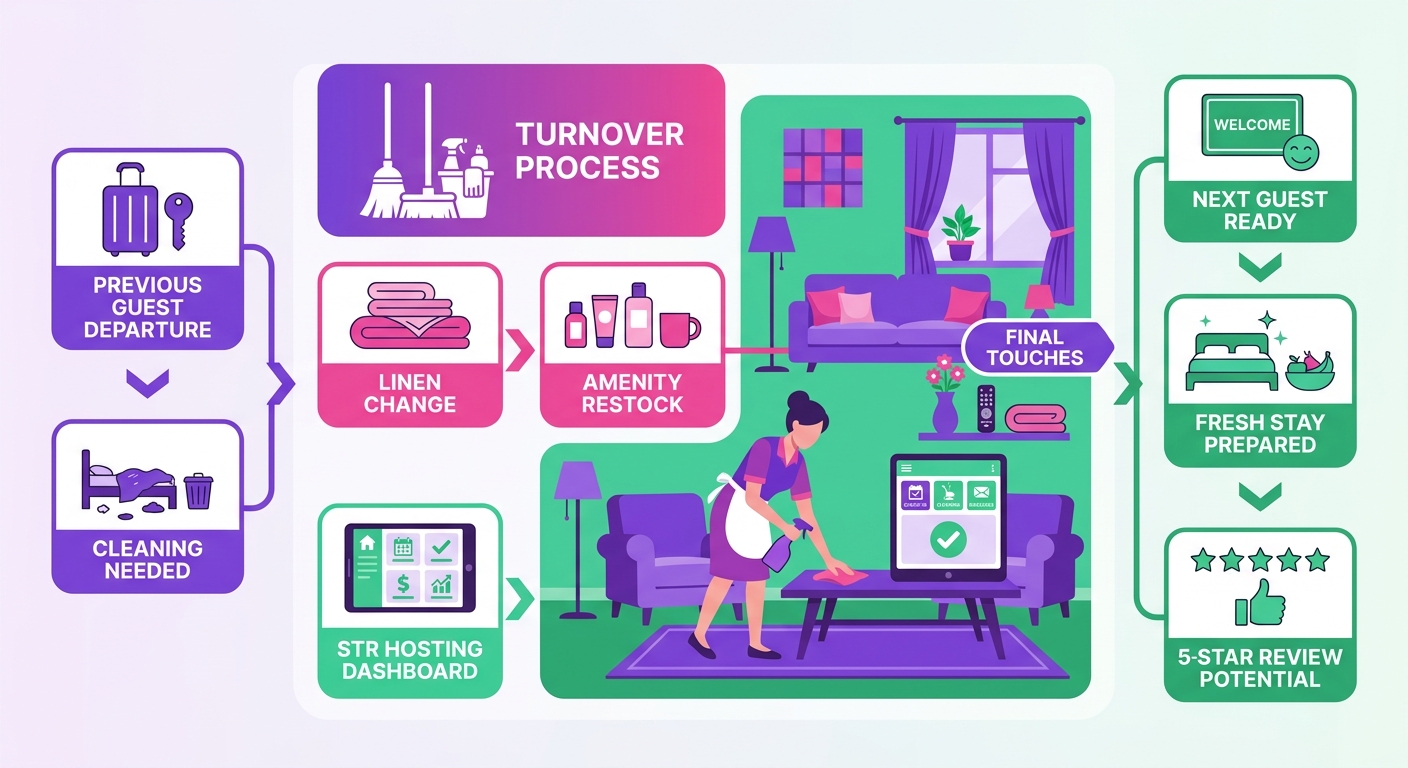
A property listed at $150/night with 274 booked nights out of 365 sits at a 75% occupancy rate. That's the number most hosts watch. But turnover frequency, how often guests check out and new ones arrive, tells a different story about your operational load.
If your average stay is 3.2 nights, those 274 booked nights produce roughly 86 separate guest cycles per year. Each cycle means a full clean, linen swap, restocking, and inspection.
At a $45 cleaning fee per turnover that's $3,870 in cleaning revenue annually, but also 86 coordination events your schedule absorbs.
Hosts running 2-night minimums face a steeper version of this. The average tenant turnover rate equivalent in STR terms is simply occupied nights divided by average stay length. Shorten stays, and that number climbs fast.
When to Use It
Your rental turnover rate can swing hard with your market, and if you ignore that, you'll feel it in your margins. A beach property at 85% occupancy in summer moves through guests every 3–4 days, often with Saturday check-outs packed back-to-back.
In January, that same property might drop to 40% occupancy with 5–7 day stays, same listing, totally different operational pressure. It's the same asset, sure, but the workload? Not even close.
Three situations where tracking turnover actually changes what you do:
Peak season ramp-up: When average stays drop below 3 nights, you need more cleaning slots per week. At $55 per clean and 12 turnovers monthly, that's $660 in cleaning costs, budget for it before the season, not during.
Shoulder season pricing: High turnover in slow months signals short-stay bargain hunters. Raising your minimum stay to 4 nights often cuts turnover by 30% without hurting revenue.
New market entry: Your first listing's historical turnover rate is the most reliable input for forecasting cleaning and supply costs on a second property.
How It Affects Other Metrics

High turnover frequency puts direct pressure on your RevPAN (revenue per available night).
Every same-day reset usually eats $45–$75 in cleaning fees and another 2–4 hours of coordination time, and on a three-night stay, that bite is hard to ignore. If the next booking doesn't cover it, that's dead revenue. Pretty simple, honestly.
Occupancy takes the hit first. A property averaging 75% occupancy with 2-night minimum stays processes around 11–12 turnovers per month.
Push minimums to 3 nights and you drop to 7–8 turnovers, occupancy may dip slightly, but your net revenue per turnover improves because cleaning costs don't scale with stay length.
ADR tells a similar story. Listings priced at $150/night with frequent 1-night gaps between bookings often underperform listings at $130/night with tighter booking windows and fewer resets.
Fewer turnovers can mean higher effective yield even at a lower nightly rate.
Find Your Rental Turnover in Minutes
Track every guest changeover, flag gaps, and keep your occupancy numbers clean. Mr. Props gives you the turnover data your Airbnb actually needs.
No credit card required. Set up in under 5 minutes.