Hospitable Alternatives: Why Mr. Props is Better for Growing STR Portfolios
Hospitable is the Old Way.
Mr. Props is Built for How You Operate Now.
Hospitable handles the basics. But if you're running more than a handful of listings across Airbnb, Vrbo, or Booking.com, you've already hit its ceiling, clunky multi-calendar views, no revenue reporting worth opening, and guest messaging that still needs you to babysit it. Mr. Props gives STR hosts a single operating system: active pricing, channel sync, automated guest communication, and portfolio-level reporting, all in one place. No duct tape.
Start Free, No Credit Card Required
See How It Works
No credit card required · Join 4,200+ hosts already managing smarter
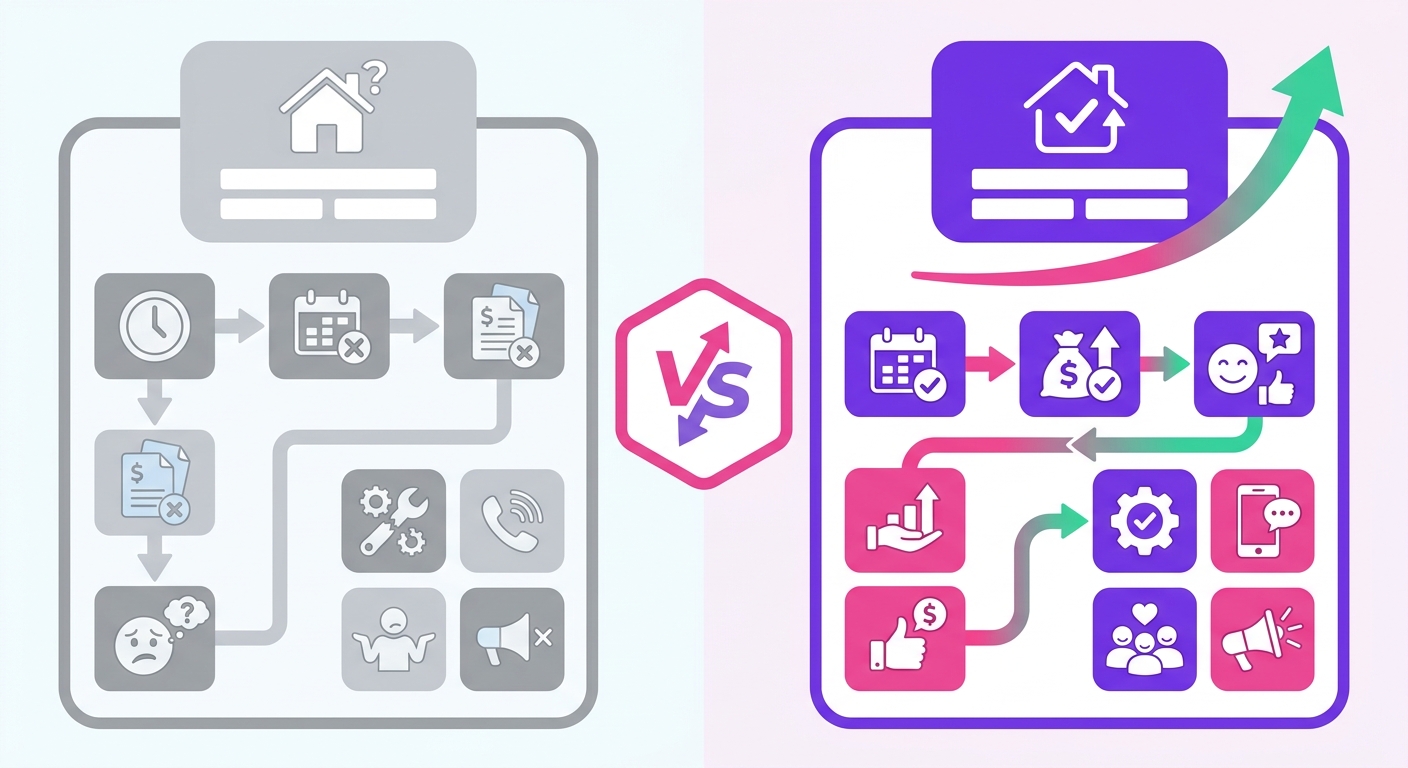
The Old Way Vs. the Mr. Props Way
Most hosts running listings across Airbnb, Vrbo, and Booking.com already know the friction: scattered dashboards, manual calendar updates, and revenue data that lives in three places at once. That's the old way. It costs time every single day.
Mr. Props consolidates channel management, pricing signals, and guest communication into one view. No duplicate data entry. No missed booking gaps. Hosts see occupancy shifts and rate performance the moment they happen, not after a manual export.
The hospitable alternatives to legacy tools aren't just prettier interfaces. They're genuinely fewer steps between a problem and its fix, and that operational clarity compounds across every property in a portfolio.
Where Other Platforms Fall Short (and What Mr. Props Does Differently)
Hosts shopping for hospitable alternatives to their current software keep running into the same three walls: surprise fees, manual workarounds, and reporting that doesn't tell them what they actually need to know. These cards break down each friction point and show the direct fix.
Fee Stacking at Scale
Competing platforms charge per-listing fees that compound fast. A host managing 15 properties on Airbnb and Vrbo can pay $300–$500/month before a single automation runs, with add-on charges for channel sync and owner reporting sitting behind separate paywalls.
Mr. Props bundles channel management, automated messaging, and owner statements into one flat-rate plan. No per-listing surcharges. No gated reporting tiers. The price you see at five units is the same structure at fifty.
Automation Gaps in Guest Communication
Many platforms offer message templates but don't trigger them based on booking conditions. A last-minute Booking.com reservation at 11 p.m. still requires a host to manually send check-in instructions, a gap that generates bad reviews when it slips.
Mr. Props fires condition-based message sequences the moment a booking confirms, regardless of channel or hour. Check-in details, door codes, and pre-checkout reminders go out automatically, without a host touching the inbox.
Reporting That Doesn't Answer Real Questions
Generic dashboards show total revenue and occupancy rate, then stop. Hosts managing multi-unit portfolios can't see which property is dragging down their average nightly rate or which cleaning turnover slot is consistently causing late check-ins.
Mr. Props breaks performance down by property, channel, and time period, so a host can spot that their two-bedroom Vrbo listing underperforms every Friday and act on it, not just observe it.
How Each Hospitable Alternative Actually Fits Your Operation
The cards above give you a quick read on features and pricing. What they can't show you is how each platform behaves once you're running 15 listings with back-to-back turnovers, a pricing rule that fires at 11 PM, and a guest who messages at 2 AM. That's where the real differences show up, and that's what this section covers.
Most hosts switching away from Hospitable aren't doing it because the product broke. They're doing it because they grew past what it was designed for, or because one specific gap (usually pricing automation or multi-channel reporting) became too expensive to work around manually.
Operator Fit: Who Each Platform is Actually Built for
Hospitable Alternatives don't all target the same host profile. A platform built for a 3-unit operator running Airbnb-only is structurally different from one built for a 50-unit portfolio spread across four channels, even if both advertise "automation" on their homepage.
- 1–5 units, single channel: Platforms with flat monthly fees under $30/unit make sense here. Automation depth matters less than ease of setup.
- 6–20 units, multi-channel: This is where channel management quality and pricing rule flexibility separate the contenders from the fillers.
- 20+ units or co-hosting portfolios: You need per-property reporting, team permissions, and owner statement generation, features most entry-level tools quietly skip.
The honest limitation here: no single platform is the best fit across all three tiers. Hosts who try to find one tool that "does everything" at the same price point usually end up with a tool that does nothing particularly well.
Pricing Logic and What It Costs at Scale
Pricing structures across these platforms vary more than the marketing suggests. Some charge per listing, some charge a percentage of revenue, and a few bundle active pricing into the base plan while others treat it as a paid add-on.
Per-Listing Vs. Revenue-share Models
A per-listing fee is predictable. At $20/unit/month, 20 units costs $400/month regardless of whether those units generate $8,000 or $40,000 in revenue. A revenue-share model (typically 1–3% of booking revenue) costs less at low revenue but scales up fast during peak season, exactly when you're already paying more for cleaning, supplies, and guest services.
Automation Differences That Actually Matter in Day-to-day Operations
Most platforms advertise automation. Few deliver it at the same depth. The gap shows up not in the feature list but in the trigger logic the conditions that determine when an automated action fires, who it goes to, and what happens if it fails.
Basic automation covers the obvious: check-in instructions sent 24 hours before arrival, a mid-stay message on day two, a checkout reminder the morning of departure. Every serious platform handles this. Where they split apart is conditional logic, the ability to send a different message to a guest who booked same-day versus one who booked three months out, or to pause a cleaning notification when a booking is cancelled inside the 12-hour window.
Guest Messaging Automation
Platforms built specifically for STR operators tend to offer multi-condition triggers: time-based, event-based, and booking-attribute-based in combination. A guest who books a pet-friendly unit, paid a pet fee, and is arriving during a holiday weekend can receive a different welcome sequence than a standard booking, automatically, without manual tagging.
Platforms that started as general property management software and later added STR features often restrict automation to single-condition triggers. That's a meaningful operational difference when you're managing 15+ listings across two or three channels.
Cleaning and Turnover Coordination
Turnover scheduling is where automation failures cost real money. A missed cleaning notification before a same-day turnover doesn't just create a bad review, it creates a rebooking problem, a potential refund request, and a guest who now has photographic evidence of a problem.
- Look for platforms that push turnover tasks to cleaners in real time when a booking is modified or cancelled, not just on a nightly sync.
- Checklist completion tracking, where a cleaner marks tasks done and the system flags incomplete items, is a feature some platforms charge extra for.
- Two-way calendar sync alone is not turnover automation. A platform that updates your Airbnb calendar but doesn't notify your cleaning team has created half a workflow.
Reporting: What You Can Actually See Without Exporting a Spreadsheet
Reporting quality is an underrated differentiator. Hosts who manage 10 or more units need to see revenue by channel, occupancy by property, and average daily rate trends, without downloading a CSV and building their own pivot tables every month.
The honest limitation: most platforms in the mid-market tier offer reporting that covers the basics but buries the useful data. Occupancy rate at the portfolio level is easy to find. Occupancy rate by bedroom count, filtered by channel, compared to the prior 90 days, that usually requires an export or a third-party integration.
Revenue Reporting Vs. Operational Reporting
Most platforms don't master both **revenue reporting** and **operational reporting**. It's just a fact. **Revenue reporting** meticulously tracks your booking income down to the last penny, including channel fees and net payouts. **Operational reporting**, on the other hand, is all about the guest experience, measuring things like your average response time, review scores, and making sure your cleaner's task list for Unit 2B got completed on time.
Hosts building a co-hosting business or managing properties for owners need both. Owner statements, in particular, require a reporting layer that pulls net revenue after expenses, a feature that some platforms position as a premium add-on rather than a standard function.
| Reporting Feature |
Common in Mid-Tier Platforms |
Usually Premium or Missing |
| Portfolio-level occupancy |
Yes |
|
| Revenue by channel |
Yes |
|
| Owner statements |
Sometimes no, sometimes yes, depending on the platform. Review scores by listing, a metric every host tracks obsessively, often sit in a separate reviews tab rather than a reporting dashboard, which means you can't correlate low scores with high-demand periods or specific cleaning crews. If that kind of cross-referencing matters to your operation, verify it before you commit to any platform.
|
Onboarding: What the First 30 Days Actually Look Like
Platform onboarding is where marketing promises collide with operational reality. Most platforms advertise a "quick setup," but the actual timeline depends on how many listings you're migrating, whether your current platform exports cleanly, and how much manual data entry is involved.
What Slows Migration Down
Calendar sync issues are the most common culprit. Moving from one platform to another while keeping live bookings intact requires careful sequencing, disconnect too early and you risk double bookings; delay too long and you're running two systems in parallel. The average host managing five or more listings reports spending 8 to 12 hours on migration tasks before going fully live on a new platform.
- Listing content (titles, descriptions, photos) transfers manually in most cases, since platforms don't share a common export format.
- Automated messaging sequences need to be rebuilt from scratch, triggers, delays, and templates don't migrate between systems.
- Cleaning and maintenance schedules require re-entering team member contacts, task templates, and notification rules.
Integrations are the other bottleneck. If you're connected to a active pricing tool, a noise monitor, or a smart lock system on your current platform, those API connections need to be re-established on the new one. Some integrations aren't available on all platforms, confirm compatibility before you start the move, not after.
Where Competitors Still Have a Real Edge
Evaluating hospitable alternatives honestly means acknowledging where established platforms still outperform newer entrants. Guesty's breadth of channel integrations remains hard to match, it connects to over 200 booking channels, which matters for hosts running listings across regional OTAs in addition to the major three. Hostaway has a mature mobile app that property managers in the field consistently rate above competitors. And OwnerRez, despite a steeper learning curve, offers trust accounting features that satisfy the legal requirements of licensed property managers in several U.S.
These aren't trivial gaps. A host managing 40 units across Airbnb, Vrbo, and a direct booking site may not need 200-channel connectivity. A solo host managing three cabins probably doesn't need trust accounting. Fit depends on the specific operational profile not on which platform has the most features.
Choosing Based on Portfolio Size and Growth Stage
The clearest framework for platform selection isn't feature count, it's operator stage: where you are now and what you'll need in 18 months.
| Portfolio Size |
Primary Need |
Platform Priority |
| 1–3 listings |
Fast setup, low cost |
Ease of use over feature depth |
| 4–10 listings |
Automation and channel sync |
Messaging rules, unified inbox |
| 11–30 listings |
Team coordination, owner reporting |
Task management, owner statements |
| 30+ listings |
Revenue intelligence, multi-user roles |
Custom reporting, API access, permissions |
The biggest migration myth? Weeks of downtime. It's just not true. Forget scrambling to re-enter data, because **Mr. Props** pulls your existing listings, all 500+ of your guest reviews, and confirmed future bookings directly from Airbnb, Vrbo, and Booking.com during setup. You don't have to lift a finger. No manual re-entry means no gaps in your calendar.
You don't have to take your listings offline for even a minute. The entire import process runs quietly in the background while you're busy configuring key preferences, like setting up your automated check-in messages. Your listings stay live on every channel the whole time. Guests with upcoming reservations won't see any disruption, and your complete review history moves with you, totally intact.
- Listings import with photos, descriptions, and house rules preserved
- Future bookings sync automatically so your calendar stays accurate from day one
- Channel connections re-establish without requiring guests to rebook
For property managers running five or more units across multiple channels, the bulk import handles everything in a single session. You don't lose a single night of revenue making the switch.
Frequently Asked Questions About Hospitable Alternatives
What's the Actual Risk of Switching Away From Hospitable Mid-season?
Losing your data isn't the real risk; most platforms export message templates and reservation history just fine. The real headache is the two-to-three week adjustment period where your **automated triggers**, like the crucial "check-in instructions" message that sends 24 hours before arrival, need to be completely rebuilt. Smart hosts who switch during a slow month like October report almost zero guest impact. Trying it in July with 90%+ occupancy? That's just asking for trouble.
Are Hospitable Alternatives Cheaper, or Do the Costs Add Up?
Don't assume **per-listing pricing models** are automatically cheaper for small portfolios. For a host with three properties, a $25/listing plan costs $75, which can actually be more expensive than a flat-rate platform like **Hospitable**. **Flat-rate tools** like **iGMS** or **OwnerRez** only become a better deal at scale, usually around the eight-listing mark. Seriously, run the per-unit math before you jump.
How Long Does Implementation Typically Take?
A single-host operation with under ten listings can usually complete setup in three to five days. Multi-unit managers with complex cleaning schedules and channel rules should budget two full weeks. The longest part isn't connecting channels, it's rebuilding message sequences and testing automated flows before go-live.
Do These Platforms Connect to Airbnb, Vrbo, and Booking.com Without Issues?
Every major alternative covered here maintains direct API connections to all three platforms. Calendar sync failures are almost always a channel-side rate-limit issue, not a platform defect. If you're running more than 20 listings, confirm whether the tool uses iCal or a true API connection, iCal syncs can lag by up to 15 minutes.
Which Option Fits a Solo Host Versus a Property Management Company?
Solo hosts with one to five listings get the most value from tools that bundle messaging and calendar sync without requiring a full onboarding call. Property management companies running 25 or more units need owner reporting, trust accounting, and team permissions, features that solo-host tools rarely include.
See How Mr. Props Handles Your Entire Portfolio
Connect your listings in minutes and let the platform manage the rest.
No credit card required. Connects to Airbnb, Vrbo, and Booking.com.